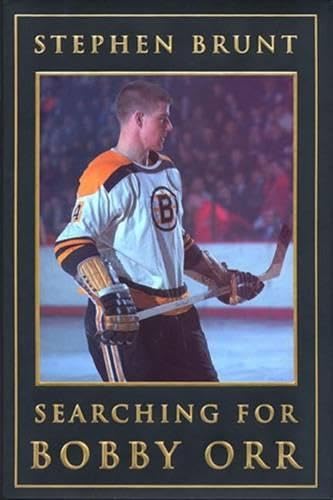



The legend of Bobby Orr is one of the most enduring in all of sports. Even those who have never played the game of hockey know the mystique and tradition surrounding Boston's immortal defenseman. In the glory years of the Original Six, he and Gordy Howe were the Ted Williams and Joe DiMaggio of their sport with equally as rabid a following. In Searching for Bobby Orr, Canada's premier sportswriter gives us a compelling and graceful look at the life and time of Bobby Orr that is also a revealing portarit of the game and a county in transition. Just how good was Bobby Orr? Who saw the spark of genius first? Who first suggested - in spite of his small stature, his almost fragile appearance - that he play defence? From Canada's foremost sports-writer comes an unprecedented exploration of the life of one of the game's greatest and most enigmatic competitors. During the early day of Bobby Orr's career - when the NHL was a six-team league - there were people around him who watched him play, amazed, and who first told the stories of his meteoric rise to superstardom. These are the "characters" Stephen Brunt meets in his quest to give us a picture of this famous yet very private man. Bobby Orr was an astonishing, effortless skater. He rewrote the book on the position of defence. He was the first defenceman ever to lead the league in scoring; the first to score twenty or more goals in a single season; and the first player ever to win three straight MVP awards. His most famous goal won the Boston Bruins the Stanley Cup in 1970 - for the first time in twenty-nine years - against the St. Louis Blues in overtime. But the story of Bobby Orr is one of despair as well as triumph. History will remember him as a key figure in the Alan Eagleson scandal and also as the unfortunate player forced into early retirement in 1978 because of grave knee injuries. Searching for Bobby Orr gives us a compelling and graceful look at the life and times of one of our greatest hockey players, as well as a revealing portrait of a game and a country in transition. Searching for Bobby Orr By Stephen Brunt Triumph Books Copyright © 2006 Stephen Brunt All right reserved. ISBN: 9781572439023 Chapter One Chapter One Parry Sound On the river, he could skate forever. No barrier but the banks and the horizon, the ice stretching far out into the bay. Soon enough, the cold seemed to disappear, even for the boy who always insisted on lacing up barefoot – it just felt better, more natural, that way. Take the puck, and try to hold it. Keep away. Offer it up, then pull it back, tuck it behind the blade, make it disappear. Sleight of hand, sleight of feet. Learn to keep your head up, your eyes forward, feel the puck on your stick, don’t look down. Speed up, change direction, the motion natural, deceptive, economical, graceful. No churning legs or laboured strides, even on beat-up, second-hand skates. He is smaller than the rest, a skinny kid, scrawny, no meat on his bones at all. But they can’t get near him, even though it looks as if he isn’t working hard, as if he is shifting through the gears in automatic – one speed, then another, then another. Size and muscle are of no use, without corners, without ends, without limits. There are no coaches standing by, waiting to impose their will. No parents shouting at the side. No drills, no repetition, but rather every rush is an improvisation, a jazz solo, a flight of the imagination. And when the boy is clear of them all, or alone by choice, when all he faces is open ice, the other sounds of his world disappear, the intermittent hum of small-town traffic, the rumble of distant factories, the angry shouts at home. Just the scrape and gouge of metal on ice, the rhythmic tap of rubber on wood, on, on forever. Pick a direction and keep on going, and eventually there’s no one in the way. Why people settled here is no mystery, though in the middle of many a brutal winter they must have wondered. Parry Sound, Ontario, stands by a natural harbour on a deep, cold, dangerous lake, a shelter for sailors on the shores of Georgian Bay at the mouth of the Seguin River. The earliest known residents were the Hurons, who fished and camped in summer before being driven out by the Iroquois, but surely there were others before them. “Shining Shore,” the Iroquois named it – Wausakwasene. When the Europeans arrived, those who passed by here were among the very first and most famous to set foot in what would become central Canada, traders and explorers and adventurers and sailors, Étienne Brulé and Samuel de Champlain, Robert de LaSalle sailing his Griffon , Alexander Henry, doomed Sir John Franklin. The place got its name, a tribute to the Arctic explorer Sir William Edward Parry, from an English surveyor, Capt. Henry Bagwell, charged by the Crown with the task of mapping Georgian Bay. Soon after arrived the lumbermen, to fell and exploit the endless forest. The first sawmill opened in 1857, and with it