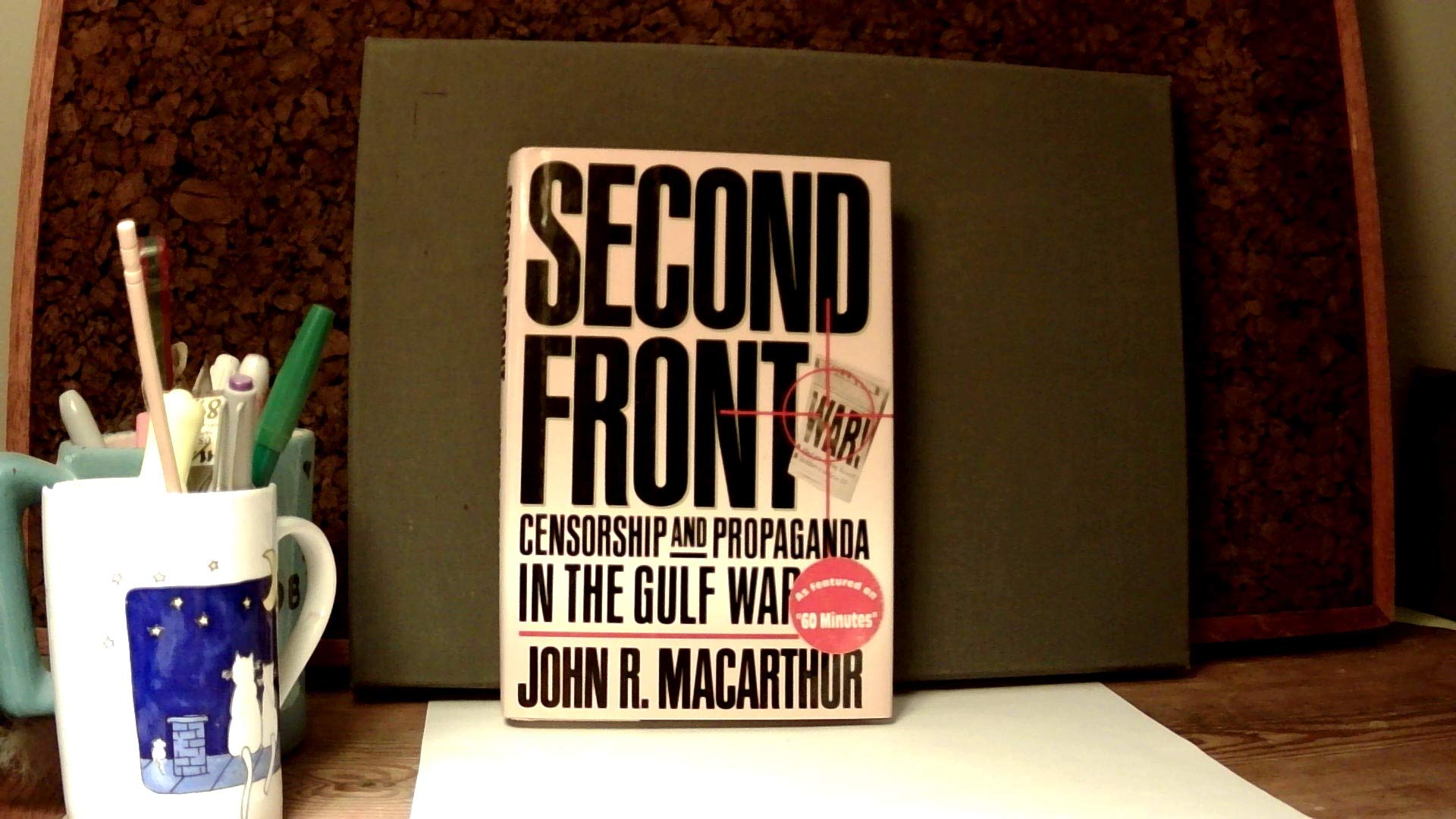



Second Front documents in vivid detail the behind-the-scenes activities by the U.S. and Kuwaiti governments which limited the American media’s constitutional right to observe, question, and report on activities during Operation Desert Storm. In frank and startling interviews with, among others, Tom Brokaw, Peter Jennings, Dan Rather, Ben Bradlee, Katharine Graham, Robert Wright, and Pete Williams, John R. MacAuthur shows how the press corps was treated more like a fifth column than as representatives of a free people. He demonstrates how, despite the torrent of words and images from the Persian Gulf, Americans were systematically and deliberately kept in the dark about events, politics, and simple facts during the Gulf crisis. With a reporter’s critical eye and a historian’s sensibility, he traces decades of press-government relations—during Vietnam, Grenada, and Panama—which helped set the stage for restrictions on Gulf War reporting and for a public-relations triumph by the government. His analysis of the issues that confronted the media in this war is frightening testimony to what happens when the government goes unchallenged, when questions go unasked. The United States was partly pushed into the Persian Gulf war by a slick public relations campaign on behalf of Kuwait. Concurrently, the Pentagon coolly executed a censorship program accepted by a timid, divided American media. That is the thesis offered by MacArthur, publisher of Harper's magazine, in his solidly documented indictment of media performance during the war. He faults both print and broadcasting for ineffective or nonexistent protests against censorship and for poor war reporting. (On obstacles to strong reporting in recent years, see Peter Stoler's The War Against the Press , LJ 12/86.) MacArthur deserves credit for illuminating interviews with CBS anchor Dan Rather and others, though his sarcastic tone, particularly on the subject of Pentagon spokesman Pete Williams, somewhat detracts from his argument. Recommended for media collections. - Bruce Rosenstein, "USA Today" Lib., Arlington, Va. Copyright 1992 Reed Business Information, Inc. Seldom have the American media appeared so hornswoggled, so cowardly, or so supine in defending the First Amendment as they are portrayed as being in this bitter polemic on Persian Gulf War coverage by the publisher of Harper's. Virtually from the moment American troops were stationed in Saudi Arabia following Saddam Hussein's takeover of Kuwait, MacArthur contends, the Bush Administration ``never intended to allow the press to cover a war in the Persian Gulf in any real sense.'' In the wake of tight news-management of Grenada and Panama, that doesn't come as a surprise; the real revelation here, based on numerous interviews with journalists and close critical analysis of news accounts, is how the press played along in the hope of grabbing the few scraps of news that fell from the government's table. According to MacArthur, Pentagon spokesperson Peter Williams decisively outflanked the media through his blandly mendacious reassurances that the press would be provided access to the conflict in stages. Thereafter, journalists--confined to press``pools'' that were escorted by armed-forces representatives- -became glorified stenographers for Pentagon propagandists. MacArthur details how the press apparently uncritically accepted and disseminated self-serving myths perpetrated by the Bush Administration and the Kuwaiti government's American p.r. flacks- -including myths about Kuwaiti babies snatched from incubators by Iraqi soldiers, the precision of ``smart bombs,'' and the exaggerated size and morale of Saddam Hussein's forces. Afterward, MacArthur says, journalists who didn't yield to hand-wringing over the government's jawboning fawned over General Schwarzkopf or led the cheerleading for their own organization's pathetic coverage. Some of MacArthur's conclusions--notably, the importance of the incubator story in the crucial Congressional debate on the war- -seem overdrawn, and he resorts to unrelieved sarcasm to buttress his case. But few readers can finish his powerful account without fearing for the future of freedom of the press--and of American democratic institutions. -- Copyright ©1992, Kirkus Associates, LP. All rights reserved.