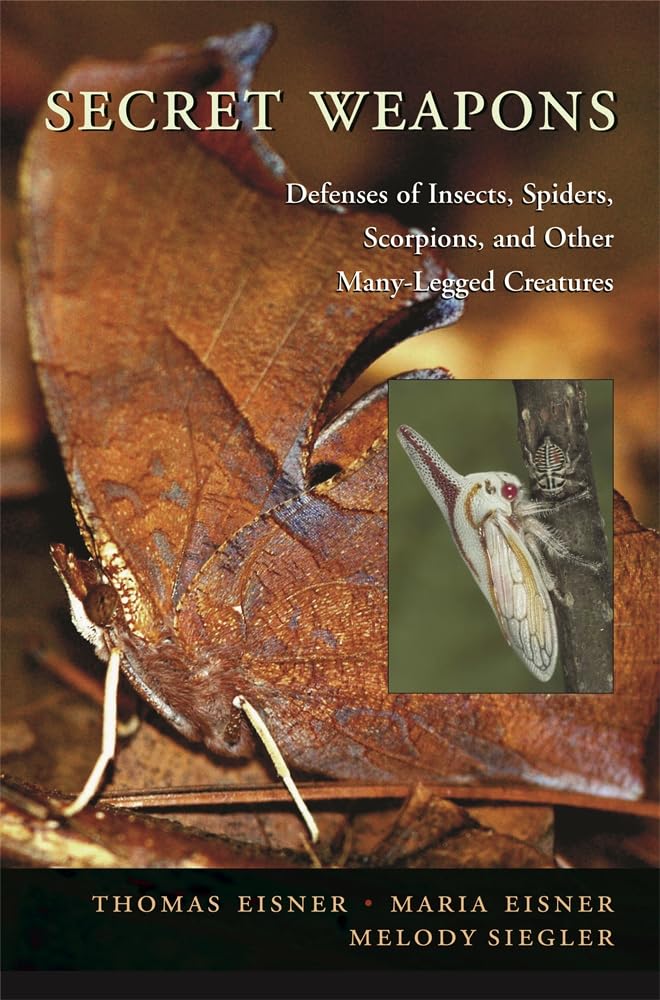
Secret Weapons: Defenses of Insects, Spiders, Scorpions, and Other Many-Legged Creatures
$32.88
by Thomas Eisner



Mostly tiny, infinitely delicate, and short-lived, insects and their relatives--arthropods--nonetheless outnumber all their fellow creatures on earth. How lowly arthropods achieved this unlikely preeminence is a story deftly and colorfully told in this follow-up to the award-winning For Love of Insects . Part handbook, part field guide, part photo album, Secret Weapons chronicles the diverse and often astonishing defensive strategies that have allowed insects, spiders, scorpions, and other many-legged creatures not just to survive, but to thrive. In sixty-nine chapters, each brilliantly illustrated with photographs culled from Thomas Eisner's legendary collection, we meet a largely North American cast of arthropods--as well as a few of their kin from Australia, Europe, and Asia--and observe at firsthand the nature and extent of the defenses that lie at the root of their evolutionary success. Here are the cockroaches and termites, the carpenter ants and honeybees, and all the miniature creatures in between, deploying their sprays and venom, froth and feces, camouflage and sticky coatings. And along with a marvelous bug's-eye view of how these secret weapons actually work, here is a close-up look at the science behind them, from taxonomy to chemical formulas, as well as an appendix with instructions for studying chemical defenses at home. Whether dipped into here and there or read cover to cover, Secret Weapons will prove invaluable to hands-on researchers and amateur naturalists alike, and will captivate any reader for whom nature is a source of wonder. "Defense is at the root of the evolutionary success of arthropods." And what a panoply of defenses they display. The authorsThomas Eisner is J. G. Schurman Professor of Chemical Ecology at Cornell University; his wife, Maria Eisner, a research associate of biology at Cornell; and Melody Siegler, an associate professor of biology at Emory Universitypresent 69 examples. They range from Mastigoproctus giganteus (the vinegaroon, which ejects a spray with an acetic acid content of 84 percent when it is physically disturbed) to Apis mellifera (the honeybee, whose stinger produces a chemically complex venom made up of about half mellitin, which is largely responsible for the pain associated with a bee sting). Yet with all that is known on this subject, much must remain to be discovered because millions of arthropod species are thought to be undiscovered. "Think of what this means," the authors say, "in terms of biological wonders lying in wait, in terms of new bugs and bug adaptations awaiting discovery." Editors of Scientific American The arthropods--those multilegged, lowly denizens of the planet that most of us would probably like to forget--are masters at the art of defense. Outnumbering all of the other animals put together, the arthropods have survived through their mastery of a multitude of chemical weapons. In their fascinating new book, the authors, all of whom study the defensive strategies of arthropods (insects, scorpions, centipedes, etc.), provide an overview of their different methods of chemical defense. The book is divided into short chapters, each of which tells the story of one species or group of related species. Color photographs, mostly from Eisner's collection, illustrate each chapter, and the chemical formulae for each species' defensive substance is provided. A list of the major references from the scientific literature appends each chapter. This unique guide to froth, venom, sprays, sticky coatings, and so forth will satisfy both the casual reader and the serious student and is a very worthy addition to any natural history collection. Nancy Bent Copyright © American Library Association. All rights reserved The arthropods--those multilegged, lowly denizens of the planet that most of us would probably like to forget--are masters at the art of defense. Outnumbering all of the other animals put together, the arthropods have survived through their mastery of a multitude of chemical weapons. In their fascinating new book, the authors, all of whom study the defensive strategies of arthropods (insects, scorpions, centipedes, etc.), provide an overview of their different methods of chemical defense...This unique guide to froth, venom, sprays, sticky coatings, and so forth will satisfy both the casual reader and the serious student and is a very worthy addition to any natural history collection. (Nancy Bent Booklist 2005-10-01) The present volume is a beautifully illustrated guide to the defense systems of mainly North American arthropods, especially insects... The first of its kind, this primer will prove indispensable to a broad audience, from lay naturalists to students, teachers, specialists--even medical doctors. (Annette Aiello Library Journal 2005-11-15) The text is technically precise but...the prose is bright and engaging...Eisner and his colleagues have skillfully captured the staggering diversity of exudates and deliver