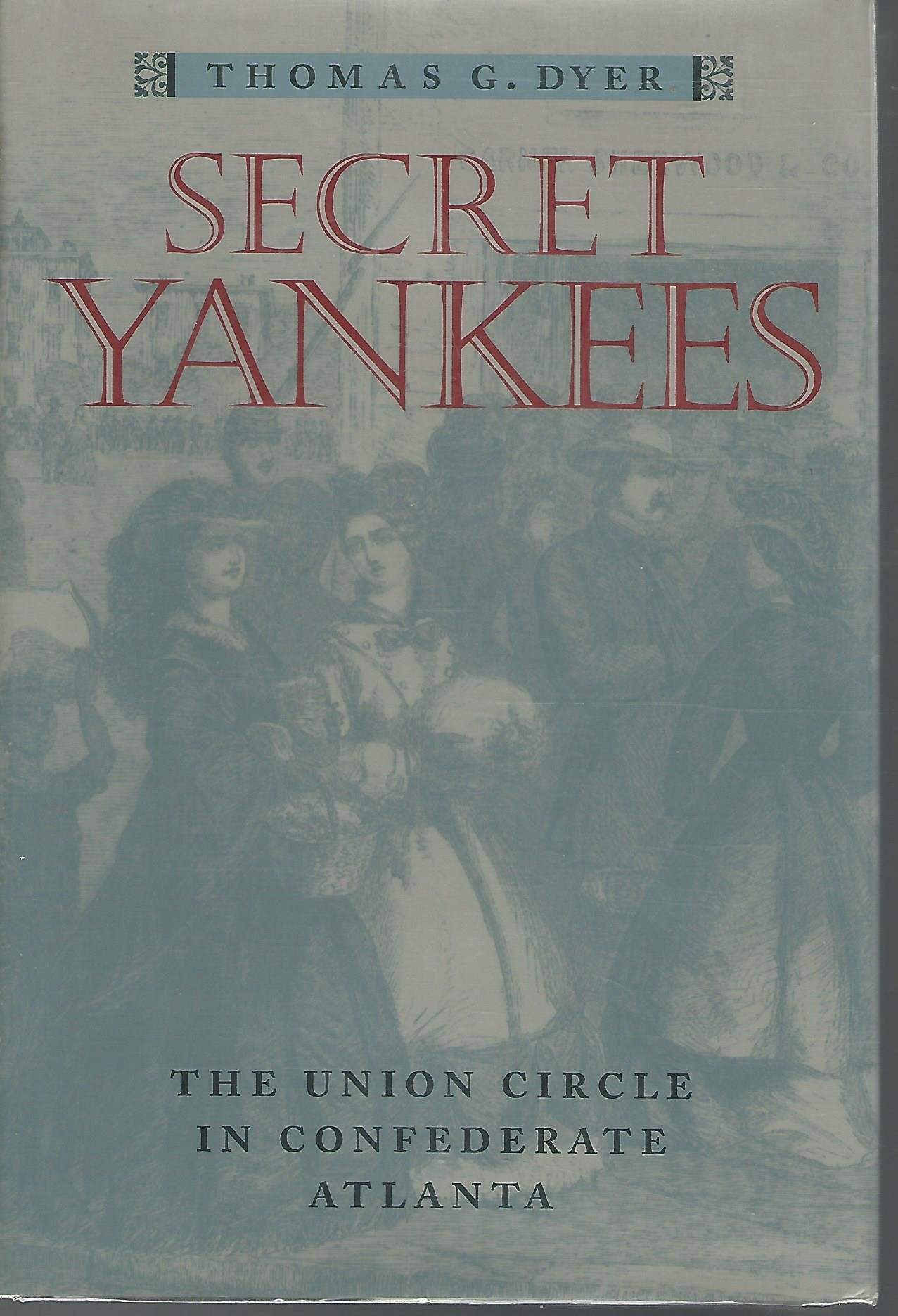
Secret Yankees: The Union Circle in Confederate Atlanta (War/Society/Culture)
$41.55
by Professor Thomas G. Dyer



An intriguing story of loyalty and patriotism, Secret Yankees brings to life the adventures of Atlanta Unionists during the Civil War, offering a perspective on the conflict that previous accounts have ignored. ("There were no Unionists in Gone with the Wind," Dyer points out.) Dyer draws on previously unpublished sources--including a long-lost diary and a work of purported fiction based closely on the experience of Cyrena Stone, a Vermont native- to recreate the drama, deprivation, and suspicion that marked the experience of the Union in the closing, and increasingly desperate, years of the war. Arrested on suspicion of spying (the penalty was death) but released by Southern authorities, her house destroyed by Union shelling during the vividly rendered fall of Atlanta, Cyrena Stone survived the war to see the triumph of the cause for which she had risked her life. More than the story of heroic individuals, Secret Yankees provides an illuminating account of personal travail in the Civil War and a thought-provoking exploration of the nature and meaning of national loyalty in wartime. In 1979, Dyer (history, Univ. of Georgia) discovered a little-known diary by Cyrena Bailey Stone, the Vermont-born wife of a northern businessman and Unionist, who painstakingly recorded events in Civil War Atlanta. Stone's diary, which covers the period from January to July 1864 and is presented verbatim in the book's appendix, depicts a different Atlanta than the one memorialized in Gone with the Wind, one not as unified behind the Confederacy. The book treats not only the precarious existence of the handful of Unionists in Atlanta but also the complexities of Unionism and loyalty as well as how these issues affected Atlantans from all socioeconomic backgrounds and political persuasions. Dyer captures the intricacies of multiple loyalties in the midst of seemingly unified secessionist sentiment. Skillfully written and carefully researched, this book is intended for both scholars and a general audience. Highly recommended.ACharles C. Hay, Eastern Kentucky Univ. Archives, Richmond Copyright 1999 Reed Business Information, Inc. The Civil War can be described as the kudzu vine of American historiography: books about it will grow anywhere, in vast numbers. A new subject well covered is far less common, though, which makes this book noteworthy. Dyer documents one of the more successful groups of Union sympathizers in the allegedly solid South. It was led by Vermonter Cyrena Stone, who had moved to Atlanta in 1854. Despite the city's being virtually under military government, she and her pro-Union cohorts risked their lives to assist the escape of Union prisoners, to protect slaves, and to provide intelligence to Sherman's advancing armies. Dyer is a sufficiently good writer to make the narrative hold even nonscholars' interest, especially since it corrects the portrait of Confederate Atlanta in Gone with the Wind an aspect that may garner it more attention than the ruck of Civil War books. It is a literate, sound, and original addition to the literature that likely will appeal to a larger than usual band of readers. Roland Green A groundbreaking account, with historian Dyers (Univ. of Georgia; Theodore Roosevelt and the Idea of Race, not reviewed) spotlight on the diary of a Yankee-born womans ordeal. When one reads of the Union flag burnings in Atlanta, the military concern for traitors to the Confederacy, and the vicious treatment of those who openly opposed secession, one understands why Cyrena Stone, left on her own in the Southern city by her husband, former Vermont businessman Amherst Stone, kept her political loyalties under her bonnet. According to her diary, which is reprinted here, Stone cannot even attend church without getting ``embittered by hearing from the pulpit such vile aspersions cast upon the Government, such prayers for its destruction.'' The logic and even the free speech of Unionists was not tolerated, and citizens of Atlanta instead flocked to crackpots, like ``General'' George Bickley of the Knights of the Golden Circle (admission $5), who proposed that the South conquer Mexico and the Caribbean. Some Unionists were heroic and openly defiant. William Markhams views prompted calls for his assassination; mulatto Robert Webster saved dozens of hot, starving, and gangrenous wounded Union soldiers. Yet, Dyer correctly focuses on his diarist, who hid her miniature Union flag in her sugar bowl and had her estate ruined by both armies, as the doomed, pathetic defense of Atlanta was partially fought in her backyard. In late summer of 1864, General Shermans sacking of Atlanta left mass graves, mangled bodies, and ruined structures. ``Union soldiers were surprised to find Unionists and loyal sentiments in Atlanta,'' Dyer notes, but former pariahs like Cyrena Stone, who hid both escaped prisoners and freed slaves and did some intelligence work for the attacking army, were now somewhat protected and even influential. T