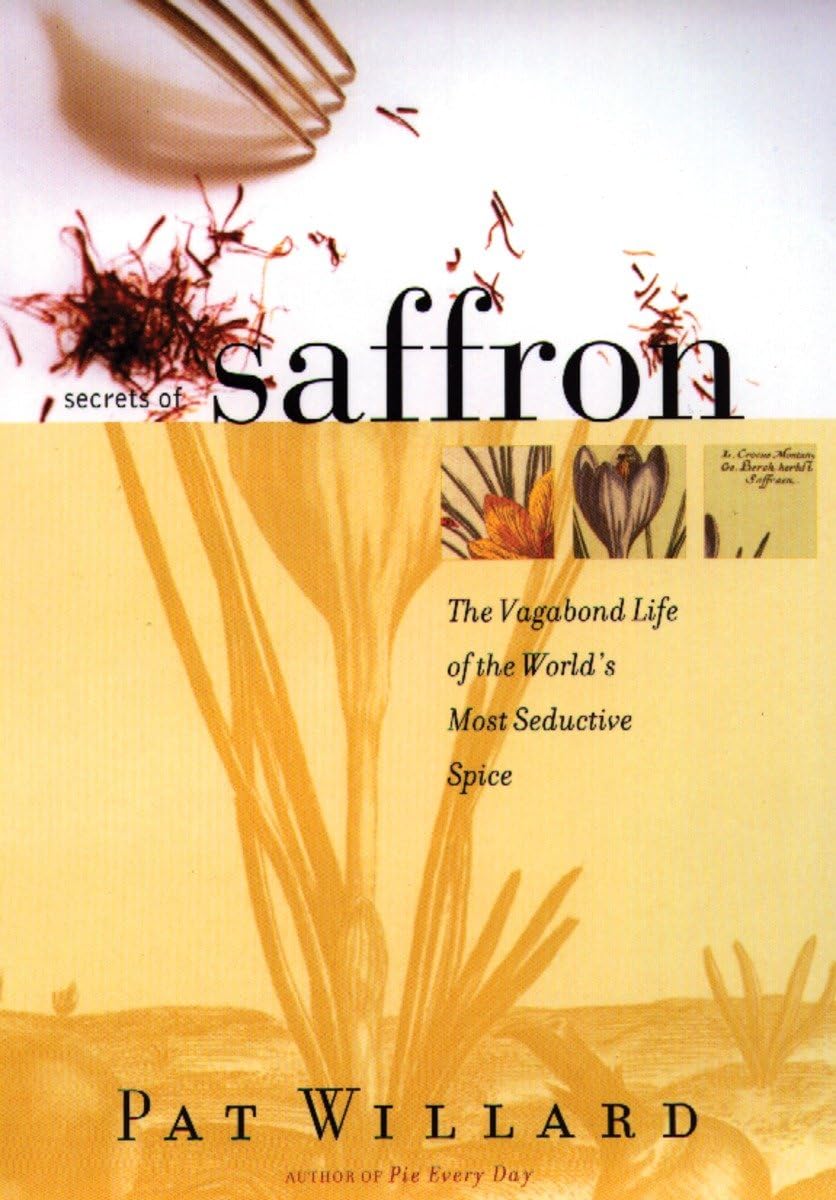
Secrets of Saffron: The Vagabond Life of the World's Most Seductive Spice
$20.00
by Pat Willard



Pat Willard's enticing exploration of the exotic spice saffron describes its journey from the ancient Sumerian kingdoms, Persia, and the island of Crete to the Pennsylvania Dutch in America. Through a beautiful blend of personal stories, myths, history, quotations, ancient remedies, and modern recipes, Willard takes us from Cleopatra's bath to the medieval court of France and beyond. A practical guide to buying, using, and even growing saffron as well as a cookbook containing recipes ranging from Paella Valenica to Saffron Consommé, this magical account is perfect for anyone who has ever been teased by this seductive spice. A lovely appreciation . . . mixing modern recipes and ancient remedies with history, myth, and some dreamy prose. . . . A book worth savoring. -Kristin Eddy, Chicago Tribune "Clear, crisp. . . . [Willard's] insights on the role of food in history, and how its use can reveal profound truths about different cultures, are fresh and thought provoking." --Patricia Fieldsteel, The New York Times "An admiring account of an exotic spice with a long and varied history. . . . A charming little gift for an inquisitive cook." -- Kirkus Reviews "A passionate account. . . . This beguiling book could transport you to foreign lands." --Bonnie Walker, San Antonio Express-News Pat Willard is the author of Pie Every Day and A Soothing Broth . She lives in Brooklyn, New York. Secrets of Saffron The Vagabond Life of the World's Most Seductive Spice By Pat Willard Beacon Press Copyright © 2002 Pat Willard All right reserved. ISBN: 9780807050095 Chapter One Heaven and Earth Go up to the ancient ruin heaps and walk around; look at the skulls of the lowly and the great. Which belongs to someone who did evil and which to someone who did good? SUMERIAN PROVERB In the ancient valley kingdom of Sumer, between the Tigris and EuphratesRivers, where some believe the Garden of Eden flourished,those who knew what to do with the curious flowers that bloomed aftersummer was forgotten would have been sanctified as priests or perfumersin service to one of the many temples or the royal court. Theycould have been attached to Inanna, who, as the contrary goddess oflove, fertility, and (as if these were not enough to contend with) war,liked her carved images to be freshly anointed every day with opulentunguents and rare balms. Or they might have served the queen of themountains, Ninhursag, who in a tangled bit of progeny was both thedaughter of and consort to An, the king of heaven. Their union resultedin most of the other gods in the Sumerian heavens, a troublesomeand demanding brew, susceptible to flattery and praise but oftenshort-tempered and indifferent to mankind. When Ninhursag wasn't with An, she whiled away the hours withEnki, the water lord, keeper of the divine laws, master of wisdom? and semen. Enki seems to have been a handful for even a goddess tomanage. Known for his generous hospitality, he indulged himself toomuch in drinking and feasting, and this brought him only trouble. Afew lamentable dalliances with several goddesses ended up populatingthe underworld; one ill-timed, unfortunate bender with themother goddess Nimah while she was supposed to be molding humansfrom clay resulted in her fashioning several flawed human beingsand letting them loose upon the world. By all accounts, Ninhursag appeared to have been philosophicalabout these sorts of lapses, but she lost all patience with him whenEnki proved himself a glutton and, in the span of one day, ate all of hersacred plants. Furious with him, Ninhursag banished him from thegarden into the and desert, where Enki slowly began to die, the eightorgans inside his body where the plants had settled weakening as hefell upon the fiery sand in withering agony. A compassionate fox,seeing how he suffered, ran to Ninhursag and persuaded her tochange her mind. She took her sweetheart back into the garden andlay beside him in the cool shade of a palm tree, bringing forth from hisbody a healing deity for each of his afflicted parts. For this reason,when Sumerians became ill they turned to their temples, where themen and women who served the deities knew how to mix potions andrubs ? thick perfumes and bracing tonics ? that would give praise tothe gods who ruled their lives and who, thus placated, would sooth amere mortal's troubled body. Once it was discovered, saffron was used in many medicinal ways,and yet the flower was never considered worthy enough to cultivate.The Sumerians were a business-minded people, bureaucratic andmethodical, who traded anything they thought they could turn a fairprofit on, not only in the more primitive northern domains of Babylonand Assyria, but in the far eastern plains across the Zagros Mountainsand southern seacoast, whose strange inhabitants the Sumerians regardedas just emerging from the ooze. Sumer's trading, and by extensionits great preeminence long before the first pharaohs of Egyptthough