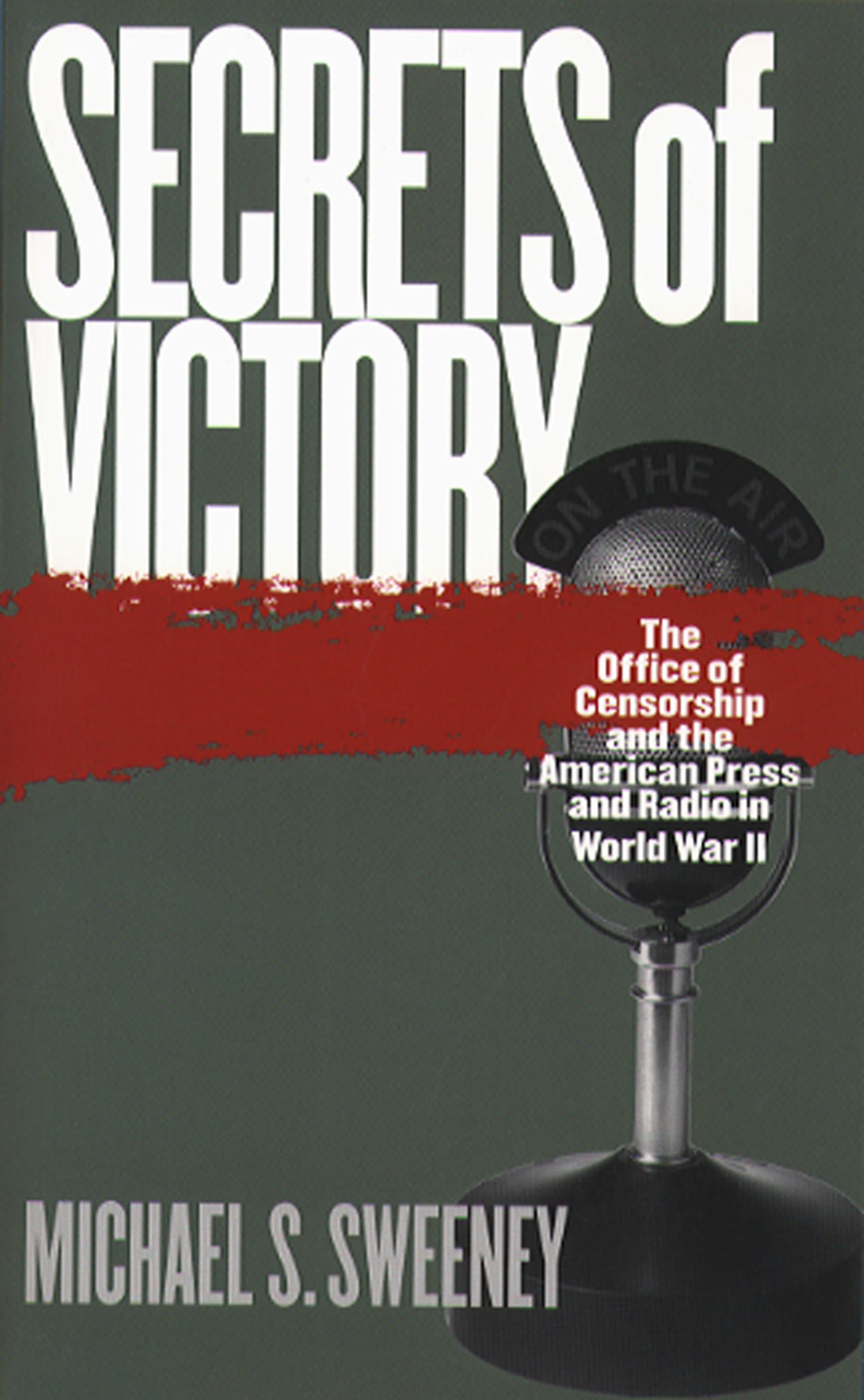
Secrets of Victory: The Office of Censorship and the American Press and Radio in World War II
$42.50
by Michael S. Sweeney



During World War II, the civilian Office of Censorship supervised a huge and surprisingly successful program of news management: the voluntary self-censorship of the American press. In January 1942, censorship codebooks were distributed to all American newspapers, magazines, and radio stations with the request that journalists adhere to the guidelines within. Remarkably, over the course of the war no print journalist, and only one radio journalist, ever deliberately violated the censorship code after having been made aware of it and understanding its intent. Secrets of Victory examines the World War II censorship program and analyzes the reasons for its success. Using archival sources, including the Office of Censorship’s own records, Michael Sweeney traces the development of news media censorship from a pressing necessity after the attack on Pearl Harbor to the centralized yet efficient bureaucracy that persuaded thousands of journalists to censor themselves for the sake of national security. At the heart of this often dramatic story is the Office of Censorship’s director Byron Price. A former reporter himself, Price relied on cooperation with — rather than coercion of — American journalists in his fight to safeguard the nation’s secrets. In this carefully documented study of press censorship during World War II, former reporter Sweeney (Utah State Univ.) shows how Byron Price's brilliant management of the Office of Censorship encouraged and supported the successful voluntary adherence to the Code of Wartime practices by members of the press and broadcast media. Price often brokered disputes between powerful figures in the military establishment, government officials of the Roosevelt administration, and members of the press and radio. He requested that members of the broadcast and press community not compromise the men and women in harm's way or undermine any Allied cause and to clear with his office any questionable or sensitive material that could possibly damage the war effort. This timely and important book about journalism, the media, and government control of information during wartime is highly recommended for academic and large public libraries. Gerald R. Costa, Brooklyn P.L., NY Copyright 2001 Reed Business Information, Inc. “Will gladden the hearts of anyone interested in communication history during critical periods in the 20th century. . . . A balanced, well-written account of how governments can handle the difficult task of preserving press freedom in wartime without jeopardizing national security.” — Political Communication “A smart and necessary book. . . . Sweeney has managed an impressive balancing act, pouring exhaustively researched detail into a clean and engaging narrative; the result is one of those books you wish you could make people read.” — Washington Post Book World “An even-paced, exhaustively researched . . . text on a paradoxical period for American media.” — Publishers Weekly “This timely and important book about journalism, the media, and government control of information during wartime is highly recommended for academic and large public libraries.” — Library Journal “Adds deeper understanding about the way the world’s leading democracy dealt with press censorship when it was brought into the war by the Japanese attack on Pearl Harbor. . . . A solid book that should be read by all students of press freedom and media history.” — Journalism History “A well-researched study of the U.S. office of censorship. . . . A well-written history of a rarely examined government agency that could have, but never did threaten, U.S. press freedom.” — International Journal of History “The most comprehensive history of the Office of Censorship and its director, Byron Price, to date. . . . Sweeney tells this story conscientiously and thoroughly.” — Journal of American History “Sweeney makes a useful contribution to the growing literature of the U.S. government’s modern relationship with mass media.” — American Historical Review “This is a first-rate book by an outstanding historian who has poured mountains of research into his topic. It will be of interest not only to scholars but also to anyone teaching courses on the press or on the America of World War II.” — Journal of Military History “American censorship policy during WWII has been extraordinarily neglected. . . . Sweeney’s solid book . . . is therefore both a welcome and important addition to the literature.” — CHOICE “American censorship policy during WWII has been extraordinarily neglected. . . . Sweeney’s solid book . . . is therefore both a welcome and important addition to the literature.” — CHOICE How the U.S. government persuaded journalists to censor themselves for the sake of national security A former reporter and editor, Michael S. Sweeney is assistant professor of communications at Utah State University in Logan. Used Book in Good Condition