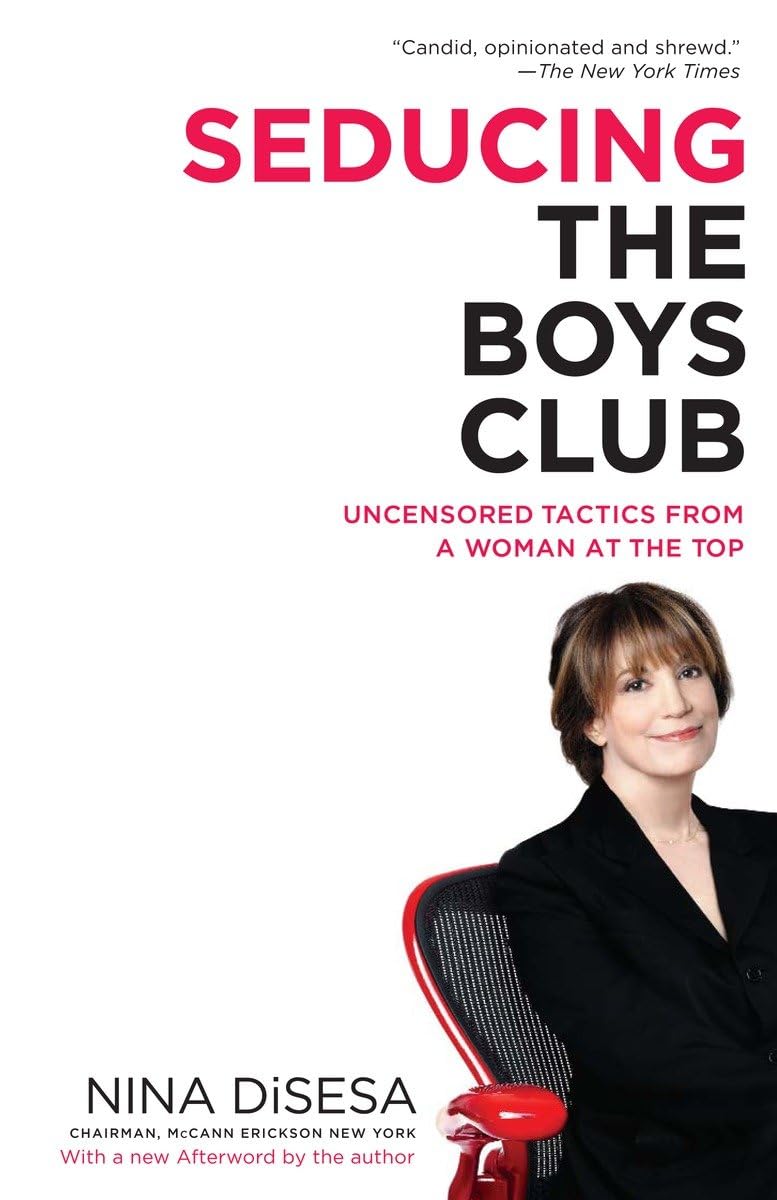



Fact #1: Forty years after the feminist revolution, fewer than 2 percent of Fortune 1000 CEOs are women. Fact #2: The playing field is not level. Fact #3: You need to get over this. Chairman of the flagship office of the largest advertising agency network in the world, Nina DiSesa is a master communicator, a ceiling crasher, and a big-time realist. In Seducing the Boys Club , DiSesa shows you how S&M–seduction and manipulation–is the secret to winning over (and surpassing) the big guys. She asserts that women need to meld their “female” characteristics (nurturing, compassion, intuition) with “male” traits (decisiveness, focus, confidence, humor) to expand their professional horizons. DiSesa also shares her practical, outrageous, and even controversial maxims for making it, including • Learn to appreciate men. Men like women who like them. • Remember that women are biologically wired to succeed. • If you want to make a name for yourself, find a mess and fix it. A secure and comfortable job only holds you back. • Act brave and you will look brave. • Screw the rules. Make up your own. Whether dead-on funny or deadly serious, DiSesa is always on her game, always on message, and absolutely on target as she arms women (men, too!) with the can-do confidence and no-compromises attitude they need to climb as high as their ambition can carry them–while keeping their standards impeccable and their integrity intact. Nina DiSesa has worked in the quintessential boys clubs of advertising for almost thirty years. In 1994, she became the first woman EVP, Executive Creative Director for McCann Erickson New York, the flagship office of the largest advertising agency in the world. Under her creative leadership, the New York office enjoyed an unprecedented 5-year growth period adding almost $2.5 billion in billings. In 1998, she was made Chairman as well as Chief Creative Officer of McCann New York. She was the first woman and first creative director to be named chairman in the McCann global network. In 1999, Nina was chosen by Fortune magazine as one of the “50 Most Powerful Women in American Business.” In 2005, she received the Matrix Award, given each year to a select group of women in communication. In 2007, she was inducted into the Hall of Fame for CEBA (Creative Excellence in Business Advertising). Nina and her husband live in an apartment in NYC and escape to their 45-acre horse farm in Dutchess County, New York. Chapter 1 My Life Started in an Elevator I wasn’t actually born in an elevator. Or conceived in one. (How freaky would that be? Can you imagine your parents doing it in an elevator?) My career started in an elevator, and that was the beginning of my real life, the one I don’t look back on and shudder at. It happened one Saturday morning in May. I was with my first husband, a crabby actor I had married four years earlier because I thought I could cheer him up. We had just left our sixth-floor Manhattan apartment to go grocery shopping and, when the elevator doors closed, my husband announced that he had made a decision. I thought he’d decided what he wanted for dinner. No. He had come to the conclusion that he didn’t love me anymore. When we reached the fourth floor he said that, upon reflection, he probably never had. By the time we got to the lobby, he confessed that he was in love with another woman. His entire revelation took less than sixty seconds. Then we went shopping for food. I bought a nice eye-of-round roast. It was on sale. I even cooked it for the little shit. A week later he packed up and left, and I sprang into action. I painted the bedroom an insomnia-inducing shade of bubble gum pink because he’d never let me decorate our apartment the way I wanted and I needed to assure myself that I was in control of my life. It made me feel like I was sleeping in a giant lung, but I didn’t care. It was my lung now and I could do with it what I wanted. Then I stopped eating the junk food that was a substitute for you-know-what and lost thirty-five pounds in six months. (Isn’t that great?) And I quit my job writing resort ads for the Catskills (“Shecky Greene! Here thru Labor Day!”), because I realized I was not going to have a family anytime soon and I needed to think seriously about a career. Oh, and during those first six months, when I was losing all that weight, I also wept. (I wonder how much of the thirty-five pounds had been water retention.) I cried all the time. Not because I missed my unfaithful husband, but because I felt abandoned, defeated, and convinced that no one would ever love me or even like me. I had no career, no future, and no one to blame. I was twenty-eight. Not a very promising beginning on the road to chairman. I had two big “aha”s after being dumped on that elevator: First, being with the wrong man is worse than having no man at all, and second, I was totally unprepared for a career because I wasn’t good at anything. I had to change that quickly an