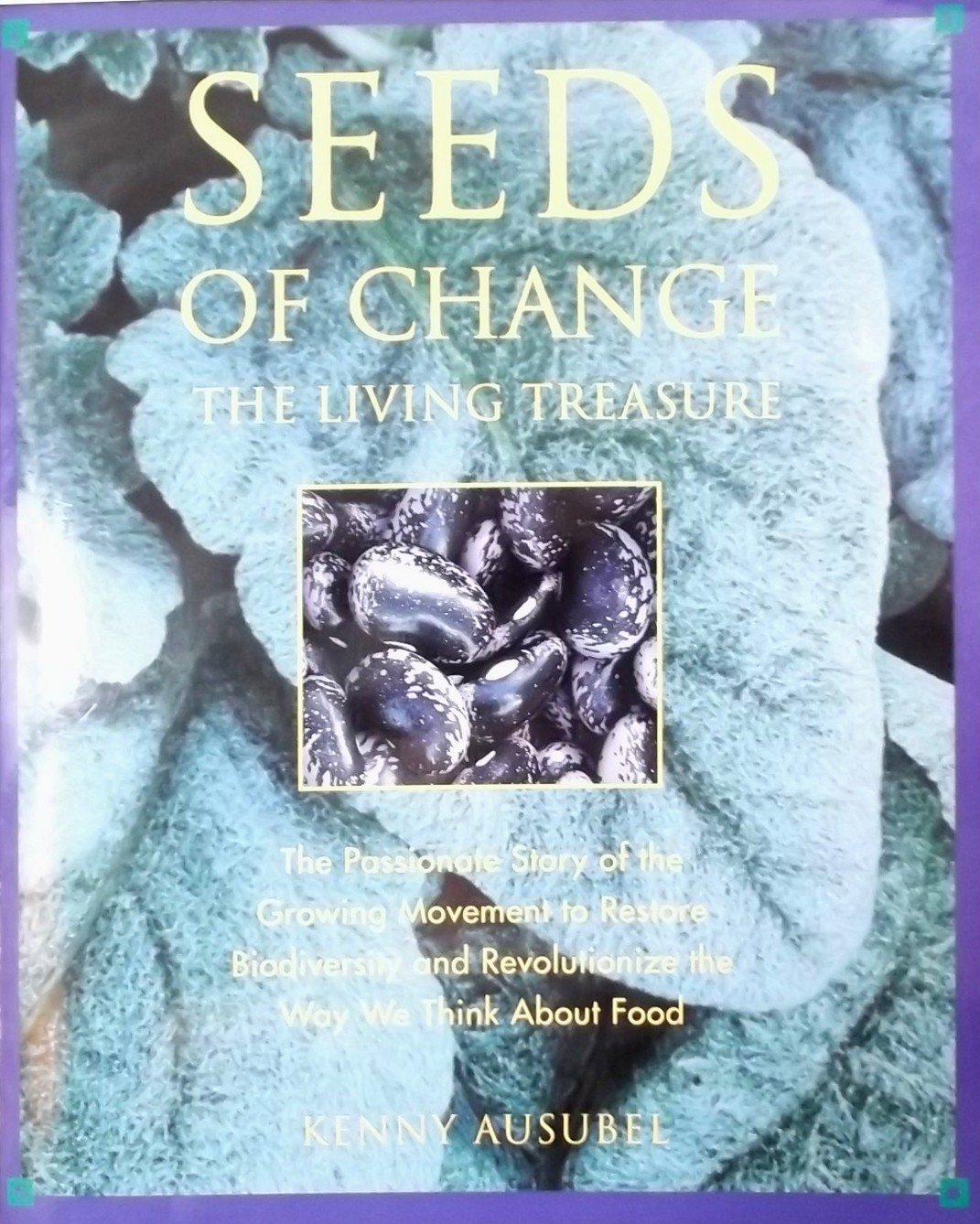
Seeds of Change: The Living Treasure : The Passionate Story of the Growing Movement to Restore Biodiversity and Revolutionize the Way We Think About
$9.90
by Ken Ausubel



Laments the trend toward biosimilarity and warns of its dangers, then outlines the efforts of Seeds of Change to preserve biodiversity through providing organic seeds, and lastly offers recipes that employ these better-tasting organic foods. Original. 75,000 first printing. $100,000 ad/promo. Filmmaker, writer, and entrepreneur Ausubel has written an engaging, informative, and often quite personal account of the founding and beginning years of Seeds of Change, a new company that sells organically grown seeds to gardeners. Much more than a narrative of a seed company and its founders, this is really a story about biodiversity. Ausubel passionately believes that individual gardeners can play a vital role in saving uncommon yet meritorious varieties of fruits and vegetables, grains, flowers, and herbs. To that end, Seeds of Change offerings are traditional, nonhybrid varieties, meaning they will, unlike hybrids, breed true to the parents and can be harvested by gardeners and passed on from generation to generation. Although readers may not always agree with the author's wide-ranging views on American business and society, ecology, anthropology, nutrition, and other topics, this is a thought-provoking and timely book. Highly recommended for public and academic libraries. - William H. Wiese, Iowa State Univ. Lib., Ames Copyright 1994 Reed Business Information, Inc. Corporate farming values mass production and the appearance of produce over crop diversity and nutritional value and involves the rampant use of pesticides and chemical fertilizers. As more and more studies prove that diet is a key component of good health, more and more people object to consuming fruits and vegetables tainted with toxic chemicals and deficient in nutrients, hence the organic farming movement and the establishment of Seeds of Change, an organic seed company devoted to preserving and disseminating seeds of heirloom, or traditional, fruits and vegetables. Many of these varieties are far more nutritious, hearty, and flavorful than commercial hybrids. Ausubel, founder of Seeds of Change, presents a cogent overview of the decline of crop diversity and the troubling erosion of our food base and explains what exactly he and various master gardeners propose as solutions. This is a beautifully illustrated and quite fascinating volume that will appeal to gardeners and everyone concerned with eating well. Seeds of Change will also be the subject of a PBS documentary scheduled for the spring. Donna Seaman The critically important--and interesting--story of the threat to earth's biodiversity and how this endangers us all, told by the founder of Seeds of Change, the country's leading organic seed producer. Ausubel details how we--to our infinite peril--are poised to triumph over biological diversity, nature's fail-safe mechanism against extinction. Of the 30,000 to 8,000 edible plants on earth, we now rely on 150--and rice, corn, and wheat alone account for half the human diet. A blight or infestation striking one of these might well cause famine on an unimaginable scale. And yet, as Ausubel shows, we are extinguishing biological diversity though our relentless destruction of native cultures and natural environment (especially tropical forests), and through the determined attempts of agribusiness to supply the world with hybrid seeds that, in contrast to heirloom or open-pollinated seeds, cannot adequately reproduce themselves and require ecologically ruinous amounts of chemicals--often, conveniently, supplied by the same corporations that develop the seeds. These agribusinesses, Ausubel says, are busily engaged in genetic engineering that not only further endangers biodiversity but gives us food of inferior taste and nutritional quality, spiced with chemical toxins. Ausubel proposes a revolution in farming, going against conventional methods and favoring the organic cultivation of as wide a variety of plants as possible--perhaps including varieties with as-yet-unknown medicinal or nutritional value. The writing is overwrought, the tone self-righteous, and much of the content self-serving--yet this offers information too important for readers to let these, and other irritations, stand in their way. (Twelve b&w and 60 color photographs--not seen) -- Copyright ©1993, Kirkus Associates, LP. All rights reserved.