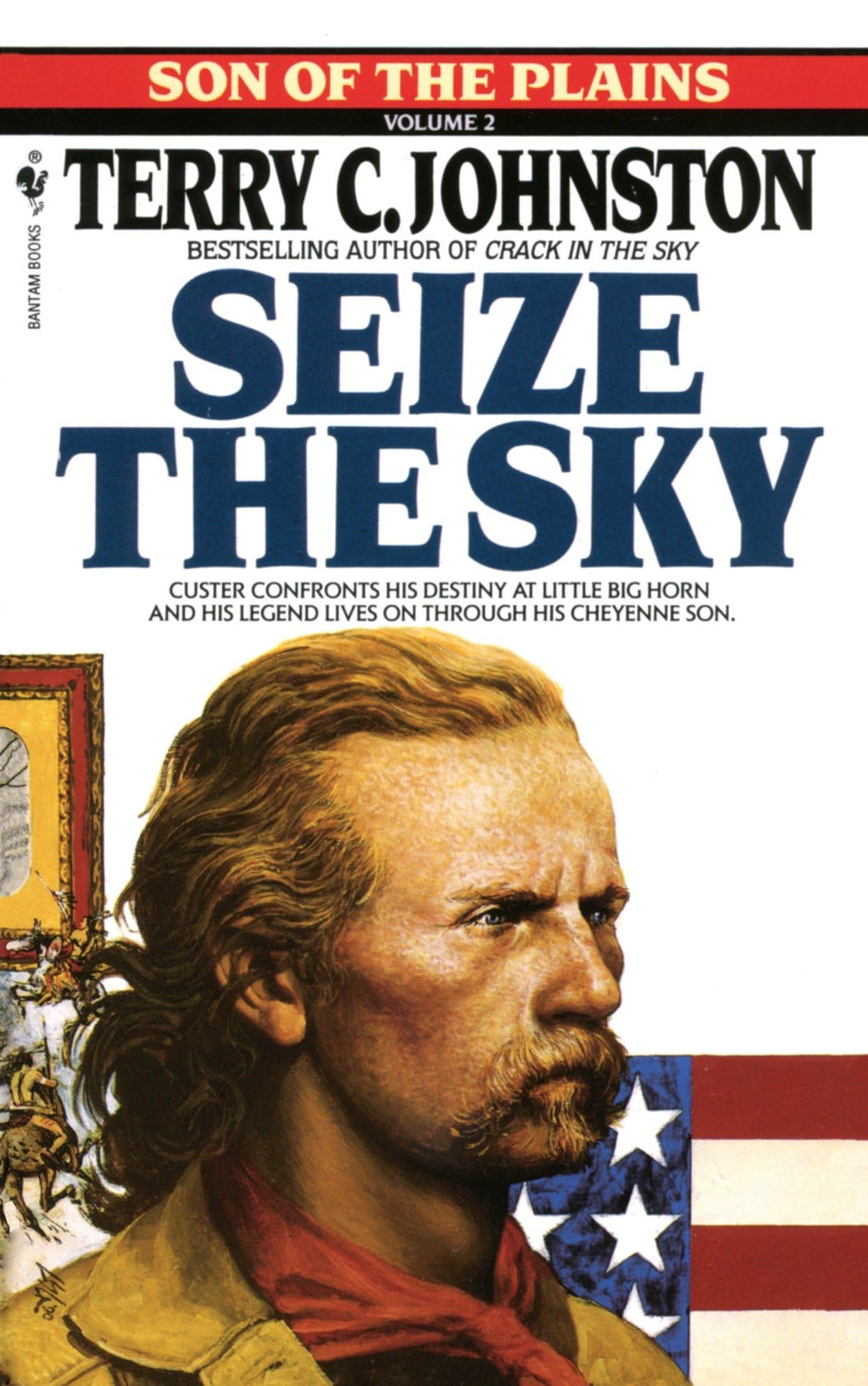



Custer confronts his destiny at Little Big Horn and his legend lives on through his Cheyenne son. Never one to proceed cautiously when an impetuous move could win him glory, Custer marched his famed Seventh Calvary against the Sioux in June 1876. He was thirty-six, already a mythic hero to some, with the possibility of a presidential nomination looming in his future; while to others he was an arrogant and dangerous fool, misguided in his determination to subjugate the Plains tribes. What should have been his greatest triumph became an utterly devastating defeat that would ring through the ages and serve as a turning point in the Indian Wars. Terry C. Johnston is recognized as a master of the American historical novel. His grand adventures of the American West combine the grace and beauty of a natural storyteller with complete dedication to historical accuracy and authenticity. Johnston was born the first day of 1947 on the plains of Kansas, and lived all his life in the American West. His first novel, Carry the Wind , won the Medicine Pipe Bearer Award from the Western Writers of America, and his subsequent books have appeared on bestseller lists throughout the country. After writing more than 30 novels, he died in March 2001 in Millings, Montana. CHAPTER 1 THE dawn air was filled with that heady, earthy fragrance of fresh dung dropped by a few of the hundreds upon hundreds of mules and horses crowding the parade ground. Springtime brought with it at least one blessing to this land of tractless, far-reaching prairie: enough rain to hold down the thick yellow dust. But rain also brought mud and great, swampy puddles that collected across the swales and at the foot of every hillock. Those puddles in turn bred mosquitoes, winged tormentors soon to rise over this northland as they had for his last three springs here on the Missouri. Huge creatures swarming above these great grasslands in a dark cloak like the horde of locusts swarming above the Egypt of ancient pharoahs. Still, it would take something far hardier than a plague of mosquitoes to drive him from this western frontier. Perhaps only a call to Washington City itself. “Mr. Burkman.” He turned to his personal aide. “I see you scribbling in your little book again.” The short, dark orderly looked at that tall soldier beside him with something akin to worship. “Yes, General.” “So tell me what you’ve written about this momentous morning so far … a morning of which grand destinies are made, Mr. Burkman.” The young private cleared his throat and glanced up at his benefactor nervously. “Uhhh, all I’ve written so far is Wednesday, seventeen May, 1876, sir.” “Nothing else?” His azure blue eyes scanned the activity on the parade ground. “All this time here on the porch this morning, and all you’ve been inspired to write is the date?” “There’s more, sir—but I’m a little at the loss for words, General. I’ve never been on a campaign before … it’s all a bit overwhelming to me right now.” “I quite understand, Private,” the officer replied with that famous, peg-toothed smile of his, slapping his orderly on the back. “Tell me, then, have you scribbled anything else of note?” “Only … Fort Abraham Lincoln, Dakota Territory,” John Burkman said. Then he uttered the rest more softly. “We prepare to embark on a mission of national importance, one that will spell the final subjugation of these plains for the settlement of white civilization, or the continuation of the Indian Wars, which have so long plagued this great land.” The officer smiled beneath the bushy mustache that hung like corn straw over his mouth. “Very good, John. I like it. But—you ought to scratch the last part of that. We’re going to put an end to the Indian Wars once and for all.” The young private licked nervously at the dulled point of his pencil, then set it to work, scratching across the sheet of his ledger, attempting to capture more of his commander’s words for history. “Yes, sir,” he replied absently as his hand flew across the page. “Keep at it, Striker!” He patted the young man’s shoulder again. “You’ll have much to tell your grandchildren about this campaign. There won’t be a man, woman, or child across this great republic of ours who won’t know about the glory-bidden U.S. Seventh Cavalry.” He stepped toward the edge of the porch, eyes raking the parade ground approvingly. Finally he stuffed his pale fingers into the skintight yellow doeskin gloves and tugged at the tall fringed gauntlets as he plodded down two steps and stopped, breathing deeply of the air of anticipation that hung thick over the parade. “John, there won’t be a soul from Washington City to St. Louis who fails to know about George Armstrong Custer when the dust settles and my personal standard flies over the battlefield.” “Yes, General!” Burkman hopped down the steps of the Custer home constructed just west of the massive parade ground so he would stand beside