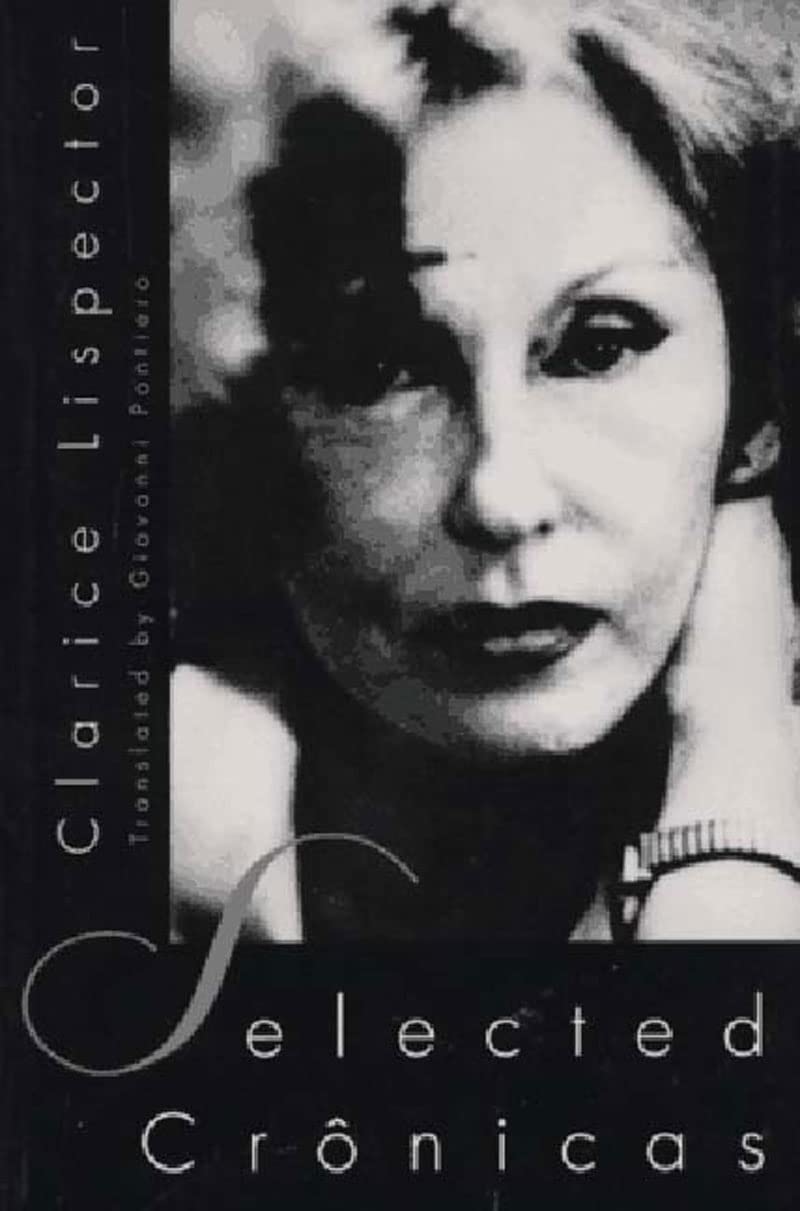



"Clarice Lispector was a born writer....she writes with sensuous verve, bringing her earliest passions into adult life intact, along with a child's undiminished capacity for wonder."― The New York Times Book Review "In 1967, Brazil's leading newspaper asked the avant-garde writer Lispector to write a weekly column on any topic she wished. For almost seven years, Lispector showed Brazilian readers just how vast and passionate her interests were. This beautifully translated collection of selected columns, or crônicas , is just as immediately stimulating today and ably reinforces her reputation as one of Brazil's greatest writers. Indeed, these columns should establish her as being among the era's most brilliant essayists. She is masterful, even reminiscent of Montaigne, in her ability to spin the mundane events of life into moments of clarity that reveal greater truths."― Publishers Weekly Selected Crônicas gathers the newspaper columns of the Brazilian writer Clarice Lispector. This collection captures Lispector's gifted voice and supplies a view of Brazil from her childhood, after her Ukrainian parents emigrated there, until the last of her columns in 1973. The stories in this volume are colored with childhood memories and a belief in the redemptive promise of justice. Brazilian newspapers have a history of intellectual journalism, although the period during which Lispector wrote these crônicas was defined by military dictatorship, censorship of the press, and political repression. It was also a time of rapid economic growth, and amid these varied pressures, she played the role of conscience, reminding her readers of unshakeable memories and unmovable truths. What Lispector had to say could only be conveyed in a literary manner for the most pragmatic of reasons, but her delightful stories suggest it was the best means no matter what she had been permitted. Lispector, who died of cancer in 1977, is clearly one of the most important Brazilian writers of the 20th century. While she is best known for her short stories and novels, including The Apple in the Dark (LJ 6/15/67), this work brings her readers a new medium, the chronicle. This varied selection of sayings, stories, diary entries, reminiscences, intensely personal essays, and interviews were published as a weekly column in a major Brazilian newspaper in the late 1960s and early 1970s. We become part of the intense world of a self-reflective woman, who values the inner world in her vehement exploration of the true nature of being. The chronicles demonstrate Lispector's literary connections to 20th-century writers, including Mansfield, Woolf, and Sartre. This collection brilliantly reintroduces this writer to North American readers.?Mary Margaret Benson, Linfield Coll. Lib., Mcminnville, Ore. Copyright 1997 Reed Business Information, Inc. A vertiginous dash through the mind of a highly idiosyncratic and inventive writer. Lispector, the Brazilian novelist (The Hour of the Star, 1990, etc.), was from 1967 to 1973 also a columnist for the Jornal do Brasil, the largest newspaper in Rio de Janeiro. This collection of 156 of her columns (crnicas) makes the work of her American counterparts, from that of Anna Quindlen to Jimmy Breslin, seem predictable, narrowly focused, and pedestrian. If a newspaper column can be compared with a social visit from the writer, who drops by often enough to become a friend, then Lispector can be said to be an enchanting, unnerving, and sometimes giddy visitor. She casts a wide net in these pieces. There are some deeply cryptic gleanings. (``I dreamed that a fish was taking its clothes off and remained naked'' is the entire text of one piece.) There are also several series of full-fledged stories, including ``The Princess,'' told in five parts, and ``The Egg and the Chicken,'' told in three. Other columns resemble conventional feature writing. ``Lightning Interview with Pablo Neruda (II),'' for example, poses questions to the poet and duly provokes answers. ``Does writing make the anguish of living more bearable?'' Lispector asks. She further asks to the poet to ``say something to surprise me.'' Most of the time, the need to surprise herself seems to guide the columns, and the result is a body of work likely to give pause to North Americans, who seem to prefer their journalism straightforward and flat-footed. Lispector's is headily expansive, a reprieve from the usual. Of course, the pressure to write for each Saturday edition does lead to various ups and downs; the downs include facile moments when even Lispector's imagination temporarily folds its tent. But the stumbling is rare. A provocative revision of journalistic possibilities. -- Copyright ©1996, Kirkus Associates, LP. All rights reserved. "If she played with the superficial truth, it was in service, she believed, of exposing one deeper, of passing readers a brief-lit lantern for the moonless dark of ourselves, even if that light revealed, sometimes, more contradicti