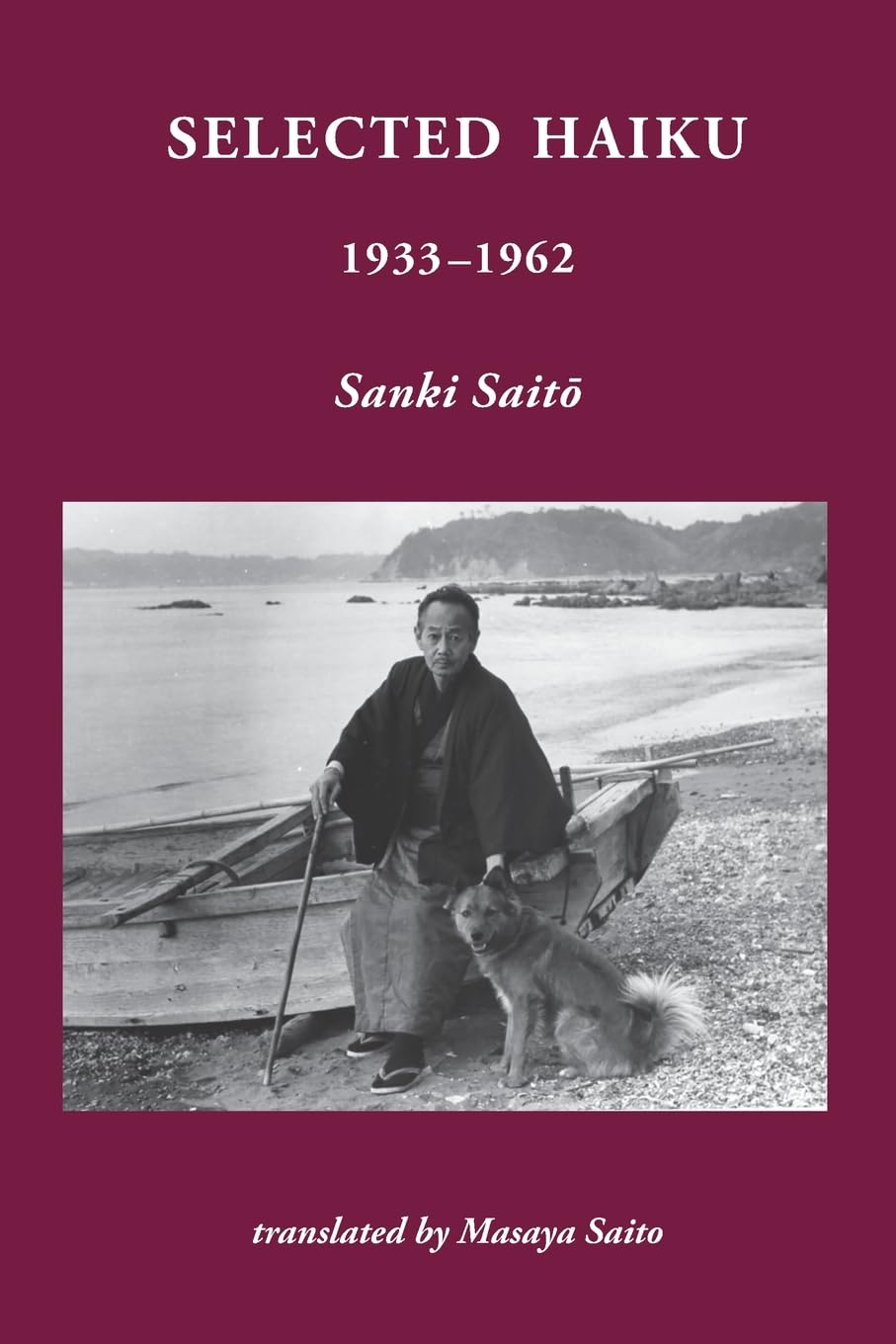



Sanki Saitō, born in western Japan in 1900, is a towering figure in twentieth-century haiku. Although he did not begin to write haiku until the age of 33, he then rapidly became a leading figure in the poetically radical New Rising Haiku movement. He was silenced in 1940 when his writing caused him to be arrested on the charge of violating the Peace Preservation Law, but he began to write again after 1945, and between 1947 and 1962 he published three major collections of haiku. Vigorous, earthy, observant, tragic, hilarious, sensuous, unillusioned, powerful, ironic - these haiku are among the major achievements in postwar Japanese poetry. In Selected Haiku 1933-1962 , Masaya Saito has vividly and powerfully translated 1,141 of Sanki's haiku. In addition he has written a full and informative introduction, outlining Sanki's life, describing his key role in the New Rising Haiku movement of the 1930s, elucidating the political and historical context in which he wrote, and discussing his mature postwar work. This is a major English-language representation of the work of one of the most striking figures in twentieth-century haiku. 'Haiku, this oddball. Short and small, unfree, difficult, and its attractiveness supreme, ' began Sanki Saito's account of his involvement with the world's shortest verse form, which began when he was already 33 years old. Once he got involved with it, however, Sanki (1900-1962) found himself in the New Rising Haiku movement that had risen among those unhappy with the traditional approach, and became its standard-bearer in no time. Some in the movement wrote openly antiwar pieces, ignoring seasonal requirements. Upshot: in 1940 he, along with a dozen other leaders of the movement, was arrested. He did not resume composing haiku until after Japan's defeat. Here Masaya Saito (no relation) has translated a selection of well over a thousand haiku of Sanki, illuminating the kaleidoscopic aspects of Sanki's art. - Hiroaki Sato An important poet deserving of this new exhaustive translation, made eminently more accessible by Masaya Saito's painstaking biography. Often his own worst enemy, Sanki's haiku plumb the depths of a turbulent, iconoclastic life during Japan's embrace of modernity and war. - Paul Miller, editor, Modern Haiku At a time when English-language haiku is exploring new directions in form and content, these fresh translations of Sanki's haiku remind us that the seasons and their manifestations are, as he puts it, 'nothing but the outermost layer of the truth of actual existence, ' and that it is the purpose of all haiku 'to immerse ourselves deep in the truth of actual being.' - Lee Gurga, editor, Modern Haiku Press Sanki Saitō was born in western Japan in 1900. He trained as a dentist, working first in Singapore and later in Tokyo. He didn't begin to write haiku until the age of 33, but he then rapidly became a leading figure in the poetically radical New Rising Haiku movement. In 1940 his writing caused him to be arrested by the Higher Special Police on the charge of violating the Peace Preservation Law; he was given a suspended sentence and forbidden to write. In 1942 he left Tokyo for Kobe; his Bohemian life in the wartime port city before its desruction is vividly described in his memoirs The Kobe Hotel. After 1945 he began to write again and published three major collections of haiku that set a benchmark for postwar haiku. From 1956 to 1957 he was editor of Haiku, Japan's leading haiku journal. He died of stomach cancer in 1962 in Hayama, Kanagawa Prefecture. More than six decades after his death, Sanki is still embraced as truly unique not only by haiku poets both radical and traditional, but also tanka and free verse poets. Masaya Saito was born in Akita prefecture. His Japanese haiku have appeared in Asahi Shinbun, Haidan, Haiku, and Haiku Bungei; in 2007 he won the Asahi Haiku Shinjin Award for his sequence of fifty haiku, Gasshō ('The Hands Together in Prayer'). His English haiku have been published in Ash (TELS Press, 1988) and Snow Bones (Isobar Press, 2016), and in the anthology Haiku in English: The First Hundred Years (Norton, 2013). His translations of Japanese haiku appear in The Columbia Anthology of Modern Japanese Literature (Columbia UP, 2005), and earlier versions of his translations of Saitō Sanki's autobiographical essays and haiku were published as The Kobe Hotel (Weatherhill, 1993).