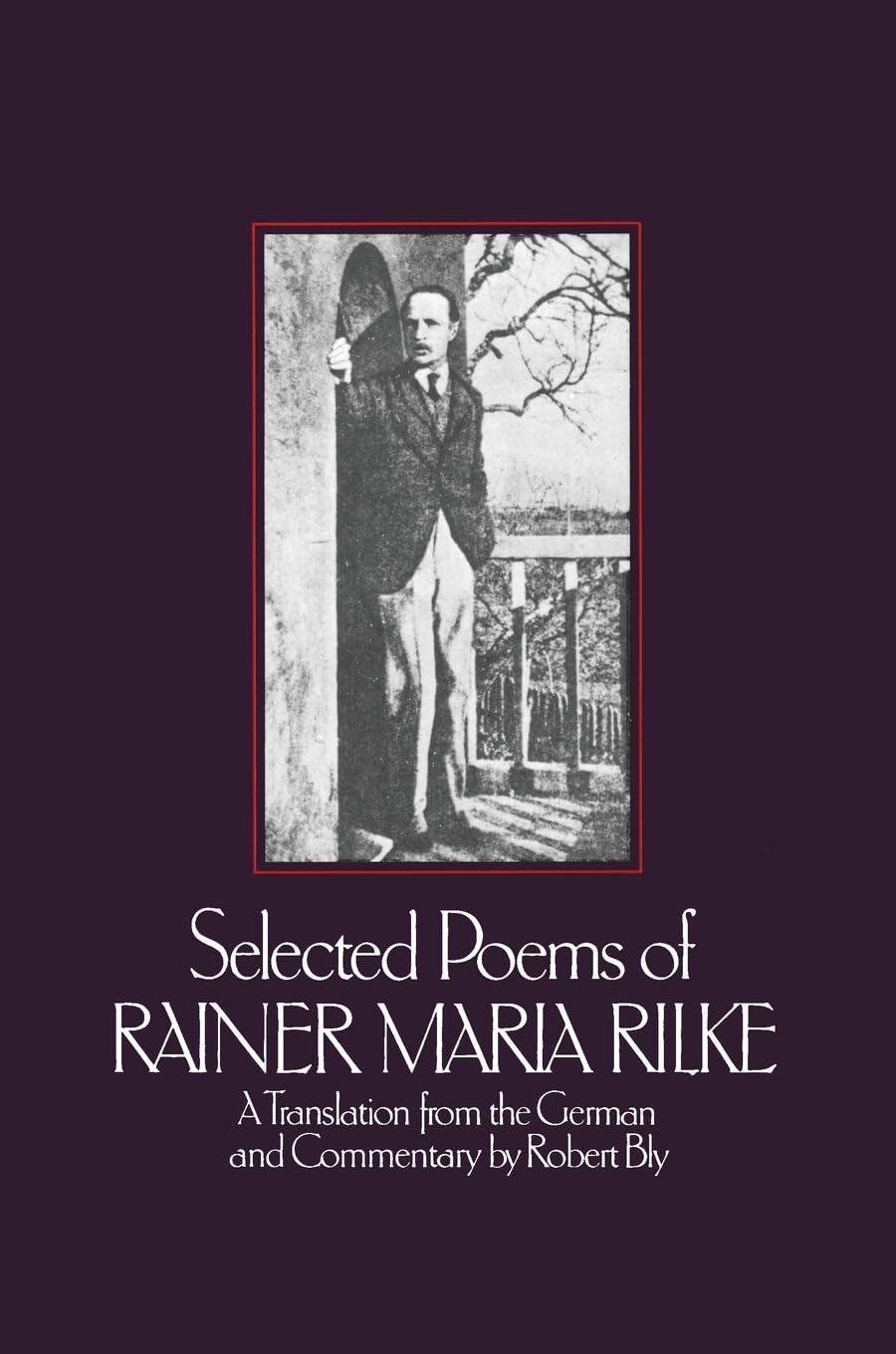



For poetry lovers and students of literature and literary criticism, Robert Bly, the National Book Award-winning poet, brings his prowess as a translator and critic to bear on the work of one of the major German poets of the century. In this landmark translation and commentary the National Book Award-winning poet Robert Bly brings his prowess as translator and critic to bear on the work of the indisputably major poets of the century. For poetry lovers and students of literature and literary criticism, Robert Bly, the National Book Award-winning poet, brings his prowess as a translator and critic to bear on the work of one of the major German poets of the century. One of the most widely read modern poets, Rainer Maria Rilke (1875-1926) first became known and respected with the publication of The Book of Hours , when he was in his twenties. He is now most famous for his Letters to a Young Poet , published during the same time, which continues to inspire generations of writers. Robert Bly's books of poetry include The Night Abraham Called to the Stars and My Sentence Was a Thousand Years of Joy . His awards include the National Book Award for poetry and two Guggenheims. He lived in Minneapolis, Minnesota. Chapter One Rilke's first large book, and the first he had confidence in, was Das Stundenbuch, which I have translated as A Book for the Hours of Prayer. The German title suggests a medieval monk's or nun's handbook of prayers. Innigkeit is the German word associated with such poetry, which becomes "inwardness" in English; but the syllables of the German word have so much more drive and finality than the English sounds. Innigkeit has the depth of a well where one finds water. And water is the element of this book, a water whose source Rilke found inside himself. The first group of poems in the book, called "The Book of Monkish Life," came in a wonderful rush, shortly after Rilke returned home from a trip to Russia with Lou Andreas-Salome and her husband in 1899. He was twenty-three years old. Until then he had felt his life to be constricted and restrained: the narrow streets of his native Prague seemed stiflingly provincial, and his mother's love and her piety left little space for him. He later said of her: In some heart-attic she is tucked away and Christ comes there to wash her every day. The power of Lou Andreas-Salome's personality and the open spaces of the Russian plains astounded him. He understood Russia's outer space as inner space. It lay east of "Europe": Sometimes a man stands up during supper and walks outdoors, and keeps on walking, because of a church that stands somewhere in the East. And his children say blessings on him as if he were dead. And another man, who remains inside his own house, stays there, inside the dishes and in the glasses, so that his children have to go far out into the world toward that same church, which he forgot. He doesn't mean any orthodox church, but says that if a man walks toward that inner space, he will free his children. It is not too late. Because One Man wanted so much to have you, I know that we can all want you. He is astonished to realize that this wanting and having are perfectly possible right now, even for twentieth-century man. Growth is growth into space, as a tree grows through its rings, as the snail grows in spirals and the solar system moves in circles: I live my life in growing orbits which move out over the things of the world. Perhaps I can never achieve the last, but that will be my attempt. I am circling around God, around the ancient tower, and I have been circling for a thousand years, and I still don't know if I am a falcon, or a storm, or a great song. In his surprise he doesn't even identify himself as a man; he could be a falcon or a storm. Before his Russian trip, Rilke had spent a few months in Italy, and he loved the religious paintings of the early Renaissance, the heavy gold frames, the gold flake: he noticed that the Mediterranean psyche associated gold with religious feeling. But he saw something different when he looked within himselfwhat we could call a North European unconscious. I have many brothers in the South. Laurels stand there in monastery gardens. I know in what a human way they imagine the Madonna, and I think often of young Titians through whom God walks burning. Yet no matter how deeply Igo down into myself my God is dark, and like a webbing made of a hundred roots, that drink in silence.He then realizes that he may have claimed too much for himself, and he delicately suggests how unformed he is: I know that my trunk rose from his warmth, but that's all, because my branches hardly move at all near the ground, and only wave a little in the wind. The language broods; it stays in the moist mood of the North European unconscious. The holy is below us, not above; and a line moves to descend, to dip down, to touch water that lies so near we are astonished our hands haven't dipped into it before. The lines sugge