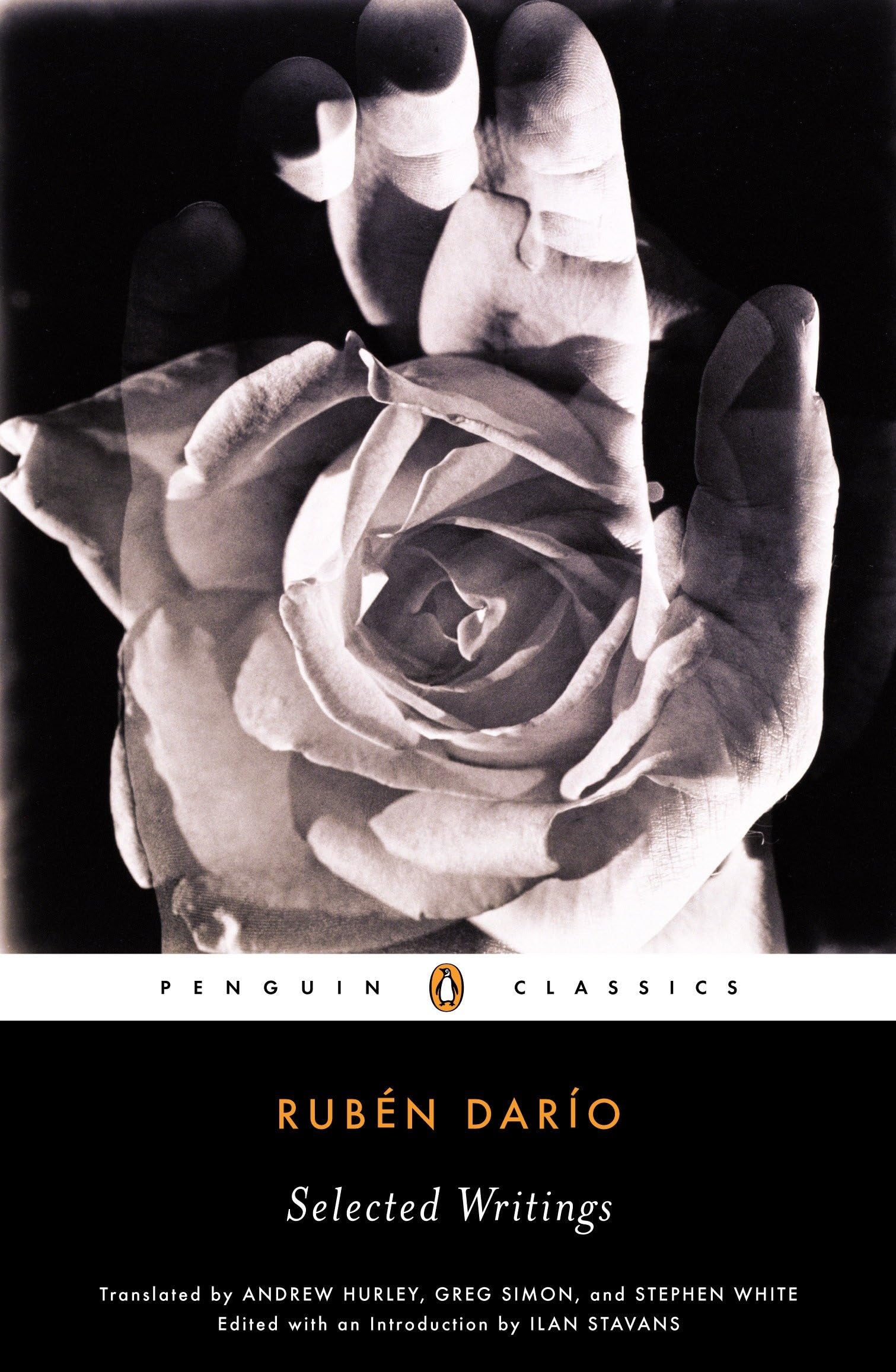



Born in Nicaragua, Rubén Darío is known as the consummate leader of the Modernista movement, an esthetic trend that swept the Americas from Mexico to Argentina at the end of the nineteenth century. Seeking a language and a style that would distinguish the newly emergent nations from the old imperial power of Spain, Darío’s writing offered a refreshingly new vision of the world—an artistic sensibility at once cosmopolitan and connected to the rhythms of nature. The first part of this collection presents Darío’s most significant poems in a bilingual format and organized thematically in the way Darío himself envisioned them. The second part is devoted to Darío’s prose, including short stories, fables, profiles, travel writing, reportage, opinion pieces, and letters. A sweeping biographical introduction by distinguished critic Ilan Stavans places Darío in historical and artistic context, not only in Latin America but in world literature. For more than seventy years, Penguin has been the leading publisher of classic literature in the English-speaking world. With more than 1,700 titles, Penguin Classics represents a global bookshelf of the best works throughout history and across genres and disciplines. Readers trust the series to provide authoritative texts enhanced by introductions and notes by distinguished scholars and contemporary authors, as well as up-to-date translations by award-winning translators. Rubén Darío (1867–1916) gained prominence in Azul... , the publication of which sparked the Modernista movement in the Spanish-speaking Americas. Ilan Stavans is Lewis-Sebring Professor in Latin American and Latino Culture at Amherst College and the author or editor of numerous books. Andrew Hurley is a translator of numerous works of literature, criticism, history, and memoir. He is professor emeritus at the University of Puerto Rico. Next to Borges, the Nicaraguan Ruben Dario (1867-1916) is perhaps Latin America's most cosmopolitan writer. But unlike Borges, Dario -- a cosmopolite who doesn't travel well -- remains mostly unknown outside the Spanish-reading world. Although his lack of success in translation is usually blamed on the difficulty of recasting his ornate, highly stylized verse, it surely has as much to do with the ambiguous nature of his achievement. Universally credited (a credit that he basked in) with liberating Spanish-language poetry from the declamatory Romanticism of his immediate predecessors, Dario became famous for innovations that, in the broader context of late 19th-century European and American literature, were no innovations at all. When placed next to that of Mallarme or Verlaine, whom he readily acknowledged as models, Dario's poetry shares the luster but lacks the depth. When placed next to that of Hugo or Whitman, whom he also admired, his metrical experiments seem little more than salon exercises. And yet Dario's influence on Hispanic literature has been enormous. There is hardly a modern Spanish or Spanish American poet -- from the Spaniard Juan Ramon Jimenez to the Latin Americans Pablo Neruda and Octavio Paz -- who is not indebted to him, if not for details of phrasing or form, then certainly for the desire to lift Spanish poetic diction from the rut into which it had fallen after the "Golden Age" of great baroque poets such as Gongora and Quevedo. But the most influential poetry is not necessarily the most durable (indeed, the opposite is often the case); and although it may be heresy to say this, it is difficult to read some of Dario's best-known poems today without wondering what all the fuss has been about. Whatever their historical importance and technical finesse, compositions like "Sonatina," about a medieval princess who pines for her faraway prince, or "It was a soft air. . . ," about the wicked and beautiful Marquise Eulalia, a femme now fatale only to herself, appeal to us principally as curiosities, the literary equivalents of the heirlooms one sees every week on "The Antiques Road Show." When Dario, in another much-quoted poem, describes the Poet as a "man-mountain chained to a lily," one assents to the thought (perhaps) but winces at the metaphor. Ironically, Dario is relevant today less for the rococo glitter of the poems that made him a celebrity -- contained in two early books, Azul (Blue, 1888) and Prosas profanas (Profane Hymns, 1896) -- than for the unvarnished subject matter of his later work. Published exactly 100 years ago, his bracing diatribe against Teddy Roosevelt -- Hercules in riding boots -- serves up the mixture of awe, fear and envy that has defined the attitude of many Latin Americans toward the Colossus to the north. Less prophetic, but equally powerful, are the poems and articles calling for pan-Hispanic solidarity in the wake of Spain's defeat in the Spanish-American War. The aging Dario, who had once bragged that Spain was his wife but France his mistress, became a propagandist for what he called "fecund Hispania," composing pa