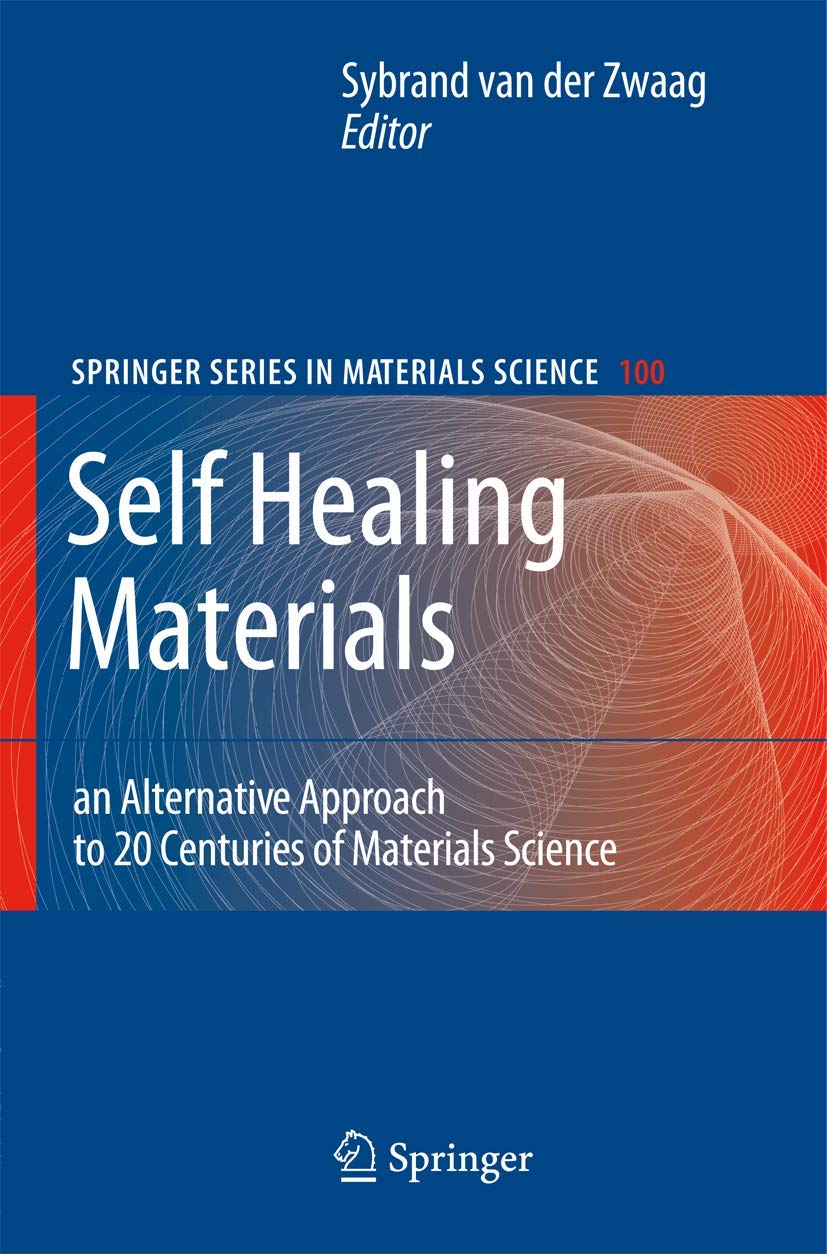
Self Healing Materials: An Alternative Approach to 20 Centuries of Materials Science (Springer Series in Materials Science, 100)
$131.88
by Sybrand Van Der Zwaag



“As a general principle natural selection is continually trying to economise every part of the organisation. ” That was Charles Darwin, writing over 100 years ago about e- ciency innature. Naturalmaterialsareremarkably ef?cient. Byef?cient wemeanthat they ful?l the complex requirements posed by the way plants and animals function, and that they do so using as little material as possible. Many of these requirements are mechanical in nature: the need to support static and dynamic loads created by the mass of the organism or by wind loading, the need to store and release elastic energy, the need to ?ex through large angles, the need to resist buckling and fracture, and to survive damage. Few optimisation algorithms have been more successful than that of “survival of the ?ttest”. The structural materials of nature exemplify this op- misation; even today, few man-made materials do better than those of nature in the function that they ?ll. And of all the remarkable properties of natural materials, one is truly exceptional – that of the ability for self-repair. One recurring goal of material development has been to emulate the materials of nature. Among these, the most illusive is that of self-repair. In approaching this it is well to be aware of the nature of the differences that separate the structural materials of man and those of nature. From the reviews: "There have been discussions of self-healing materials in various journals for some time, this is the first attempt at bringing the current state of knowledge in one place on a broad variety of materials. … the book should be of interest to the entire community of materials scientists working on both structural and functional materials. … will also be suitable as a textbook in a course on self-healing materials at the graduate level. … a unique compilation of state-of-art on this topic." (Ravi Rungta, JOM, March, 2008) This book, the first in this new field of materials science, aims to present a coherent picture of the design principles and resulting properties of self healing materials over all material classes, and to offset them to the current design principles for structural materials with improved mechanical properties. Where appropriate a comparison to natural materials is made. As such it will be a landmark and a reference work in the coming years. The book consists of a number of invited contributions from leading experts in the field. While each chapter describes a separate approach or a different aspect of self healing materials, the common structure of each chapter creates a coherent and consistent picture of this emerging and challenging field. Hence the book is not only a valuable asset for professional materials scientists but it is also suitable as a text book for courses at MSc level.