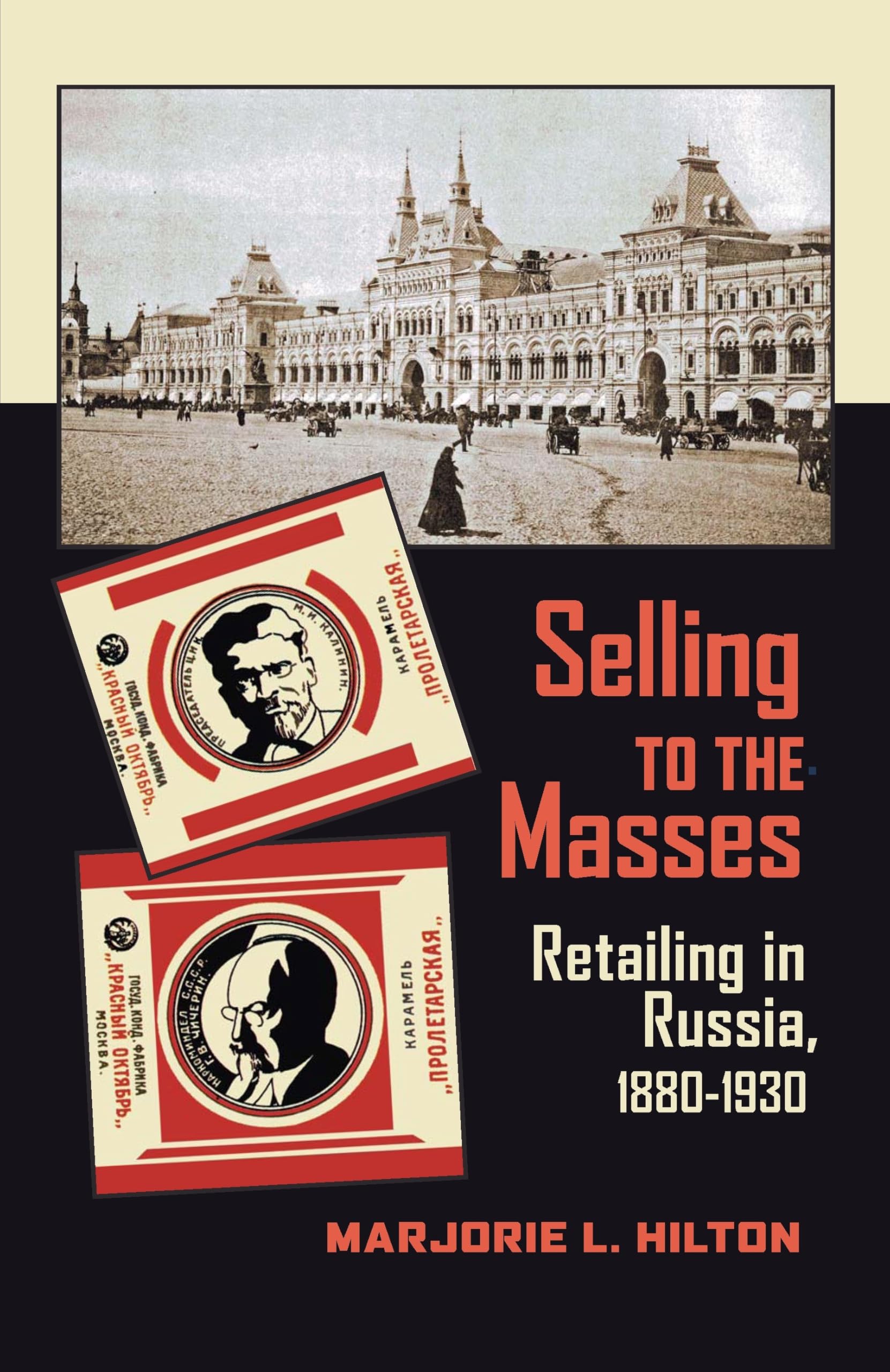
Selling to the Masses: Retailing in Russia, 1880–1930 (Russian and East European Studies, 233)
$60.00
by Marjorie Hilton



Marjorie L. Hilton presents a captivating history of consumer culture in Russia from the 1880s to the early 1930s. She highlights the critical role of consumerism as a vehicle for shaping class and gender identities, modernity, urbanism, and as a mechanism of state power in the transition from tsarist autocracy to Soviet socialism. Beginning in the late nineteenth century, Russia witnessed a rise in mass production, consumer goods, advertising, and new retail venues such as arcades and department stores. These mirrored similar developments in other European countries and reflected a growing quest for leisure activities, luxuries, and a modern lifestyle. As Hilton reveals, retail commerce played a major role in developing Russian public culture—it affected celebrations of religious holidays, engaged diverse groups of individuals, defined behaviors and rituals of city life, inspired new interpretations of masculinity and femininity, and became a visible symbol of state influence and provision. Through monarchies, revolution, civil war, and monumental changes in the political sphere, RussiaÆs distinctive culture of consumption was contested and recreated. Leaders of all stripes continued to look to the \u201ccommerce of exchange\u201d as a key element in appealing to the masses, garnering political support, and promoting a modern nation. Hilton follows the evolution of retailing and retailers alike, from crude outdoor stalls to elite establishments; through the competition of private versus state-run stores during the NEP; and finally to a system of total state control, indifferent workers, rationing, and shortages under a consolidating Stalinist state. Hilton's book is an original and vividly written study of Russian commercial culture from the late imperial through the early Soviet periods. Delving into the practical and ideological meanings of retail trade for merchants, consumers, and the state, it combines breadth and depth to provide insights into fascinating continuities in the attitudes toward commerce between these two opposed regimes. ― Sally West, Truman State University Tracing common motifs across a turbulent half century in Russian history, Hilton constructs a compelling, engaging argument about the importance of retail culture in the development of a modern urban society in the late 19th and early 20th centuries. . . . Highly recommended. ― Choice This book will be of interest to scholars of culture, gender, and politics. Smoothly, yet pointedly written and thoughtfully organized . . . a little something for everyone in these pages. ― The Russian Review Hilton has presented a rich and rewarding analysis of the attitudes and policies that shaped retail commerce in late imperial and early Soviet Russia. She provides useful points of comparison by consistently keeping an eye on analogous developments in Western Europe. ― The NEP Era The most compelling part of Hilton's study is her treatment of prerevolutionary retailing . . . . A masterful and engaging study. ― Slavic Review Hilton offers a well researched book on Russia's stores, shops, retail arcades and marketplaces from 1880 to 1930. . . A compelling argument that retail space impacts the construction of social identities . . . and that consumerist culture goes beyond consumption as a series of interrelated acts organized around the key activities of buying and selling. ― Slavic and East European Journal At once entertaining and scholarly, 'Selling to the Masses' provides intriguing insights into the changing relationship between retailers, consumers and the Russian state during one of the most turbulent periods of that country's history. Hilton painstakingly demonstrates how in the late tsarist and early Soviet periods retailing in Russia functioned as a site of ideological struggle, a means of imposing social order and affirming national identity. As such, her book will be of immense interest to students of Russian history, Soviet studies, business history, gender studies and anthropology. ― Slavonica One of the strengths of Hilton's book is its vividness. The author writes well and her sketches of shops, shoppers and shop workers go some way to offering the reader an accessible and carefully realized entry into the world of late imperial and early Soviet consumerism. ― SEER The commercial space across Red Square from the seat of state power has for centuries been 'as much a part of Russia's history as the Kremlin and St. Basil's,' whether as the trading rows of the Imperial era or the state department store (GUM) of Soviet times. This claim demands a cognitive shift for most historians, for whom commerce is far less central to the Russian past than politics, church or state. Yet Marjorie Hilton's work succeeds in demonstrating how embedded retail trade has been in broader policies and culture, and indicative it can be of both changes and continuities in the relationship between state and society throughout th