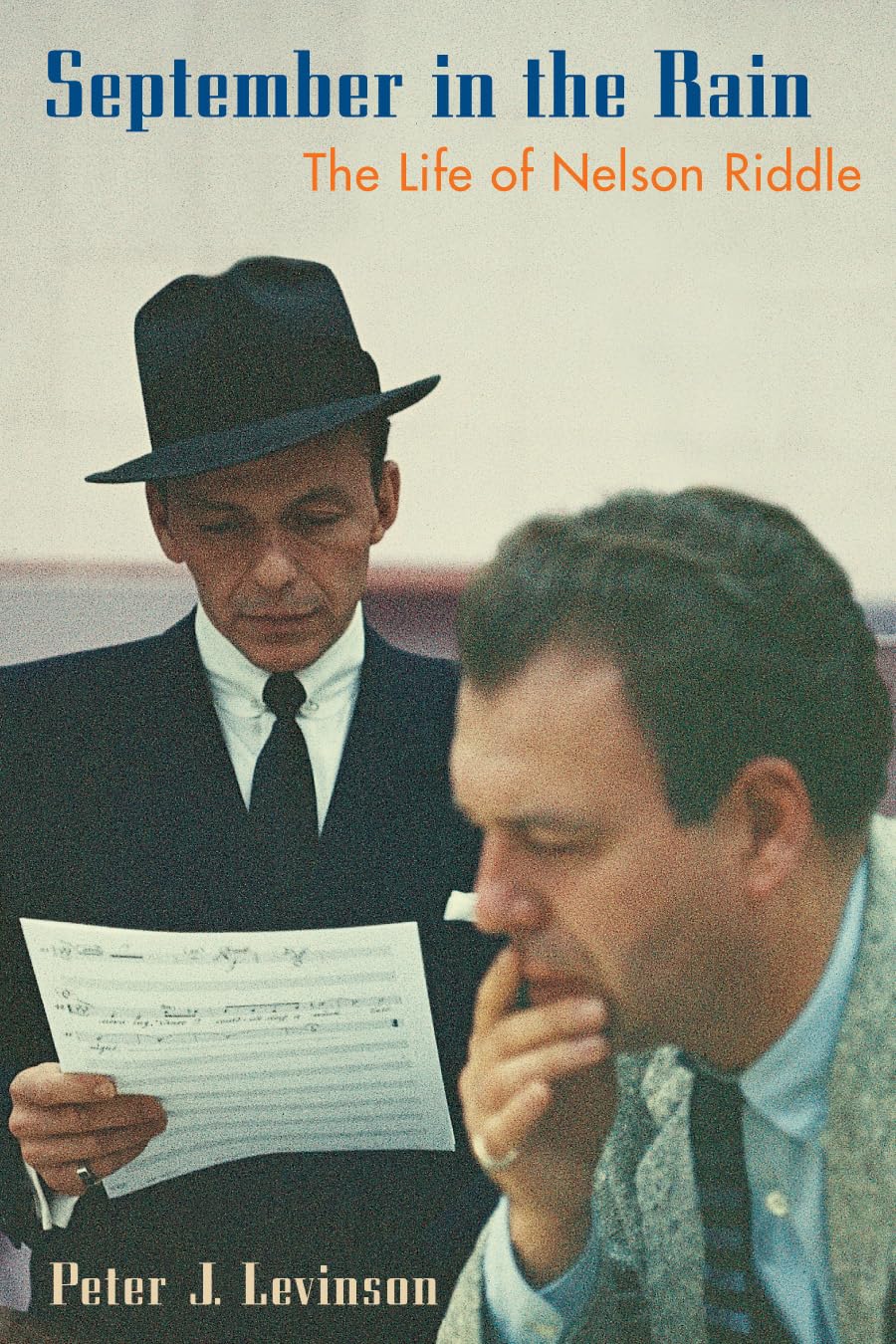



Known for single-handedly saving Frank Sinatra's career in the mid-1950s with his stunning orchestral arrangements, Riddle's "intelligent, seductive style" also attracted such singers as Nat King Cole, Ella Fitzgerald, Judy Garland, Johnny Mathis, and Linda Ronstadt. Peter Levinson, a friend of Riddle's, presents the musical side of Riddle as well as the private, including details of his marriage-ending affair with Rosemary Clooney. Peter J. Levinson began his involvement with American popular music in the late 1950s as a freelance writer in New York City. He then began work as a publicist for record companies in New York and Los Angeles. He lives in Malibu, California. September in the Rain The Life of Nelson Riddle By Peter J. Levinson Taylor Trade Publishing Copyright © 2005 Peter J. Levinson All right reserved. ISBN: 9781589791633 Chapter One The Jersey Years "Ya know, all those years I never saw Nelson smile or laugh," remarkedEmil Richards, a vibraharpist and percussionist who recorded frequently under Nelson'sleadership for two decades. "He just seemed to be an unhappy kind of guy." Richardswas not alone in feeling this way; his sentiment is shared by many others who recall thegloom and unhappiness that characterized Nelson Riddle's life. Nelson's somber outlook flew in the face of the fact that he had established animpeccable reputation for the consistency of the sophisticated and impressionistic musicalarrangements he wrote for the foremost pop and jazz singers of the twentieth century?FrankSinatra, Ella Fitzgerald, and Nat "King" Cole?during his almost fifty-yearcareer. He maintained his negative attitude despite the fact that he had written brilliantarrangements for over two dozen other important vocalists, including Judy Garland,Peggy Lee, Johnny Mathis, Rosemary Clooney, Steve Lawrence, rock star LindaRonstadt, and opera star Kiri Te Kanawa. (With his help, Ronstadt and Te Kanawa successfullycrossed over into classic popular music.) This was even stranger given theOscar he received in 1975 for The Great Gatsby (a gold album), his four other AcademyAward nominations (for Li'l Abner, Can-Can, Robin and the Seven Hoods, and Paint YourWagon ?also a gold album), and the total of forty films he scored overall. AmongNelson's other achievements were two hit instrumental records of his own, "LisbonAntigua" (#1 on the Billboard pop chart and a gold record) and "Route 66," the theme ofone of several television series he scored, beginning with Naked City , including TheSmothers Brothers Comedy Hour and The Julie Andrews Hour , and ending with the thirdBob Newhart show. This was in addition to his seven Emmy Award nominations,which included one for his score for the first miniseries, The Blue Knight starringWilliam Holden. And it was notwithstanding the three Grammys that Nelson won (outof eleven nominations) for his composition Cross Country Suite , written for clarinetistBuddy DeFranco in 1958, and his arrangements for What's New (1983) and Lush Life (1985) for Linda Ronstadt. His star on the Hollywood Walk of Fame on HollywoodBoulevard symbolizes Nelson Riddle's career?one of both achievement and substance. * * * Nelson Smock Riddle, Jr., was born on June 21, 1921, in the small town of Oradell,New Jersey, a bedroom community across the Hudson River and ten miles west of NewYork City. He was baptized at the Dutch Reform Church in Oradell. Smock was an oldDutch family name. Nelson's outgoing, fun-loving father, for whom he was named, was of bothEnglish-Irish and Dutch parentage. Fundamentally a sign painter, a craftsman, a sometimecommercial artist, and an amateur cartoonist who enjoyed creating new characters,unfortunately he seemed to have very little interest in making a profit for hisefforts. Nelson, Sr., also had a love of popular music; he played trombone and ragtimepiano, the latter an instrument which his son adopted at the age of eight. Nelson's mother, Marie Albertine Riddle, passed on to her son a deep and abidingappreciation of classical music. He remembered her singing French folk songs to himwhen he was a little boy, one of which, "Frère Jacques," was later adapted and becamethe basis for his swinging arrangement of "Brother John." Marie Albertine, betterknown simply as Albertine, was a small woman?five foot three or four?ratherdwarfed by her husband, who was slightly over six feet tall. She was born in 1888 inMulhouse, France, a town in Alsace-Lorraine, a province near the German border thathad been a subject of bitter contention between the two countries on and off for hundredsof years. It was the West Bank of that time. Her father was Spanish and of noblelineage; he claimed that his family had been part of the Spanish monarchy that hadonce ruled Holland. As a child, Albertine was raised in a convent. Albertine had been married once previously, and her divorce led her to leave theCatholic church. Because of her alleged upper-clas