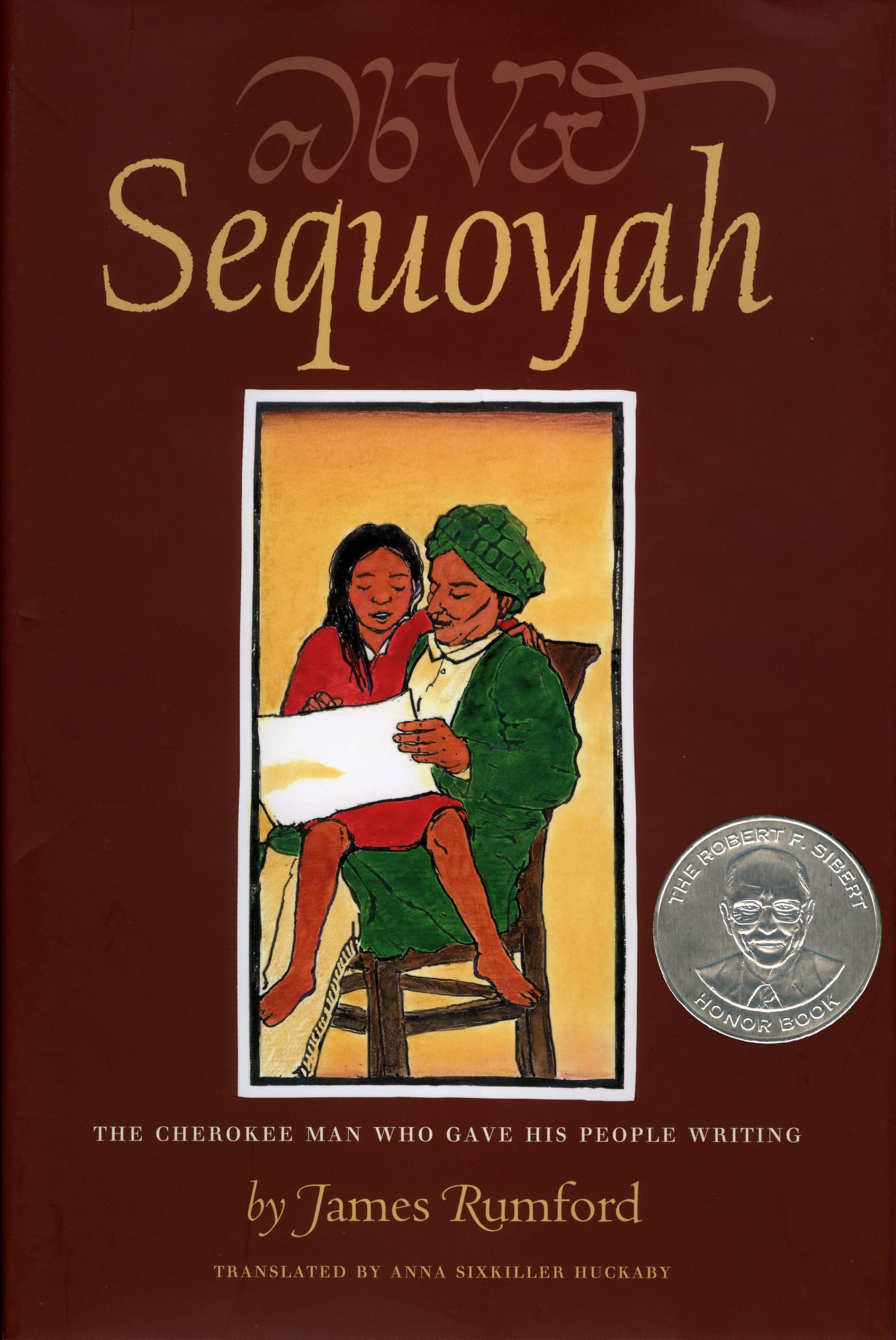
Sequoyah: The Cherokee Man Who Gave His People Writing (Robert F. Sibert Informational Book Honor (Awards))
$3.50
by James Rumford



A 2005 Sibert Honor Book The story of Sequoyah is the tale of an ordinary man with an extraordinary idea—to create a writing system for the Cherokee Indians and turn his people into a nation of readers and writers. The task he set for himself was daunting. Sequoyah knew no English and had no idea how to capture speech on paper. But slowly and painstakingly, ignoring the hoots and jibes of his neighbors and friends, he worked out a system that surprised the Cherokee Nation—and the world of the 1820s—with its beauty and simplicity. James Rumford’s Sequoyah is a poem to celebrate literacy, a song of a people’s struggle to stand tall and proud. Starred Review. Grade 1-4–Fascinated by the Giant Sequoias they see during a California vacation, unnamed children listen to their father tell of the trees' namesake from the opposite side of North America. Thus, in short paragraphs accompanied by richly textured illustrations, Rumford presents the seminal events in Sequoyah's life, culminating in his invention of the Cherokee syllabary. The author writes with a concise eloquence that echoes the oral tradition and makes this one of those rare gems of read-aloud nonfiction. As in his other picture books, the artwork is executed in a style and medium that evoke the period and culture of the subject, in this case creating bold-lined scenes reminiscent of 19th-century woodblock prints. Done in ink, watercolor, pastel, and pencil, the illustrations were adhered to a rough piece of wood, and its textures were highlighted through the use of chalk and colored pencil. The perfect finishing element is the parallel text in Cherokee, which not only demonstrates the product of Sequoyah's genius but also makes this beautiful book readily accessible to Cherokee children in their own language. The end matter includes additional facts and the complete syllabary. Sequoyah is a perfect companion to Rumford's other picture books on important world scholars from history and legend–Jean-François Champollion, Ibn Battuta, Cadmus–whose (mostly linguistic) achievements are comparatively unsung. A must-have for all collections. –Sean George, Memphis-Shelby County Public Library & Information Center, Memphis, TN Copyright © Reed Business Information, a division of Reed Elsevier Inc. All rights reserved. Gr. 1-3. This fascinating biography, presented in a tall, slim format, introduces Sequoyah, who decided in the early 1800s to give the Cherokee language a written form. Creating 84 symbols for sounds, he began to teach the language to others in the Cherokee nation. This technique spread, enabling the publication of books and newspapers, and it survives today. Below the paragraphs of English text, appearing usually on the book's right-hand pages, is a translation into the Cherokee language. Like the giant sequoia trees that appear in the framework story, the illustrations on the facing pages are vertical and stately. Created in ink, watercolor, pastel, and pencil, the unusual artwork has a primitive quality that reflects the strength and deceptive simplicity of the text. Back matter includes a chart showing the Cherokee syllabary, a discussion of Sequoyah and his accomplishment, and a time line of his life. Carolyn Phelan Copyright © American Library Association. All rights reserved "The author writes with a concise eloquence that echoes the oral tradition and makes this one of those rare gems of read-aloud nonfiction." School Library Journal, Starred Textured full-page mixed-media illustrations...feature strong figures and spare scenes reminiscent of the Asian and Native American artwork Rumford cites as sources of inspiration. Horn Book, Starred Simple, declarative sentences take on the cadences of legend...the bright, textured illustrations take on the look of heavily outlined block prints, giving the whole the feeling of an old-fashioned children's history. Kirkus Reviews, Starred Master storyteller James Rumford combines his love for art and history in his picture books. Each of his books is vastly different in its content, design, and illustrations but one aspect remains constant throughout his work: his passion about his subjects. Rumford, a resident of Hawaii, has studied more than a dozen languages and worked in the Peace Corps, where he traveled to Africa, Asia, and Afghanistan. He draws from these experiences and the history of his subject when he is working on a book. His book Sequoyah: The Cherokee Man Who Gave His People Writing was a 2005 Sibert Honor winner. Used Book in Good Condition