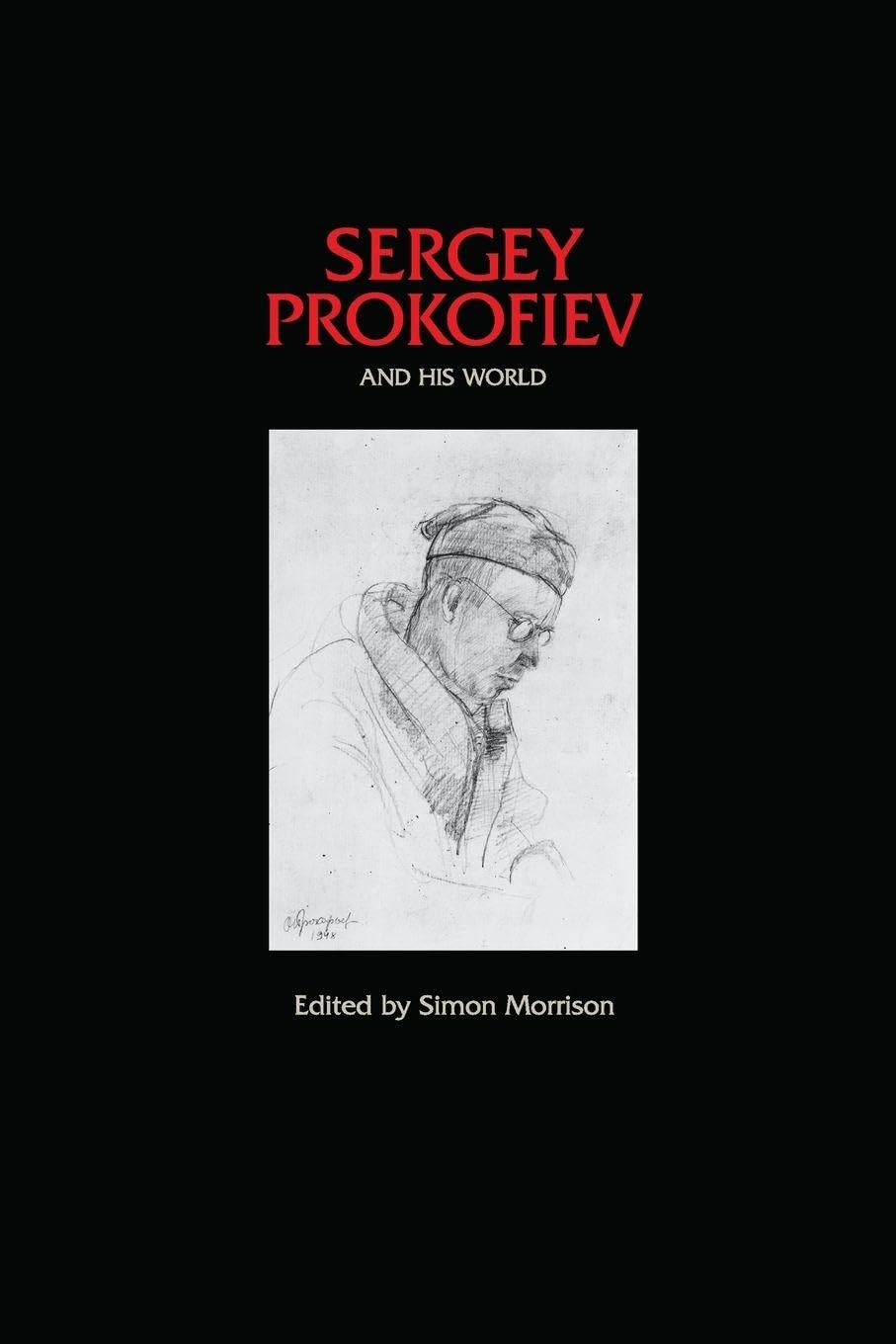



Sergey Prokofiev (1891-1953), arguably the most popular composer of the twentieth century, led a life of triumph and tragedy. The story of his prodigious childhood in tsarist Russia, maturation in the West, and rise and fall as a Stalinist-era composer is filled with unresolved questions. Sergey Prokofiev and His World probes beneath the surface of his career and contextualizes his contributions to music on both sides of the nascent Cold War divide. The book contains previously unknown documents from the Russian State Archive of Literature and Art in Moscow and the Prokofiev Estate in Paris. The literary notebook of the composer's mother, Mariya Grigoryevna, illuminates her involvement in his education and is translated in full, as are ninety-eight letters between the composer and his business partner, Levon Atovmyan. The collection also includes a translation of Sigizmund Krzhizhanovsky's unperformed stage adaptation of Eugene Onegin , for which Prokofiev composed incidental music in 1936. The essays in the book range in focus from musical sketches to Kremlin decrees. The contributors explore Prokofiev's time in America; evaluate his working methods in the mid-1930s; document the creation of his score for the film Lieutenant Kizhe ; tackle how and why Prokofiev rewrote his 1930 Fourth Symphony in 1947; detail his immortalization by Soviet bureaucrats, composers, and scholars; and examine Prokofiev's interest in Christian Science and the paths it opened for his music. The contributors are Mark Aranovsky, Kevin Bartig, Elizabeth Bergman, Leon Botstein, Pamela Davidson, Caryl Emerson, Marina Frolova-Walker, Nelly Kravetz, Leonid Maximenkov, Stephen Press, and Peter Schmelz. "This is a valuable addition to Princeton's series on the background and world of prominent composers. And unlike many multiauthored volumes, this one concentrates on useful information rather than opinion--indeed, the first half is all documents. . . . All fascinating stuff." ---Della Couling, Classical Music " Sergey Prokofiev and His World looks at the composer's life and music in great detail, shedding new light on the arts in the Soviet Union, in particular, through documents that have become accessible only recently." ― The Weekly Standard "[An] invaluable volume." ---J. Behrens, Choice "[This] volume is absolutely indispensable to anyone even casually interested in this field, and all scholars working in Soviet music studies have reason to be grateful to Simon Morrison for his pioneering work." ---Pauline Fairclough, Oxford Journals Simon Morrison is associate professor of music at Princeton University. He is the author of Russian Opera and the Symbolist Movement and The People's Artist: Prokofiev's Soviet Years . Sergey Prokofiev and His World By S. Morrison Princeton University Press Copyright © 2008 Princeton University All right reserved. ISBN: 978-0-691-13895-4 Chapter One "Look After Your Son's Talents": The Literary Notebook of Mariya Prokofieva EDITED, TRANSLATED, AND INTRODUCED BY PAMELA DAVIDSON The same parting words were always addressed to me: "Look after your son's talents." I remember them with gratitude to this very day and always followed them, whenever possible. - Mariya Prokofieva The Serge Prokofiev Archive in London houses a copy of an unusual item from the Serge Prokofiev Estate in Paris: a small notebook, completed at the end of 1917, filled with miscellaneous entries from various sources, including poems, philosophical aphorisms, and notes on a wide range of subjects frommysticismto astronomy. It is not known exactly how this notebook ended up among Prokofiev's papers in France; he may have packed it in his suitcase when he left Russia in May 1918, or his mother may have brought it to him together with his musical papers and diary of 1917 when she joined him in France in June 1920, arriving with just two suitcases after an arduous journey from Kislovodsk via Constantinople. Whichever route was taken, it is clear that the notebook was of considerable importance to Prokofiev, otherwise it would not have been chosen as one of the few items to be taken out of Russia after the Revolution. For many years it was assumed that the entries in the notebook were all made by Prokofiev. This view was taken for granted because the notebook had been kept with Prokofiev's personal papers and containsmaterials closely linked with his creative work and pursuits at the time: poems by Zinaida Gippius and Konstantin Balmont that he set to music in 1915 and 1917; excerpts from Edouard Schur and Schopenhauer, whose works he was reading in 1916 and 1917; and two of his own humorous poems, composed in 1916 and 1917. In the course of recent research, however, it became apparent that only the very last entry in the notebook is in Prokofiev's hand; all the other entries are written in the "beautiful and energetic" handwriting of his mother, Mariya Grigoryevna Prokofieva (1855-1924)