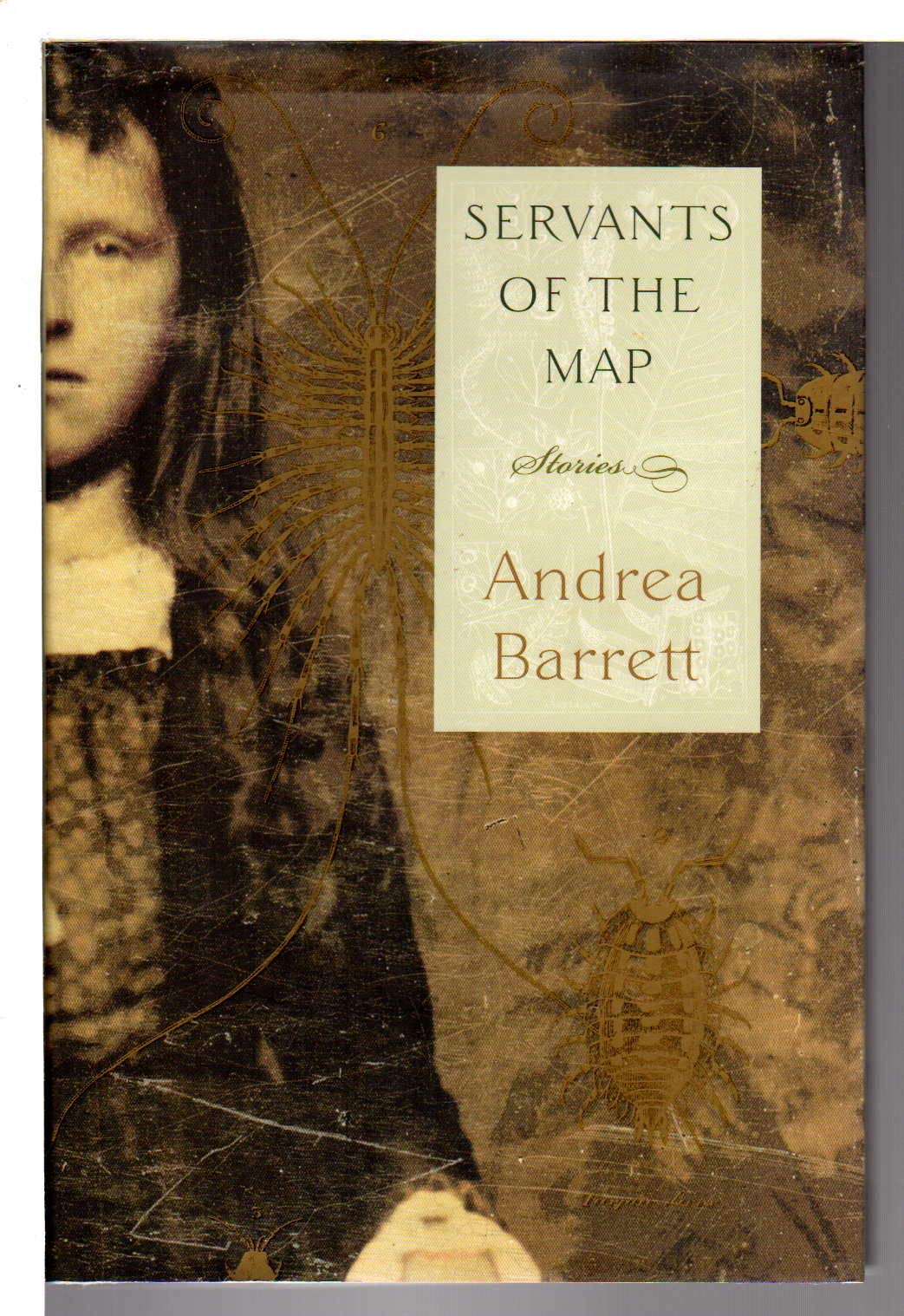



Spanning two centuries, an intricately woven collection of stories and novellas journey across landscapes of yearning, awakening, loss, and unexpected discovery, as a mapper of the highest mountain peaks discovers his true calling, a young woman must come to terms with a romantic fantasy, and the lives of many other extraordinary characters unfold in a borderland between science and passion. No one limns the opposing pull of inner and outer worlds more eloquently than Andrea Barrett. Her naturalists, explorers, scientists, and healers are driven to work and above all to know ; they categorize, theorize, and collect the phenomena of the natural world with an urgency that feels like physical need. But they are motivated equally by desire and loneliness, and the theme of domestic life runs like a countermelody through each of the six lovely, deeply memorable stories in Servants of the Map . The narrator of the title story, a cartographer in the Grand Trigonometrical Survey of India, is a timid, home- and family-loving man, but the Himalayas strike him with the force of a revelation. The heroine of the lyrical "Theories of Rain" is a creature of strong feelings and appetites, driven to ask questions about the world around her in the same spirit as she longs for a neighbor and mourns the brother separated from her in childhood. Her scientific curiosity is scarcely different from her desire: "Through that channel of longing, the world enters me." Fans of Barrett's earlier books (the sublime Ship Fever and Voyage of the Narwhal ) will delight in tracing the stories and characters that wind in and out of these three books, producing the sense of something lovely, ongoing, and whole. In the final story, Elizabeth finds consolation in her work caring for tubercular patients--"as if, in the order and precarious harmony of this house and those it shelters she might, for all that gets lost in this life, at last have found a cure." The same might be said of science, and of Barrett's art. --Mary Park All six of the intricate and closely related tales in Barrett's latest collection depict intriguing moments of tension between scientific endeavor and human nature, dating from the early 19th century to the present. In the mesmerizing title story (selected for both Best American Short Stories 2001 and Prize Stories: The O. Henry Awards 2001), young Max Vigne seeks the adventure of a lifetime as part of an 1863 expedition to map the Himalayas but instead finds personal anguish and unexpected self-knowledge. "The Cure," set in 1905, finds Max's daughter Elizabeth reflecting on the strange paths that led her to becoming a healer in the Adirondack wilderness. "The Mysteries of Ubiquitin" portrays an up-and-coming female biochemist distracted by a chance to live out her childhood dream of romance. This book more than matches Barrett's earlier story collection, Ship Fever, which won the National Book Award. Highly recommended for most fiction collections. - Starr E. Smith, Fairfax Cty. P.L., VA Copyright 2001 Reed Business Information, Inc. MacArthur fellow Barrett writes with great empathy about naturalists, scientists, explorers, and healers, the heroes of her National Book Award-winning story collection, Ship Fever (1996), her magnificent novel, The Voyage of the Narwhal (1998), and now this equally spellbinding set of stories, which are knit unobtrusively to each other and her earlier books. In these complex yet ravishing tales of scientific pursuits stoked by loneliness and desire, Barrett ponders the spiritual toll associated with exile from home and loved ones, and conflicts between the passion for learning and the demands of love and family life. In the brilliantly subtle title story, Max, a shy English surveyor with a passion for botany, toughs it out in the dangerous and glorious Himalayas as part of the remarkable Grand Trigonometrical Survey of India, bitterly missing his wife and children even as he realizes that this is the life for him. In the gently poetic "Theories of Rain," a bright yet isolated young woman longs for sensual love and knowledge of the universe, while in two beautifully rendered stories set in the present, a molecular biologist named Rose finds that her work proves more reliable than human connections. Barrett's characters are deep and self-possessed, and their stories, so intelligently and delectably told, both romanticize and validate the quest for understanding life that drives scientists and artists alike. Donna Seaman Copyright © American Library Association. All rights reserved [O]ne more example of the originality and wit Barrett demonstrates throughout a most distinguished collection of stories. -- New York Times Book Review , Barry Unsworth Andrea Barrett lives in Rochester, New York. Servants of the Map Stories Andrea Barrett