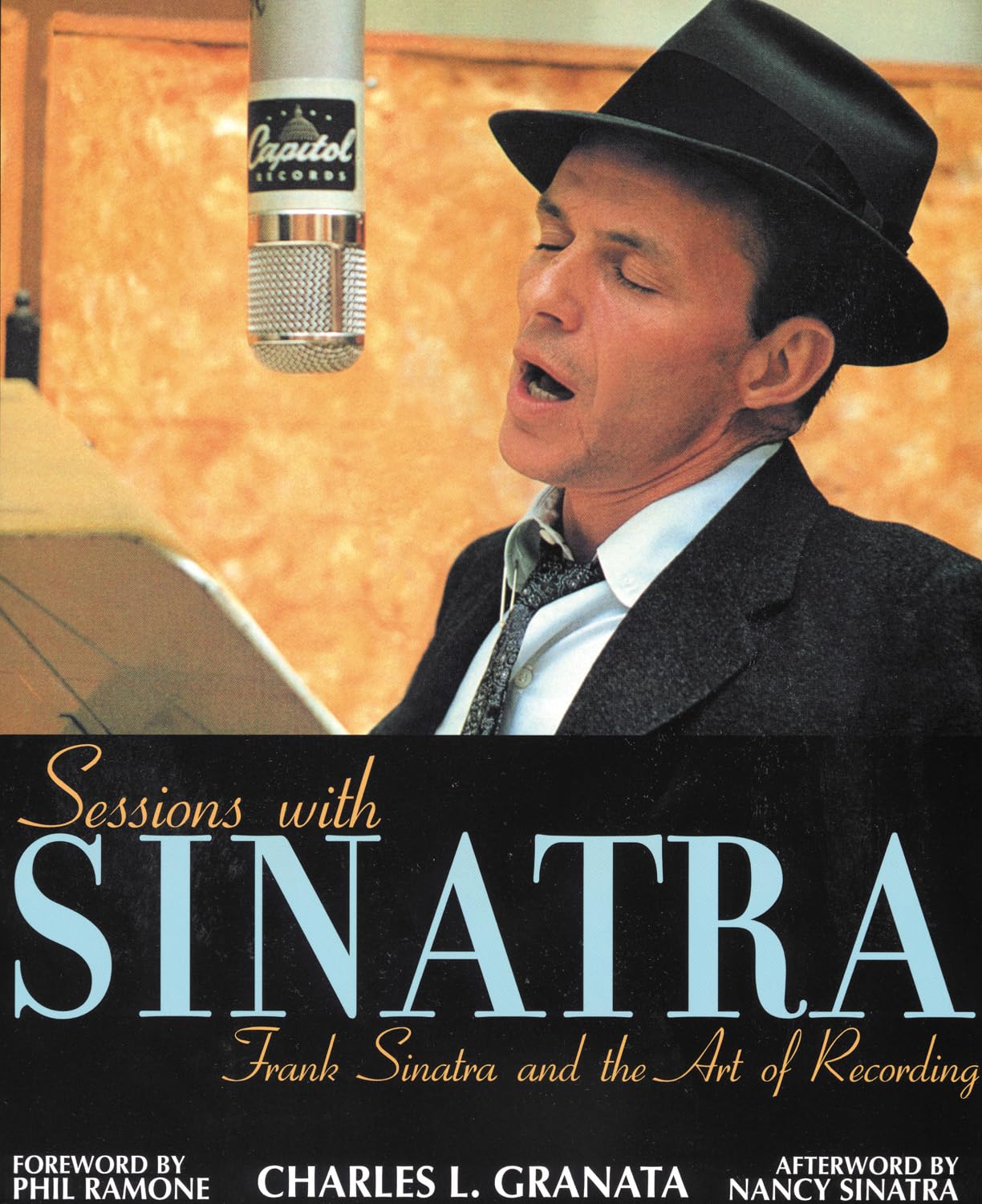
Sessions with Sinatra: Frank Sinatra and the Art of Recording
$21.99
by Charles L. L. Granata



Featuring 100 photographs of Frank Sinatra working with orchestras and arrangers, listening to playbacks, and, of course, singing, this book tells the whole story of how he created the Sinatra sound and translated the most intense personal emotions into richly worked-out songs of unrivalled expressiveness. One of the thrills of listening to Sinatra is wondering how he did it—and this book explains it all, bringing the dedicated fan and the casual music lover alike into the recording studio to witness the fascinating working methods he introduced and mastered in his quest for recorded perfection. Revealed is how, in addition to introducing and perfecting a unique vocal style, Sinatra was also his own in-studio producer—personally supervising every aspect of his recordings, from choosing the songs and arrangers to making minute adjustments in microphone placement. “If you can buy only one Sinatra book . . . this is the one to have.” — Kirkus Reviews “A genial and informative listening companion.” — Boston Globe “This magnificent book is a must-read.” — San Francisco Examiner Charles L. Granata is a leading expert on Sinatra, acts as the project director and producer for all of his Columbia recordings, and has completed hundreds of interviews with people who worked with Sinatra on his records. He is the author of Wouldn’t It Be Nice: Brian Wilson and the Making of the Beach Boys’ Pet Sounds. He lives in Livingston, New Jersey. Sessions with Sinatra Frank Sinatra and the Art of Recording By Charles L. Granata Chicago Review Press Incorporated Copyright © 2004 Charles L. Granata All rights reserved. ISBN: 978-1-55652-509-4 Contents Foreword by Phil Ramone, Introduction, PART I THE BIG BAND YEARS, 1937-1942, PART II THE COLUMBIA YEARS, 1943-1952, PART III THE CAPITOL YEARS, 1953-1962, PART IV THE REPRISE YEARS, PART V CAPITOL REVISITED, Afterword by Nancy Sinatra, Appendix A Companion Recordings, Appendix B The Basic Collection, Appendix C Concept Albums, Appendix D Fifty Songs That Define the Essence of Sinatra, Acknowledgments, Bibliography, Index, CHAPTER 1 The Big Band Years, 1937-1942 Beginnings As he grew older, Frank Sinatra delighted in reminiscing about the big band era. Frequently, in the company of family and friends (especially those connected with "the business"), he would slip into the comfortable role of storyteller and talk about how much he idolized Bing Crosby and what a tough taskmaster Tommy Dorsey was. His unprompted conversation showed that those formative years created fond memories, and his recollections of the period were vivid and full of sentiment. There is little doubt that much of the insight that guided Frank Sinatra over the course of half a century as a musician was based on the practical knowledge he'd gained during his tenure as the featured band vocalist with both Harry James (1939), and Tommy Dorsey (1940-1942). It was during these years that he befriended many of the talented songwriters, arrangers, and musicians who would weave their way into the fabric of his musical existence, including arranger Axel Stordahl and lyricist Sammy Cahn. He took quickly to songwriters, and it was clear practically from the beginning that he possessed a discriminating taste for top-quality songs and a knack for selecting only those tunes that he instinctively knew fit his style. His perceptive use of the microphone was born of this era, as was his understanding that a good measure of his craft was his ability to act. When singing, he could manipulate and control his body language to suit the setting of the lyric, which could evoke a certain response from his listening audience. Much of the singer's musical wisdom stemmed from the day-in, day-out trials and tribulations of a rising band singer. As far back as the early 1940s, Sinatra was crediting Tommy Dorsey with providing the fundamentals that he would adapt to fit his vocal styling, carefully refining his approach to develop a distinct method of phrasing that would become unmistakably his own. A sharp observer, Frank Sinatra was among the first to realize that the vocalist was quickly supplanting the orchestra as the main attraction in pop music and that he could easily apply his talents to capitalize on the trend. While his arrival signaled the beginning of the end of the big bands, Sinatra was responsible for rescuing the finest components of the swing style, creating a sensational new sound: one that depended on the vocalist to function as the heart of the performance. While most biographical accounts cite Sinatra's time with Harry James and Tommy Dorsey as being his first real "band" experience, his big band days had really begun much earlier than his first Brunswick recording session, held in New York City on July 13, 1939. While the Brunswick date would be his inaugural commercial recording session, it was not his initial foray into a recording studio. After a stint wit