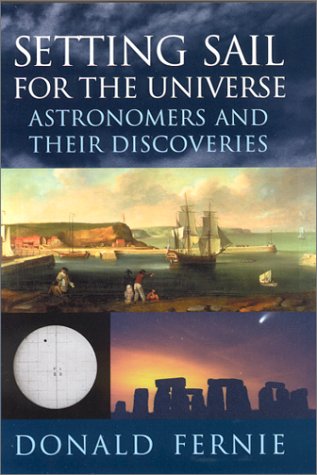



This collection brings together for the first time twenty-eight of noted astronomer Donald Fernie’s best “Marginalia” columns from American Scientist magazine. Published between 1985 and the present (and updated as necessary), the articles focus on the history of astronomy, bringing life to many of the people who have sought to explain what we observe above us in the night sky. Written in an engaging style, these tales of discovery will be of interest to the general reader as well as those with a science background. Fernie recounts the remarkable tales of human adventures, struggle, and follies behind some well-known and lesser-known scientific conquests of the past few centuries, such as the contentious discovery of Neptune and the misguided search for Vulcan, a proposed planet between the Sun and Mercury. Several of the articles focus on the characters themselves, such as Edmond Halley of Halley’s comet fame, or the obscure Jeremiah Horrocks, who made the first realistic determination of the distance from the sun to the earth, as well as a pre-Newtonian suggestion of the existence of an attractive force now known as gravity. This is a collection of two dozen essays about astronomy written by college professor Fernie and originally published in American Scientist , a publication of the scientific society Sigma Xi. Subjects vary from Stonehenge to Sirius, but most delve into discoveries about the solar system: six recount expeditions to observe rare transits of Venus across the solar disk. A transit is a means to figure out the distance between the earth and the sun, but it requires observations from points widely spaced apart. This method, Fernie relates, is the lasting contribution to astronomy by one precocious Jeremiah Horrocks before he died at age 22. Frustratingly, astronomers had to wait for a century and a quarter, until 1761, to act on Horrocks' idea. Waiting for planetary alignments, an occupational hazard for astronomers, seems to be a motif across Fernie's topics, and their unwillingness to put in the necessary waiting time cost the British bragging rights to the discovery of Neptune. The great variety in topics makes this an appealing diversion for astronomy buffs. Gilbert Taylor Copyright © American Library Association. All rights reserved This collection brings together twenty-eight of noted astronomer Donald Fernie's best "Marginalia" columns from American Scientist magazine. Published between 1985 and the present (and updated as necessary), the articles focus on the history of astronomy, bringing to life many of the finest minds who have sought to explain what we observe in the night sky. Written in an engaging style, these tales of discovery will be of interest to the general reader as well as those with a science background. Fernie recounts the remarkable human adventures, struggles, and follies behind some well-known and lesser-known scientific conquests of past centuries, such as the contentious discovery of Neptune and the misguided search for Vulcan, a proposed planet between the Sun and Mercury. Several of the articles focus on the characters themselves, such as Edmond Halley of Halley's comet fame, or the obscure Jeremiah Horrocks, who made the first realistic determination of the distance between the sun and the earth, and preceded Newton in suggesting the existence of an attractive force now known as gravity. J. Donald Fernie is professor emeritus of astronomy at the University of Toronto. "I hope that somewhere along the line I get to see a comet that really turns me on. Things haven't gone well so far. True, when the comet of the century is announced every few years I dash out to the backyard and stare through my binoculars like everyone else, but even when I actually succeed in finding the damn thing I'm never really overcome by much more than ennui. . . Anyway, I see we're off again after the latest comet of the century. It involves nothing less than 'what may well become the largest campaign in the history of modern astronomy.' Moreover, 'the event could have been the most spectacular astronomical event ever to be witnessed in the heavens during recorded history.' (Comet people talk like that.)"- from Setting Sail for the Universe Used Book in Good Condition