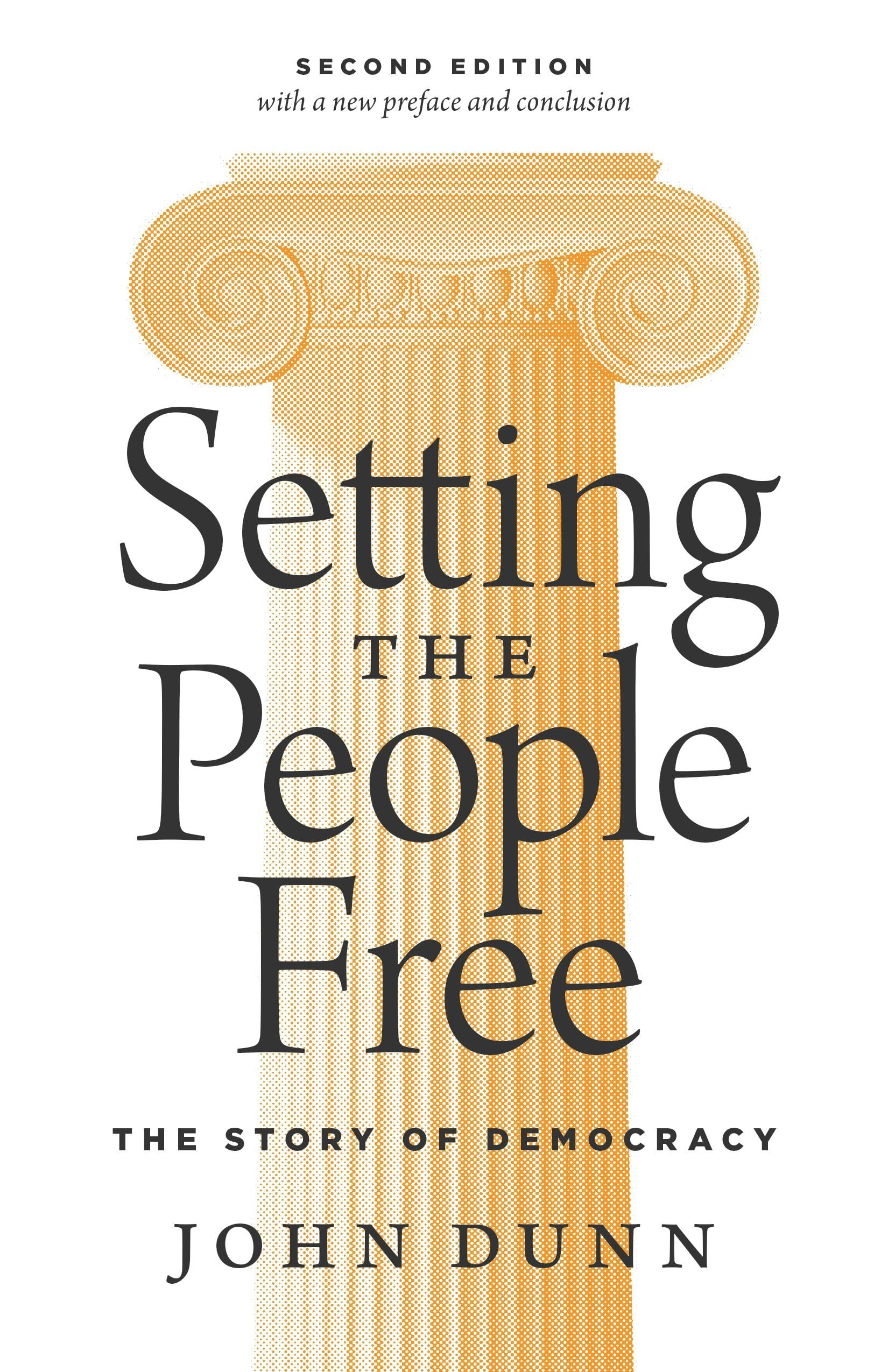



Why does democracy―as a word and as an idea―loom so large in the political imagination, though it has so often been misused and misunderstood? Setting the People Free starts by tracing the roots of democracy from an improvised remedy for a local Greek difficulty 2,500 years ago, through its near extinction, to its rebirth amid the struggles of the French Revolution. Celebrated political theorist John Dunn then charts the slow but insistent metamorphosis of democracy over the next 150 years and its apparently overwhelming triumph since 1945. He examines the differences and the extraordinary continuities that modern democratic states share with their Greek antecedents and explains why democracy evokes intellectual and moral scorn for some, and vital allegiance from others. Now with a new preface and conclusion that ground this landmark work firmly in the present, Setting the People Free is a unique and brilliant account of an extraordinary idea. "A marvellously rich book." --David Marquand, New Statesman "Dunn wears his erudition lightly and writes clearly and freshly about some of politics' most venerable questions.... Blows a gust of fresh air through the cobwebbed byways of political thought." --John Gray, Independent "John Dunn has given us a rare thing: an intellectually aristocratic book written for a profoundly democratic age." --Sunil Khilnani, Financial Times "John Dunn's book is much more than a history of democratic ideas.... [It is] among the most original and thought-provoking books on politics to have been published in England for many years, written in a spare, incisive English style which at its best is worthy of Hobbes." --Jonathan Sumption, Spectator "Stimulating and deft.... An impressive and interesting book." --Andrew Roberts, Daily Telegraph “John Dunn’s book is much more than a history of democratic ideas…. [It is] among the most original and thought-provoking books on politics to have been published in England for many years, written in a spare, incisive English style which at its best is worthy of Hobbes.” ―Jonathan Sumption, Spectator “A marvellously rich book.” ―David Marquand, New Statesman “Stimulating and deft…. An impressive and interesting book.” ―Andrew Roberts, Daily Telegraph “John Dunn has given us a rare thing: an intellectually aristocratic book written for a profoundly democratic age.” ―Sunil Khilnani, Financial Times “Dunn wears his erudition lightly and writes clearly and freshly about some of politics’ most venerable questions…. Blows a gust of fresh air through the cobwebbed byways of political thought.” ―John Gray, Independent John Dunn is professor emeritus of political theory at King’s College, University of Cambridge. Setting the People Free The Story of Democracy By John Dunn PRINCETON UNIVERSITY PRESS Copyright © 2019 John Dunn All rights reserved. ISBN: 978-0-691-18003-8 Contents Preface and Acknowledgements to the Second Edition, xi, Acknowledgements for the Original Edition, xv, Preface: Why Democracy?, xvii, 1 Democracy's First Coming, 1, 2 Democracy's Second Coming, 48, 3 The Long Shadow of Thermidor, 95, 4 Why Democracy?, 123, Conclusion, 163, Notes, 185, Index, 221, CHAPTER 1 Democracy's First Coming OUT OF THE DARK and from very long ago has come a word. Like every word which carries authority for human beings, it began its life somewhere in particular. Today that word reaches out almost everywhere on earth where humans gather together in any numbers. Wherever it goes, it presses a claim for authority and a demand for respect. Everywhere, still, these claims remain sharply contested. In some settings they are brushed effortlessly aside, and all but cowed into silence. In others they are affirmed sonorously enough, but heard by most listeners with a hollow groan. Virtually nowhere any longer, even in the most brutal of autocracies, are they merely unintelligible as claims; and in remarkably few sites by now are they simply and permanently inaudible: excluded or erased from public speech by the sheer ferocity of repression. (Note, for example, what was first to respond even for Iraq in the summer of 2003 when the United Nations Security Council demanded its submission, before America launched its invasion. It was not the tyrant who had ruled the country with such murderous brutality and for so long, and whose image dominated every Iraqi public space, but what passed for a national representative assembly: a Parliament. It was they, not their real master, who showily declined to submit. Within the week, their real master, less showily, had decided quite differently. Or so, at least for a time, it seemed.) As it travels through time and space, the word democracy never travels all on its own. Increasingly, as the last two centuries have gone by, it has travelled in fine company, alongside freedom, human rights, and perhaps now even, at least in pretension, material prosperity as well. B