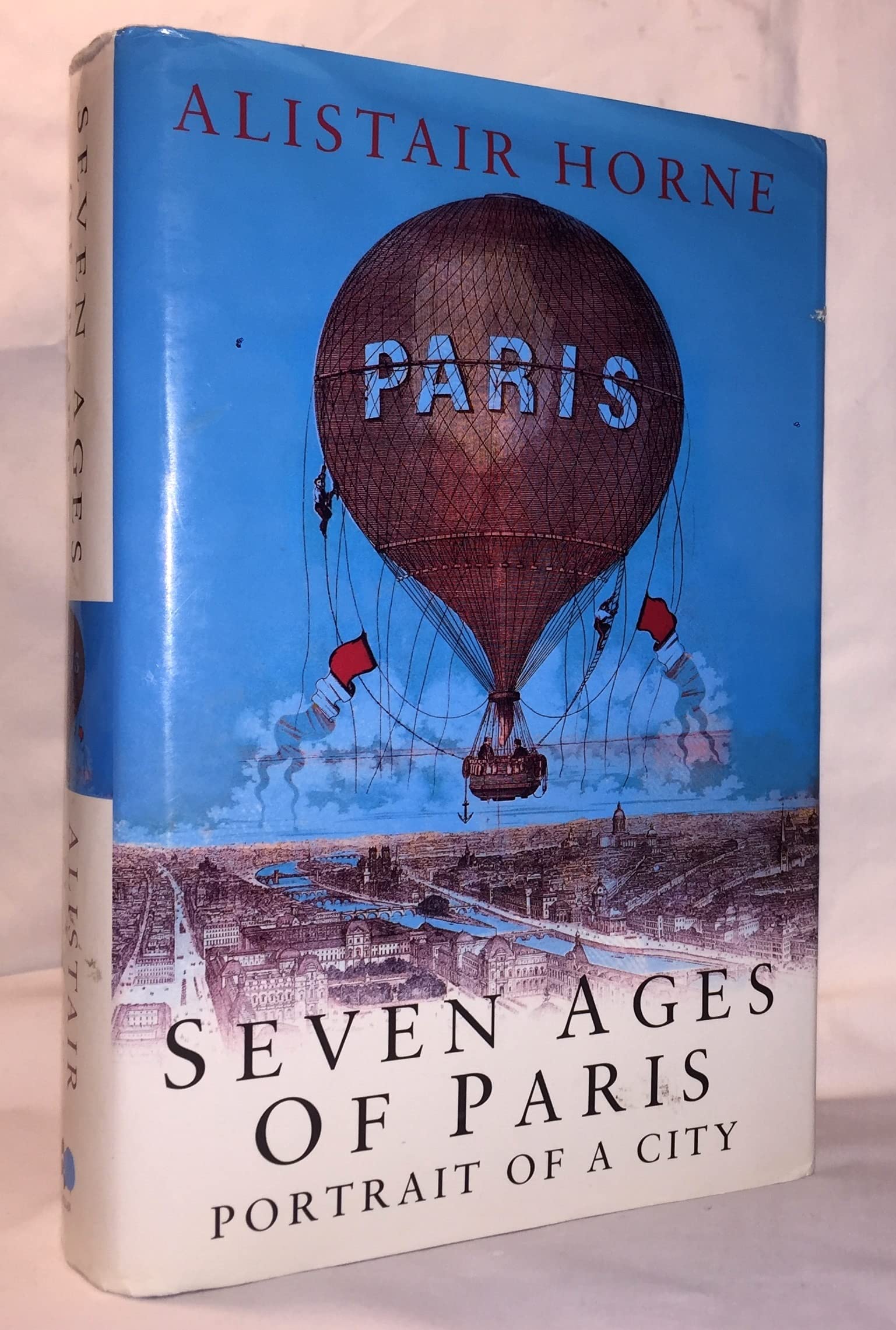



When Paris was a small island in the middle of the Seine, its gentle climate, natural vineyards and overhanging fig trees made it the favorite retreat of Roman emperors and de facto capital of western Europe. Over two millennia the muddy Lutetia, as the Romans called Paris, pushed its borders far beyond the Right and Left Banks and continued to stretch into the imagination and affection of visitors and locals. Now the spirit of Paris is captured by the celebrated historian Alistair Horne, who has devoted twenty-five years to a labor of love. Seven Ages of Paris begins with the reign of the forceful Philippe Auguste, who greatly expanded the Capetian kingdom before devoting himself to fortifying the city and to the construction of the Louvre. Paris shed blood in the Hundred Years War and in the religious wars between Catholics and Huguenots and prospered under Henri IV’s reconciliation. His grandson, Louis XIV, built the famed palace at Versailles and patronized the playwrights Molière and Racine. With the ancien régime swept away by the Revolution, Napoleon ushered in the Imperial age, and, subsequently, the Second Empire. Partly to dampen Paris’s revolutionary zeal, Baron Haussmann modernized the city: avenues were widened, squares expanded and the medieval market at Les Halles razed. Horne portrays the Prussians bivouacking on the Champs-Elysées in 1871. Paris bounced back after the war: the 1900 World Exposition showed off an electrified Champs-Elysées and the Métro station entrances in the Art Nouveau style. Most visibly, the Eiffel Tower went up in 1889 to mark the hundredth anniversary of the Revolution. The hubris of the Belle Epoque led straight into the Great War. The Armistice and the Paris Peace Conference sealed a phoney peace, and when war resumed the city suffered four terrible years of occupation and was visited by Hitler himself. Liberation brought the last of Horne’s seven ages, the Fifth Republic, headed by de Gaulle. Seven Ages of Paris also recalls the women who defined Parisian life—from Héloïse down to Josephine Baker. With an elegiac description of the Père Lachaise Cemetery, Horne brings to an end a brilliantly written history of the world’s most captivating city. This highly readable narrative by celebrated journalist and historian Horne (The Fall of Paris; A Savage War of Peace: Algeria, 1954-1962) uses an admittedly idiosyncratic organizational scheme to trace the history of Paris through seven periods, beginning in the 12th century and ending with the death of Charles de Gaulle in 1969. His "ages" focus on medieval and Renaissance Paris; the era of King Henry IV; the 18th century and Louis XIV; revolutionary and Napoleonic Paris; the 19th century, culminating in the Bloody Week of the Commune; the Belle poque; and the age of war and occupation. While politics informs and guides his presentation, this is by no means a political history. Each section includes fascinating insights into the social and cultural life of the age, fashions in clothing, architectural developments, leading personalities, and lifestyles of rich and poor alike. With the verve of a master storyteller, Horne captures Parisians' "zest for living." While often depicting Paris itself as a beautiful woman, he does not neglect the famous female personalities of each era. This readable survey complements yet stands in sharp contrast to Patrice Higonnet's recent Paris: Capital of the World, which takes a more academic focus and eschews a chronological approach. Highly recommended for large public libraries. Marie Marmo Mullaney, Caldwell Coll., NJ Copyright 2002 Reed Business Information, Inc. Horne, a prolific and popular British historian, is the author of a trilogy on French history: The Price of Glory (1962), The Fall of Paris (1965), and To Lose a Battle (1969). His years of research have resulted in a particular love of Paris, which now results in a book synthesizing all he has learned about the French capital. He divides the history of Paris into, as the book's title indicates, seven great epochs, each one representing an important transition in the city's evolution. The first of the seven eras is the age of King Phillipe Auguste ("the first ruler to make [Paris] his administrative capital") and the last is the stewardship of Charles de Gaulle ("bringing a certain order and opening the path to a grand renouvellement of France"). We also visit the Paris of Louis XIV (who abandoned it for his chateau at Versailles) and the pre-World War I Belle Epoque ("it felt like a period that would last forever"). A rich, vigorously fresh study for history lovers. Brad Hooper Copyright © American Library Association. All rights reserved “Knowledgeable and colorful, written with gusto and love. . . . [An] ambitious and skillful narrative that covers the history of Paris with considerable brio and fervor”— The Los Angeles Times Book Review “Consistently bewitching. . . . [Horne] renders France unusuall