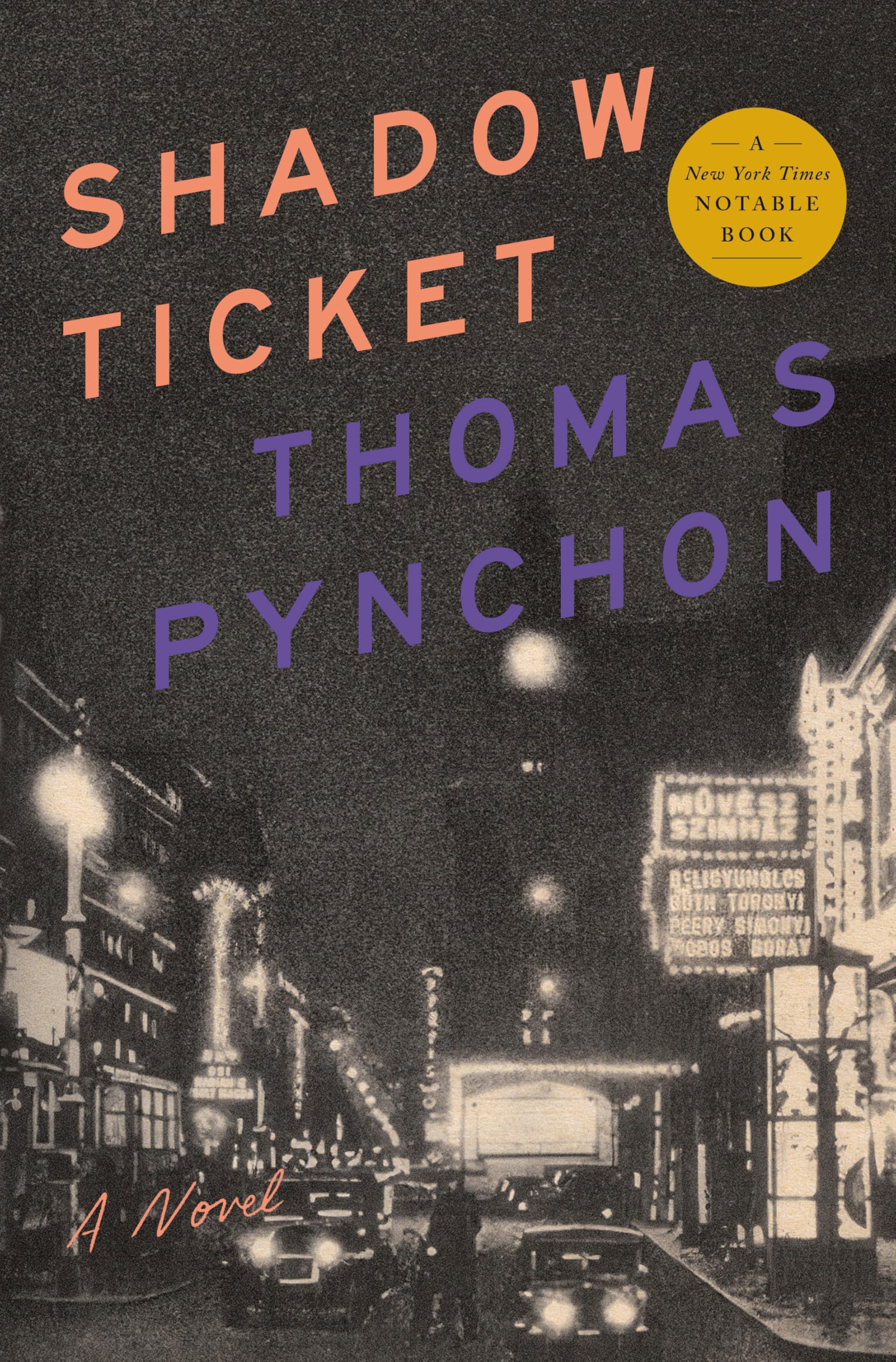



A New York Times Bestseller • A New York Times , Washington Post , and Associated Press Notable Book • Named a Best Book of the Year by The Los Angeles Times , Vulture , TIME , The Guardian , The New Republic, and LitHub The new novel from Thomas Pynchon, author of Gravity's Rainbow , The Crying of Lot 49 , Vineland , and Inherent Vice . “A masterpiece.” — The Telegraph “Bonkers and brilliant fun.” — The Washington Post “Late Pynchon at his finest. Dark as a vampire’s pocket, light-fingered as a jewel thief, Shadow Ticket capers across the page with breezy, baggy-pants assurance — and then pauses on its way down the fire escape just long enough to crack your heart open.” — The Los Angeles Times Milwaukee 1932, the Great Depression going full blast, repeal of Prohibition just around the corner, Al Capone in the federal pen, the private investigation business shifting from labor-management relations to the more domestic kind. Hicks McTaggart, a onetime strikebreaker turned private eye, thinks he’s found job security until he gets sent out on what should be a routine case, locating and bringing back the heiress of a Wisconsin cheese fortune who’s taken a mind to go wandering. Before he knows it, he’s been shanghaied onto a transoceanic liner, ending up eventually in Hungary where there’s no shoreline, a language from some other planet, and enough pastry to see any cop well into retirement—and of course no sign of the runaway heiress he’s supposed to be chasing. By the time Hicks catches up with her he will find himself also entangled with Nazis, Soviet agents, British counterspies, swing musicians, practitioners of the paranormal, outlaw motorcyclists, and the troubles that come with each of them, none of which Hicks is qualified, forget about being paid, to deal with. Surrounded by history he has no grasp on and can’t see his way around in or out of, the only bright side for Hicks is it’s the dawn of the Big Band Era and as it happens he’s a pretty good dancer. Whether this will be enough to allow him somehow to Lindy-hop his way back again to Milwaukee and the normal world, which may no longer exist, is another question. “Pynchon’s first novel in a dozen years grabs you by the collar the way a mob enforcer might to refresh your memory. Remember his genre parodies, his outrageous names, his ornate zingers, his lollygagging but frequently hilarious descriptions? It’s all here in this supercharged noir — a Chandleresque, Depression-era yarn involving a missing heiress and a disaster-prone private eye.” — The New York Times “Bonkers and brilliant fun . . . rollicking, genially silly and ultimately sweet . . . Of all living novelists, Pynchon may have the most distinct voice — a clipped tough guy patois delivered with the rhythms of borscht belt comedy, amplified by an endless appetite for linguistic play — that has proved largely inimitable. It’s not just that no one else writes quite like Pynchon; it’s that no one even tries. The endless accumulation of incident pulls you along, but sometimes you have to stop to marvel at any given sentence, much as you might at a 170-foot-tall bottle of ketchup that suddenly looms above you during a road trip.” — The Washington Post “Late Pynchon at his finest. Dark as a vampire’s pocket, light-fingered as a jewel thief, Shadow Ticket capers across the page with breezy, baggy-pants assurance — and then pauses on its way down the fire escape just long enough to crack your heart open. Only now can we finally see that Pynchon has been quietly assembling — one novel at a time, in no particular order — an almost decade-by-decade chronicle no less ambitious than Balzac’s La Comédie Humaine , August Wilson’s Century Cycle or the 55 years of Garry Trudeau’s Doonesbury . This is his Pynchoniad, a zigzagging epic of America and the world through our bloodiest, most shameful hundred years. Perhaps suffering from what Pynchon called in V. our ‘great temporal homesickness for the decade we were born in,’ he has now filled in the only remaining blank spot on his 20th century map: the 1930s.” — L os Angeles Times “A masterpiece . . . Between the novel’s sheer weirdness, its obscurity, its evocative 1930s setting and its joyously Raymond Chandler-esque dialogue – pinging back and forth between hard-boiled men and harp-tongued broads, I enjoyed Shadow Ticket more than any other Pynchon . . . The fact that Shadow Ticket is brilliant and prescient isn’t a surprise; that it exudes so much joy and sensuousness is. To have had the career Pynchon had, and still be so invigorated by your work, is all any novelist can ask. I hope this isn’t his last hurrah – but if it is, what a way to go out.” — The Telegraph (5/5 stars) “A literary triumph . . . A gloriously language-driven detective novel that waits for no one.” — The Boston Globe " Shadow Ticket is simultaneously caper, quest, farce, and political commentary rolled into a linguistically ex