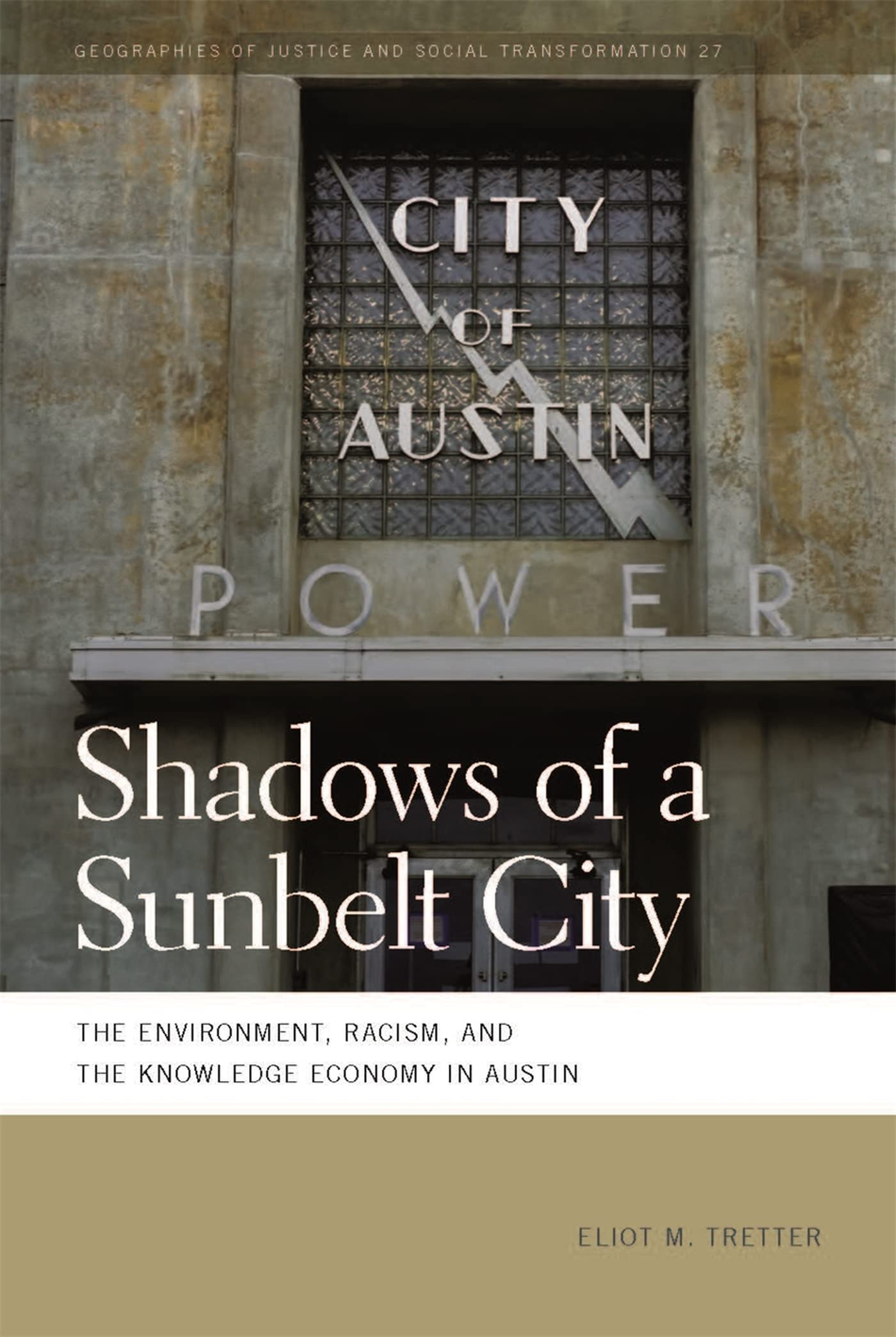
Shadows of a Sunbelt City: The Environment, Racism, and the Knowledge Economy in Austin (Geographies of Justice and Social Transformation)
$26.95
by Eliot M. Tretter



Austin, Texas is generally depicted as one of the great urban success stories of the past half century--a place that has grown enormously through 'creative class' strategies that emphasize diversity and environmental consciousness. Eliot Tretter's book reinterprets this familiar story by exploring the racial and environmental underpinnings of the postindustrial knowledge economy. He is particularly attentive to the role of the University of Texas (often working with federal, municipal, and private-sector partners), and the book will join a growing critical literature about how universities shape urban environments -- Provided by publisher. The book's subtitle hints at the sundry issues that Tretter engages by narrating the entwined stories of the university and the city, touching upon issues of environmentalism, urban renewal, federal science policy, and the dynamics of tech investment. These varied themes make for a difficult juggling act, but Tretter handles them with admirable skill. Alex Sayf Cummings author of Democracy of Sound: Music Piracy and the Remaking of American Copyright in the Twentieth Century. What distinguishes this [book] from most other urban growth narratives is a clear focus on the very critical contribution of Austin's particular growth coalition. Joseph S. Wood author of The New England Village . What Tretter's book does differently and so well is to focus on what he calls "Austin's shadows" -- the price black and brown communities have paid for this growth and innovation, the effect this growth has had on the environment, and the role the State of Texas and the University of Texas have played in "creating the industrial landscape in Austin" that we see in 2016. Dwonna Goldstone author of Integrating the 40 Acres: The Fifty-year Struggle for Racial Equality at the University of Texas . [Shadows] will be of interest to students of urban history, city planners, and all those seeking to relocate to one of the fastest growing cities in the country. Mary L. Scheer author of Women and the Texas Revolution. As a disciplinary manner, some historiansmay find Shadows of a Sunbelt City: The Environment, Racism, and the KnowledgeEconomy in Austin less a history of UT's and Austin's intertwined developmentthan a set of essays that use history to (again, effectively) debunkinfluential development pieties. Michan Connor, Journal of Southern History Shadows of a Sunbelt City offers an important new interpretation of Austin’s twentieth-century urban history and more recent political-economic transformation into a putatively high-tech 'smart city of knowledge.' A stimulating intervention into one of this country’s fastest growing cities, Eliot Tretter's study questions and significantly advances our current understanding of an impressive range of literatures. The book illuminates the unusual circumstances that shaped the political economy of the University of Texas and its relationship with both the city and the state. Tretter recovers an important and largely untold story in showing that Austin’s development has not been a giant love fest or an unalloyed good… Ultimately, Shadows of a Sunbelt City provides a welcome corrective to anodyne cheerleading about the ?creative class? and the wonders of high-tech development. As a disciplinary manner, some historians may find Shadows of a Sunbelt City: The Environment, Racism, and the Knowledge Economy in Austin less a history of UT’s and Austin’s intertwined development than a set of essays that use history to (again, effectively) debunk influential development pieties. Shadows of a Sunbelt City offers a compelling analysis of the power that universities wield in regional development and their complicity in reshaping the urban form to benefit powerful actors, often at the expense of vulnerable residents. As he examines how policy and social relations transform cities, Tretter challenges the narrative that sustainable urban policy, and the knowledge economy that undergirds it, is universally beneficial. A counternarrative to a popular perception of Austin as a progressive city A counternarrative to a popular perception of Austin as a progressive city Eliot M. Tretter is an assistant professor of geography at the University of Calgary. He is also the author of Austin Restricted: Progressivism, Zoning, Private Racial Covenants, and the Making of a Segregated City