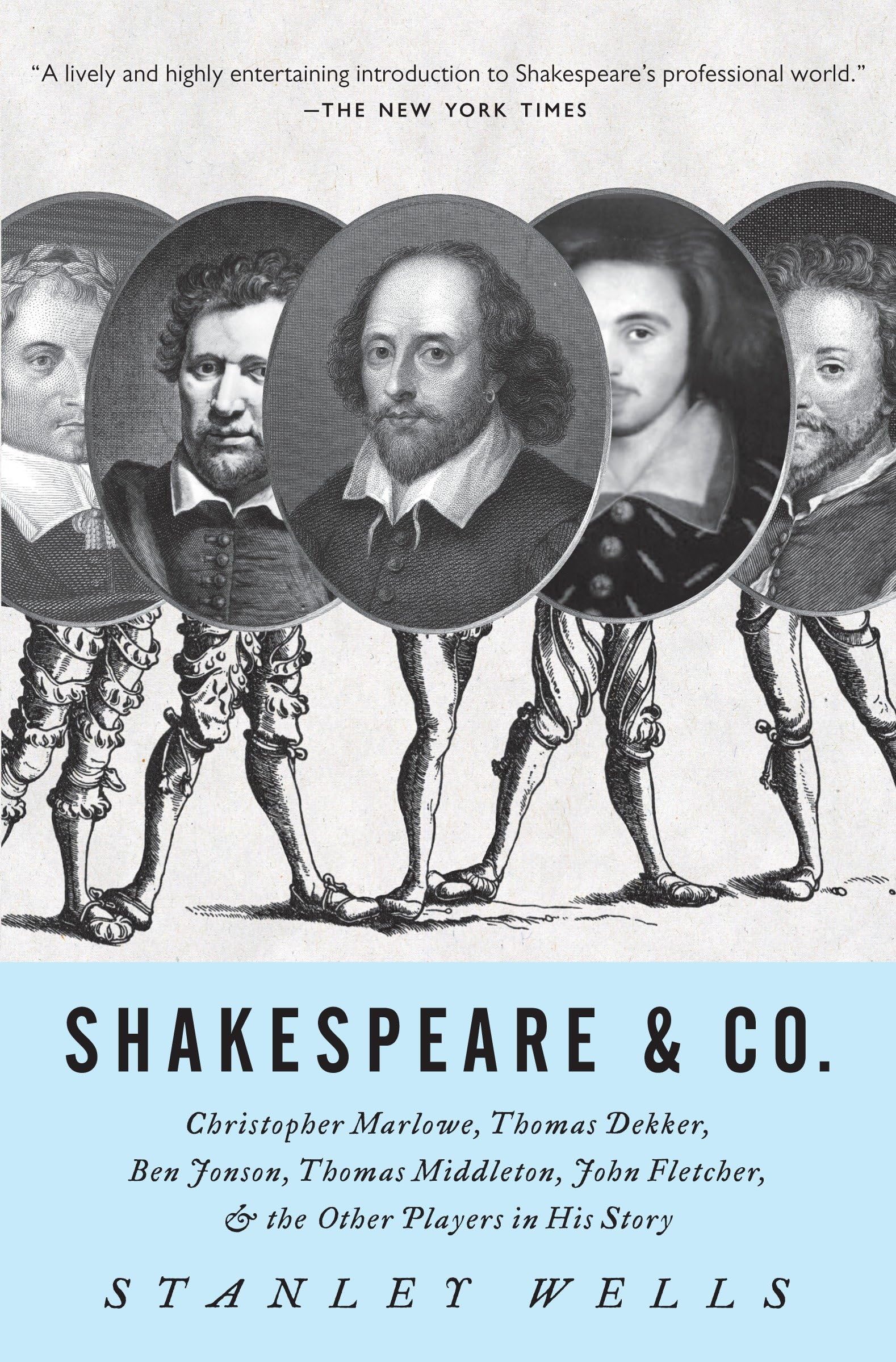
Shakespeare & Co.: Christopher Marlowe, Thomas Dekker, Ben Jonson, Thomas Middleton, John Fletcher and the Other Players in His Story
$11.88
by Stanley Wells



From the dean of Shakespeare studies comes a lively, entertaining work of biography that firmly locates Shakespeare within the hectic, exilarating world in which he lived and worked.Theatre in Shakespeare's day was a growth industry. Everyone knew everyone else, and they all sought to learn, borrow, or steal from one another. Stanley Wells explores the theatre world from behind the scenes, examining how the great actors of the time influenced Shakespeare's work. He writes about the lives and works of the other major writers of the day and discusses Shakespeare's relationships-sometimes collaborative—with each of them. Throughout, Wells shares his vast knowledge of the period, re-creating and celebrating the sheer richness and variety of the social and cultural milieus that gave rise to the greatest writer in our language. "A lively and highly entertaining introduction to Shakespeare's professional world." — The New York Times “[Wells] sets out with elegance and ease to chronicle Shakespeare's relationships with his fellow workers, that remarkable collection of actors and playwrights without whom there would not have been a golden age of English drama-or, Wells vigorously argues, Shakespeare as we know him.” — The Atlantic Monthly “Entertaining. . . . Highly readable. . . . Pulling Shakespeare back down among the mortals-especially entertaining ones such as Marlowe and Jonson-is a worthy undertaking.” — Richmond Times Dispatch Stanley Wells is the author of Shakespeare: For All Time , chairman of the Shakespeare Birthplace Trust, Emeritus Professor of Shakespeare Studies at the University of Birmingham, general editor of the Penguin and Oxford editions of Shakespeare's works and co-editor of The Oxford Companion to Shakespeare . He lieves in England. 1The Theatrical SceneEarly one morning in 1600 or 1601, boys ran around London sticking up bills announcing that if you went to the Globe playhouse on the south bank of the River Thames that afternoon you could see a new play called Hamlet . They pasted the bills on the doors of taverns and houses, and on pissing-posts provided for the convenience of those who walked the streets. The lads pulled down out-of-date bills announcing earlier performances and chucked them away. Hastily printed, these pieces of paper were of the moment. They brought profit to printers such as William Jaggard, later to be one of the publishers of the collected edition of Shakespeare's plays known as the First Folio, which appeared in 1623. From 1602 Jaggard held a monopoly on the production of playbills. Not a single one survives, but at least we have a transcript of one that was displayed by traveling players in Norwich in 1624; it read: 'Here within this place at one of the clock shall be acted an excellent new comedy called The Spanish Contract by the Princess' servants; vivat rex .'The new bills named the play to be performed, with a few words of description and commendation such as 'the right excellent conceited tragedy of Hamlet, Prince of Denmark '. They told you that it was to be acted by the Lord Chamberlain's company at the Globe. They did not necessarily say who wrote it: the company's reputation was high, whatever it played. It frequently performed before the Queen and her courtiers, as publishers were proud of boasting on the title pages of the relatively small number of plays that got into print.By the time Shakespeare wrote Hamlet his name, as well as that of the company for which he exclusively wrote, was becoming an attraction both to readers and to theatregoers. Born in 1564, and therefore 37 years old in 1601, he was best known to readers as the author of two popular narrative poems, the immensely successful, rather saucy Venus and Adonis (1593) and its tragic successor, The Rape of Lucrece (1594). He had already written or co-written more than twenty plays. Indeed by this date he had completed both his cycles of English history plays, most of his romantic comedies, and his tragedies from Titus Andronicus through Romeo and Juliet to Julius Caesar . A founding member as both actor and shareholder of the Lord Chamberlain's Men, established in 1594, he was now a prosperous and admired member of his profession. Though he lived in modest lodgings when he was in London, he owned a fine house and garden in his home town of Stratford-upon-Avon, where his wife and his two daughters, Susanna and Judith, remained - his only son, Hamnet, had died in 1597. There he was a prominent householder and landowner: in 1602, not long after writing Hamlet , he paid £320 for land in Old Stratford, as well as buying a cottage close to his home, presumably for one of his servants. And only three years later he made an even bigger investment of £440 in a lease of the Stratford tithes. These were large sums. Theatre was a profitable business. And it brought fame as well as money. Several of his plays had appeared in print, at first anonymously, as was common enough, but incre