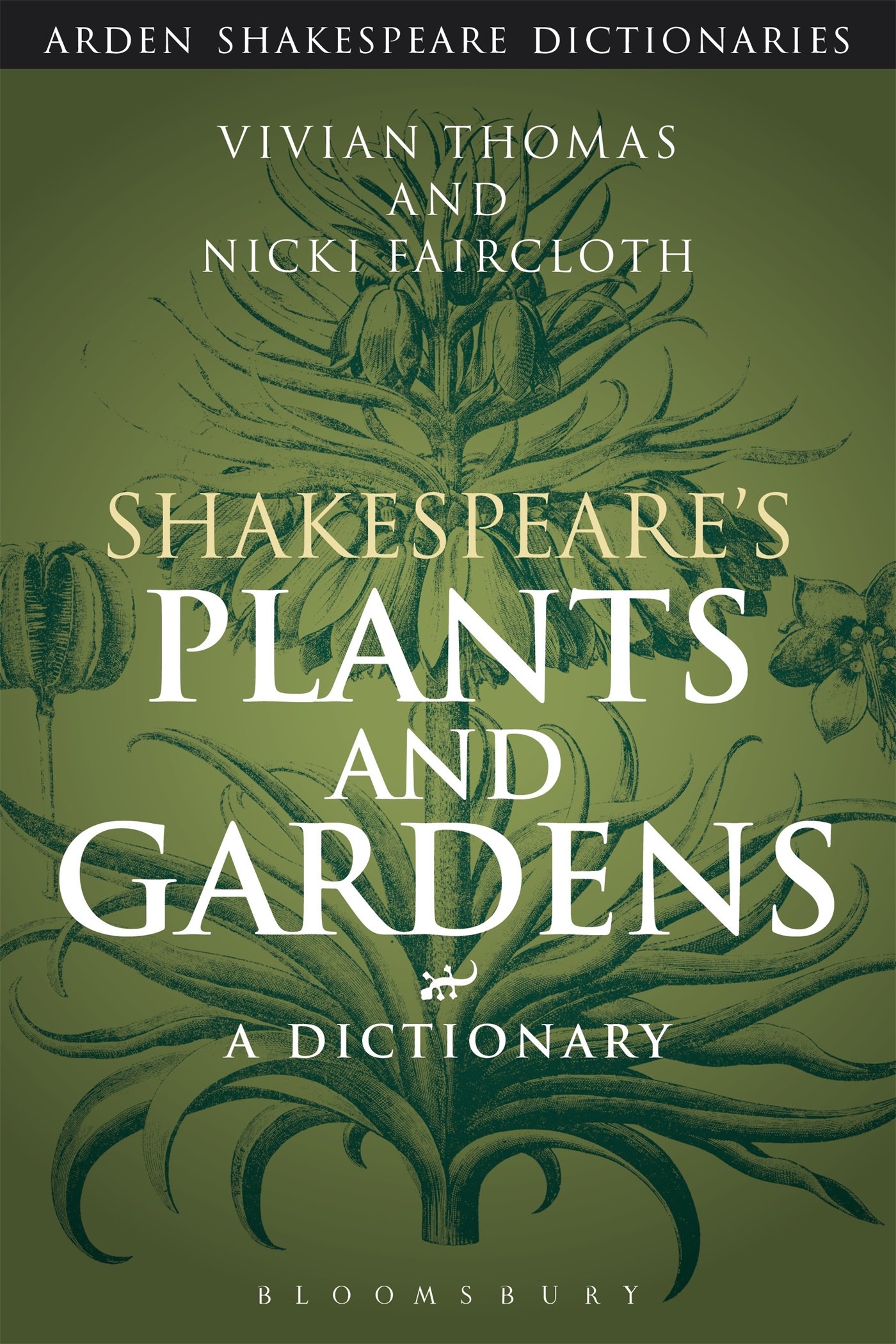
Shakespeare's Plants and Gardens: A Dictionary (Arden Shakespeare Dictionaries)
$52.95
by Vivian Thomas



Shakespeare lived when knowledge of plants and their uses was a given, but also at a time of unique interest in plants and gardens. His lifetime saw the beginning of scientific interest in plants, the first large-scale plant introductions from outside the country since Roman times, and the beginning of gardening as a leisure activity. Shakespeare's works show that he engaged with this new world to illuminate so many facets of his plays and poems. This dictionary offers a complete companion to Shakespeare's references to landscape, plants and gardens, including both formal and rural settings. It covers plants and flowers, gardening terms, and the activities that Shakespeare included within both cultivated and uncultivated landscapes as well as encompassing garden imagery in relation to politics, the state and personal lives. Each alphabetical entry offers a definition and overview of the term discussed in its historical context, followed by a guided tour of its use in Shakespeare's works and finally an extensive bibliography, including primary and secondary sources, books and articles. “This latest work in the Arden Shakespeare Dictionaries series offers a fascinating and comprehensive resource for students and the interested general reader, in both Shakespearean studies and in garden history, seeking as it does to examine every plant and aspect of gardens in Shakespeare's work... An impressive work of scholarship and research, it largely succeeds in this challenging goal.” ― Around the Globe “Thomas and Faircloth's value-added concordance brings a contemporary academic treatment to William Shakespeare's use of plant and garden terminology. The terms in the roughly 350 entries appear in the forms in which Shakespeare used them and are alphabetically arranged. Most words are discussed in a minimum of a half-page, with those heavily used in the Bard's works-lily, garden, forest-explored over multiple pages. Entries place the word/item in its historical, social, and literary context; identify its placement within Shakespeare's writings; explicate his use of the word; and quote the associated line(s). The volume has an intriguing appendix in which each of the playwright's works is listed alphabetically by title, beneath which is a collective of all the plant and garden-based words used within it. VERDICT:Very useful for those libraries supporting Shakespearean scholars and those collecting the other titles in the series.” ― Library Journal “Scholars looking for the symbolic significance of unfamiliar plants will find much of use here, as demonstrated by the entry on the medlar, a now uncommon fruit with both sexual connotations and punning potential. The volume is almost as interesting for its wide-ranging introduction and survey of botanically related criticism as for the entries…It will be a good addition for comprehensive Shakespeare collections or libraries supporting intensive study of the early modern period. Summing Up: Recommended. Comprehensive early modern collections supporting graduate students and researchers/faculty.” ― Choice A comprehensive source for landscape, plant and garden references in Shakespeare. Dr. Vivian Thomas followed a career in economics with post-graduate study in Renaissance Drama at New College, Oxford, before becoming lecturer in English Literature at the University of Birmingham. He has been Visiting Lecturer at the New University of Lisbon, the universities of Cologne, Gdansk and Valenciennes, and Phillips Exeter Academy, New England. Now a free-lance lecturer he has lectured for the University of Warwick, The Shakespeare Birthplace Trust and Sovereign Education. A specialist in Shakespeare Studies, he is the Academic Patron of the Open University Shakespeare Society. Nicki Faircloth is a freelance lecturer and writer based in London. Sandra Clark is Professor Emeritus of Renaissance Literature, Birkbeck, University of London, and Senior Research Fellow at the Institute of English Studies, School of Advanced Study, University of London