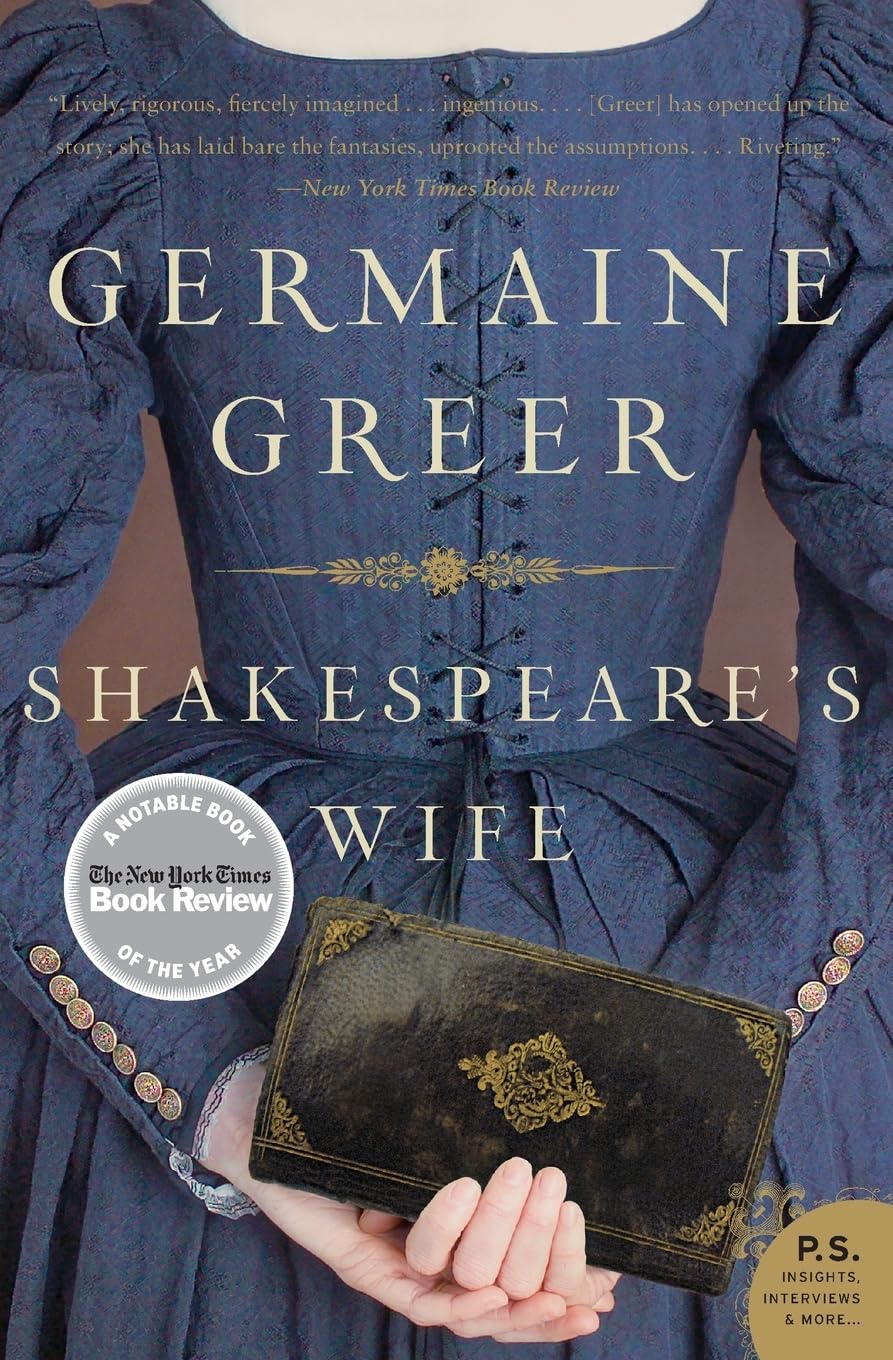
Shakespeare's Wife: A Groundbreaking Feminist Biography of Ann Hathaway―Reclaiming a Maligned Figure from Scholarly Neglect
$12.07
by Germaine Greer



Little is known about Ann Hathaway, the wife of England's greatest playwright; a great deal has been assumed, none of it complimentary. In Shakespeare's Wife , Germaine Greer boldly breaks new ground, reclaiming this much maligned figure from generations of scholarly neglect and misogyny. With deep insight and intelligence, she offers daring and thoughtful new theories about the farmer's daughter who married Britain's immortal Bard, painting a vivid portrait of a truly remarkable woman. “Intriguing . . . A portrait of life in Stratford circa 1600 on almost every level and in every aspect.” - Booklist “A richly textured account…Greer’s theory about Shakespeare’s relation with his wife is original and persuasive…She reminds us of facts other critics have ignored.” - Marilyn French, Publishers Weekly (Boxed Signature Review) “Lively, rigorous, fiercely imagined…an ingenious new book…” - Katie Roiphe, New York Times Book Review “A riveting read…Not only Greer’s scholarship but her sympathy and her imagination are fully engaged.” - Victoria Glendinning “Illuminating…Greer’s book opens up new perspectives in offering alternative hypotheses to many of the all-too-easy assumptions about Shakespeare’s wife and his relationship to her…This is an important book in the challenges that it poses to received opinion. It will have a permanent and beneficial effect on attempts to tell the story of Shakespeare’s life.” - Stanley Wells, New York Review of Books “Fascinating…Greer meticulously exposes the sexist biases underlying depictions of Ann…and re-creates in lavish detail the material realities of women’s lives in 16th century England.” - Entertainment Weekly “With a dazzling display of erudition and lively prose, SHAKESPEARE’S WIFE is a delight to read and a breath of fresh air for those interested in the Bard’s life... Even those who disagree with Greer’s interpretation should find SHAKESPEARE’S WIFE stimulating. Her radical exploration of Ann Hathaway is a compelling triumph.” - Roger Bishop, BookPage Little is known about Ann Hathaway, the wife of England's greatest playwright; a great deal has been assumed, none of it complimentary. In Shakespeare's Wife , Germaine Greer boldly breaks new ground, reclaiming this much maligned figure from generations of scholarly neglect and misogyny. With deep insight and intelligence, she offers daring and thoughtful new theories about the farmer's daughter who married Britain's immortal Bard, painting a vivid portrait of a truly remarkable woman. Germaine Greer is a writer, academic, and critic, and is widely regarded as one of the most significant feminist voices of our time. Her bestselling books include The Female Eunuch and The Whole Woman . She lives in northwest Essex, England, and has taught Shakespeare at universities in Australia, Britain, and the United States. Shakespeare's Wife By Germaine Greer HarperCollins Publishers, Inc. Copyright © 2009 Germaine Greer All right reserved. ISBN: 9780061537165 Chapter One Introducing the extensive and reputable family of Hathaway alias Gardner of Shottery together with the curious fact that one of their kinsmen was a successful playwright for the Admiral's Men Shakespeare's wife was identified as long ago as 1709, when Nicholas Rowe informed the readers of his edition of the plays: 'His wife was the daughter of one Hathaway, said to have been a substantial yeoman in the neighbourhood of Stratford." 1 There were many Hathaways within a day's ride of Stratford. Hathaways farmed in Bishopton and Shottery in Warwickshire, and in Horton, Bledington, Kingscote and surrounding districts in neighbouring Gloucestershire. There were also tradesmen called Hathaway in London, Banbury and Oxford, and one or two claimed the rank of gentleman. The Hathaway horde was so numerous in fact that the Shottery family into which Ann was born used a distinguishing alias. They were known mostly as Hathaway alias Gardner, and sometimes as just plain Hathaway or just plain Gardner. In the medieval period such aliases served to distinguish between people with the same surname by specifying the region or town they came from or the trade they followed. Perhaps an earlier Hathaway had indeed been a gardener. Sometimes, when there was no male heir, a female descendant's husband might inherit on condition that he assumed her family name as an alias. The point of aliases is still being disputed by genealogists; although during Ann Shakespeare's lifetime the use of aliases became less consistent, it was a generation or two before it faded out altogether. We know that Ann's grandfather John Hathaway was already using the alias, so it is not something we are likely ever to unravel. For years nobody realised that the 'Jone Gardner of Shottery' who was buried in Holy Trinity churchyard in 1599 was the same person they had already identified as Ann Shakespeare's stepmother. 2 In 1590 a 'Thomas Greene alias Shakespeare' was buried