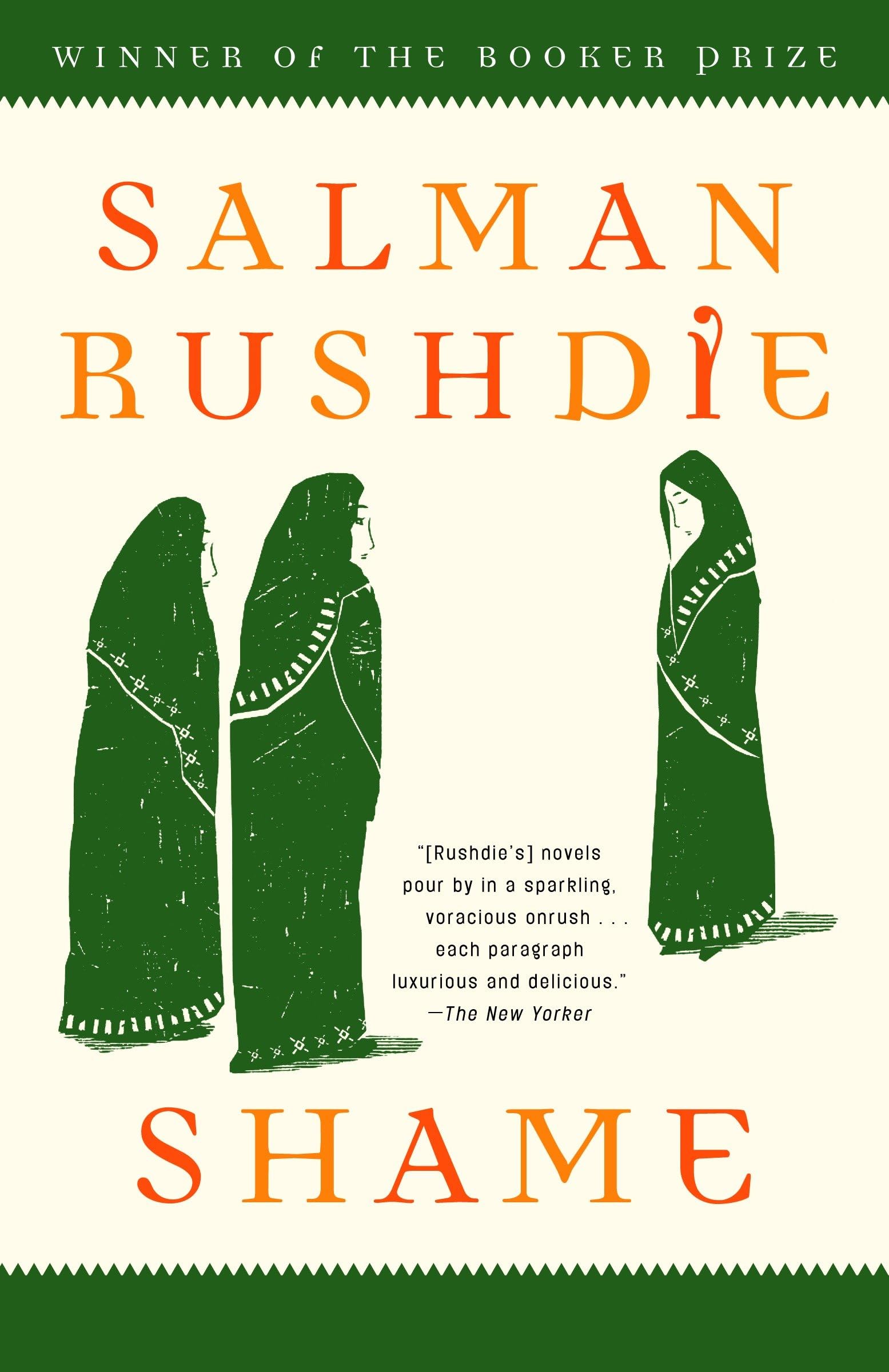



The novel that set the stage for his modern classic, The Satanic Verses , Shame is Salman Rushdie’s phantasmagoric epic of an unnamed country that is “not quite Pakistan.” In this dazzling tale of an ongoing duel between the families of two men–one a celebrated wager of war, the other a debauched lover of pleasure–Rushdie brilliantly portrays a world caught between honor and humiliation–“shamelessness, shame: the roots of violence.” Shame is an astonishing story that grows more timely by the day. “[Rushdie’s] novels pour by in a sparkling, voracious onrush . . . each paragraph luxurious and delicious.” — The New Yorker “A pitch-black comedy of public life and its historical imperatives.” — The Times (UK) “There can seldom have been so robust and baroque an incarnation of the political novel as Shame . It can be read as a fable, polemic, or excoriation; as history or as fiction. . . . This is the novel as myth and as satire.” —Sunday Telegraph “ Shame is and is not about Pakistan, that invented, imaginary country, ‘a failure of the dreaming mind.’ . . . Rushdie shows us with what fantasy our sort of history must now be written—if, that is, we are to penetrate it, and perhaps even save it.” — The Guardian “Mr. Rushdie’s style [is] a source of delight, a bright stream of words . . . a voice at once whimsical, sly and exclamatory, full of apostrophes and asides, flexible enough to incorporate the up-to-date slang and obscenities of the warring men and the peculiar speech rhythms . . . of the Pakistani ladies in a state of excitement.” — The New York Times Book Review “The extravagantly tragicomic nightmare evoked by Shame . . . does for Pakistan what Mr. Rushdie’s equally remarkable . . . Midnight’s Children did for India. The narrative voice of Shame creates its own irresistible logic. In a postscript to his story, the author acknowledges having quoted Milan Kundera, Franz Kafka, Nikolai Erdmann and Georg Büchner. Here and there in the text, one can’t help thinking of Gabriel García Márquez. These are extraordinary writers with whom to be associated, but it’s company that Salman Rushdie deserves.” — The New York Times “Revelation and obscurity, affairs of honor, blushings of all parts, the recession of erotic life, the open violence of public life, create the extraordinary Rushdie mood.” — The Guardian (London) “ Shame should consolidate [Rushdie’s] position as one of the finest young writers around. This novel of crossed family destinies in contemporary Pakistan teems with interesting characters, dramatic events, and marvelous verbal inventions. Like its predecessor, it recreates an exotic but thoroughly believable world that is a delight to experience. . . . A wonderful book.” — Quill & Quire Salman Rushdie is the author of fourteen previous novels, including Midnight’s Children (for which he won the Booker Prize and the Best of the Booker), Shame, The Satanic Verses, The Moor’s Last Sigh, and Quichotte, all of which have been shortlisted for the Booker Prize; a collection of stories, East, West; a memoir, Joseph Anton; a work of reportage, The Jaguar Smile; and three collections of essays, most recently Languages of Truth . His many awards include the Whitbread Prize for Best Novel, which he won twice; the PEN/Allen Foundation Literary Service Award; the National Arts Award; the French Prix du Meilleur Livre Étranger; the European Union’s Aristeion Prize for Literature; the Budapest Grand Prize for Literature; and the Italian Premio Grinzane Cavour. He is a member of the American Academy of Arts and Letters and a fellow of the American Academy of Arts and Sciences, and he is a Distinguished Writer in Residence at New York University. He is a former president of PEN America. His books have been translated into over forty languages. 1 THE DUMB-WAITER In the remote border town of Q., which when seen from the air resembles nothing so much as an ill-proportioned dumb-bell, there once lived three lovely, and loving, sisters. Their names … but their real names were never used, like the best household china, which was locked away after the night of their joint tragedy in a cupboard whose location was eventually forgotten, so that the great thousand-piece service from the Gardner potteries in Tsarist Russia became a family myth in whose factuality they almost ceased to believe … the three sisters, I should state without further delay, bore the family name of Shakil, and were universally known (in descending order of age) as Chhunni, Munnee and Bunny. And one day their father died. Old Mr Shakil, at the time of his death a widower for eighteen years, had developed the habit of referring to the town in which he lived as ‘a hell hole’. During his last delirium he embarked on a ceaseless and largely incomprehensible monologue amidst whose turbid peregrinations the household servants could make out long passages of obscenity, oaths and curses of a fer