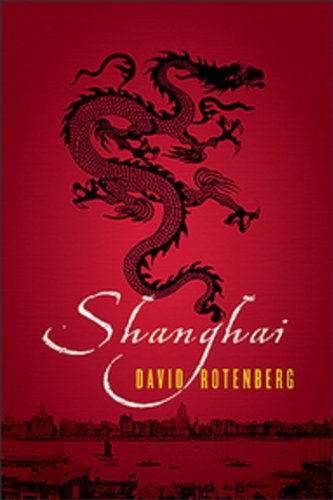



With his last breath, China’s First Emperor, Q’in She Huang, entrusts his followers with a sacred task. Scenes intricately carved into a narwhal tusk show the future of a city “at the Bend in the River,” and The Emperor’s chosen three—his favourite concubine, head Confucian, and personal bodyguard —must bring these prophecies to life by passing their traditions on for generations. Centuries later, the descendents of the Emperor’s chosen confidantes observe as Shanghai is invaded by opium traders and missionaries from Europe, America, and the Middle East. Of them all, two families—locked in a rivalry that will last for generations—will be central to the evolution of the city. As history marches on, locals and foreign interlopers clash and intertwine; their combined fates shaping what will become the centrepiece of the new China—Shanghai. Chapter One The Ivory Compact As the late-afternoon winter sun slid behind the towering dark clouds, a shadow swelled across the beautiful but usually desolate foothills of the Green Mountain, the Hua Shan. In the murky light, thousands upon thousands of rebel troops readied themselves to spring a trap that would end the life of the most powerful man the world had ever known, or very possibly would ever know—Q’in She Huang, China’s First Emperor A village fisherman raced to the far side of a partially frozen upland lake where his prized eels were supposed to be hibernating in their underwater pen. As he approached, the water was roiling and rich with blood. Females had slithered up onto an ice floe and were giving birth while the thicker, more powerful males thrashed the open water as they gorged themselves on their young. The fisherman watched in shocked silence, then turned his eyes upward, toward the darkening sky. Just down the winding mountain path a hunchbacked farmwife smacked the ice from a blanket she had hung to dry on the bamboo stand the night before and was amazed to find that the coverlet, although frozen stiff, was hot to the touch. Farther back in the foothills, a toothless peasant pinched the nightsoil collector’s product between his thumb and forefinger and brought it to his nose. To his amazement, the product was as fresh as the man had claimed it to be. He dropped the human fecal matter to the ground and stared at the night-soil collector. Then he looked to the black clouds, sniffed the air, turned, and ran. Peasants always recognize the distinctive ozone reek that precedes change. But as they retreated to their huts and drew their children close to them, none knew the nature of the change that was beginning, not in the foothills with the rebel troops but on the upper plateau of the Hua Shan, the Holy Mountain. Change conceived and brought into being by the renowned Q’in She Huang himself. * * * “YOU THINK ME MAD,” China’s First Emperor said in a hoarse whisper. “You—all three of you—think I am beyond my wits. That I was tempted here in the depths of winter to this lonely mountaintop to …” His voice trailed off. For a moment, Q’in She Huang allowed himself to look toward the vine-covered mouth of the cave behind him. He took a deep breath and let it out slowly in a fine line of white mist. His breath dusted the faces of the three people he trusted most on this earth, his Chosen: his personal Body Guard; his head Confucian; and Jiang, his favourite concubine. What are you thinking now, in your secret hearts? he wondered, then put the thought aside. He knew there was no way to know another’s hidden self. There was no way to find the mind’s construction in a person’s face. He raised his arms, setting the abalone shells sewn into his silk coverlet tinkling. Then he spoke loudly. “Do you believe that I, who had the Great Wall built, I, who receive personal tribute from the barbarian lands far to the west, from the cruel kingdoms of the south and the arrogant men of the island called Nippon, that I, who united the Middle Kingdom for the first time, am now beyond my wits?” The Confucian noted the subtle shift in the First Emperor’s language. No longer was he using the immoderate style of the ancient writers. Now his words were succinct and to the point. More importantly, his thoughts weren’t the erratic, unpredictable rantings of a man insanely searching for the secret to eternal life. These were the lucid, considered thoughts of the man who had designed the longest man-made waterway in the world, joining the Yangtze River with Beijing, who had standardized the character writing distinctive to the Black-Haired people and created the Mandarin system of examinations that had led to the world’s first organized civil service. This was the First Emperor he had known as a young man, not the one who had burned Confucians along with their books—a madness that he had witnessed and written about in his private journal. “Do you believe that I am now infirm of mind—mad? That I brought you here to this barren place in search of some mountebank