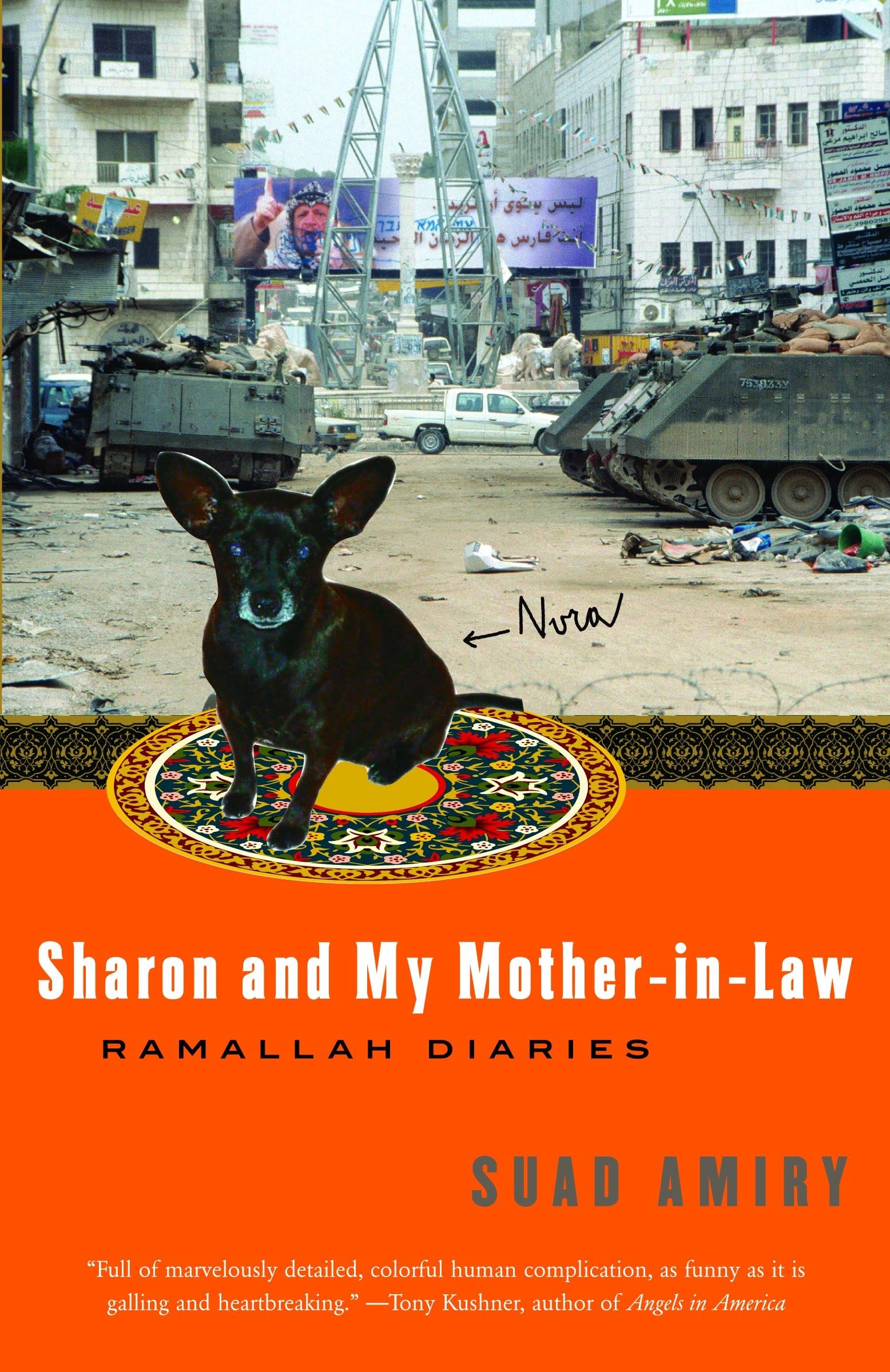



Based on diaries and email correspondence that she kept from 1981-2004, here Suad Amiry evokes daily life in the West Bank town of Ramallah. "A literary protest done with great wit, skill, and passion. Not only is it really funny but it shows the kind of courage, vision, and humanity needed to bring peace to the Middle East." —Eve Ensler, author of The Vagina Monologues Capturing the frustrations, cabin fever, and downright misery of her experiences, Amiry writes with elegance and humor about the enormous difficulty of moving from one place to another, the torture of falling in love with someone from another town, the absurdity of her dog receiving a Jerusalem identity card when thousands of Palestinians could not, and the trials of having her ninety-two-year-old mother-in-law living in her house during a forty-two-day curfew. With a wickedly sharp ear for dialogue and a keen eye for detail, Amiry gives us an original, ironic, and firsthand glimpse into the absurdity—and agony—of life in the Occupied Territories. "Full of marvelously detailed, colorful human complication, as funny as it is galling and heartbreaking." —Tony Kushner, author of Angels in America "Sharply, gloriously different . . . The seemingly casual narrative . . . works its way into your heart without asking you to hate anyone: just to hate a situation." — The Scotsman "Powerful. . . . Extremely funny." — The Sunday Times (London) "A literary protest done with great wit, skill, and passion. Not only is it really funny but it shows the kind of courage, vision, and humanity needed to bring peace to the Middle East." —Eve Ensler, author of The Vagina Monologues Suad Amiry is an architect and the founder and director of RIWAQ, Centre for Architectural Conservation, in Ramallah. She grew up in Amman, Damascus, Beirut, and Cairo, and studied architecture at the American University of Beirut and at the Universities of Michigan and Edinburgh. Amiry participated in the 1991—1993 Israeli-Palestinian peace negotiations in Washington, D.C., and from 1994 to 1996 was assistant deputy minister and director general of the Ministry of Culture in Palestine. She is the author of several books on architecture and was awarded Italy’s Viareggio-Versilia Prize in 2004 for this book. She lives in Ramallah. I Was Not in the Mood Summer 1995 "You kick us out of Jaffa, then wonder how come we're born elsewhere!" These words flew out of my mouth when I opened it to answer the first in a long list of questions asked by the Israeli security officer at Lod (Tel Aviv) Airport. I was certainly not in the mood. It was 4:30 in the morning on a hot summer day in 1995. The almost-five-hour flight from London had fatigued me and all I wanted to do was rush out of the airport to meet Ibrahim, who had sweetly come all the way from Ramallah to pick me up at this very early hour. My anxiety and irritation increased as the young woman at passport control slipped a pink tag into my Palestinian passport. I, of course, have no problems either with pink or with being Palestinian. But at that very moment, all I wanted was a white tag. As I had experienced many times before, pink automatically meant at least an extra hour with security officers at the airport. Oh, how I wanted a white tag this time! "How come you were born in Damascus?" the officer repeated, obviously neither pleased nor satisfied with my impulsive reply. I was not in the mood to tell the security officer that in 1940 my father, who had come to Beirut from Jaffa, was overwhelmed the minute he saw my Damascene mother. She was eighteen, he was thirty-three. He had graduated from the American University of Beirut some twelve years before, while she was still a student at the British Syrian Training College. The minute he stepped inside the grandiose courtyard of her family mansion in Damascus old town and realized how rich her merchant father was, his dream of marrying this tall, dashingly beautiful woman with greenish-grey eyes started to fade. In the end, this particular dream was fulfilled, but many others were shattered, and my father and mother lived a tormented life together. I was not in the mood to tell him that in December 1978 my father had died of a heart attack in Prague while attending a writers' conference. The well-known Palestinian writer Emile Habibi was the last person to see my father alive and spend the evening with him. I was not in the mood to inform the Israeli security officer that every time my mother got pregnant, she went back to Damascus to give birth. In 1943, 1944 and 1949, she traveled between Jerusalem and Damascus to give birth to my sisters, Arwa (now a psychologist living in Amman) and 'Anan (a sociologist now living in America), and, much later, to my brother, Ayman (a diplomat). She also traveled between Amman and Damascus, where I was born two years after that. I did not want to admit to this, as it would only complicate matters and would certainly