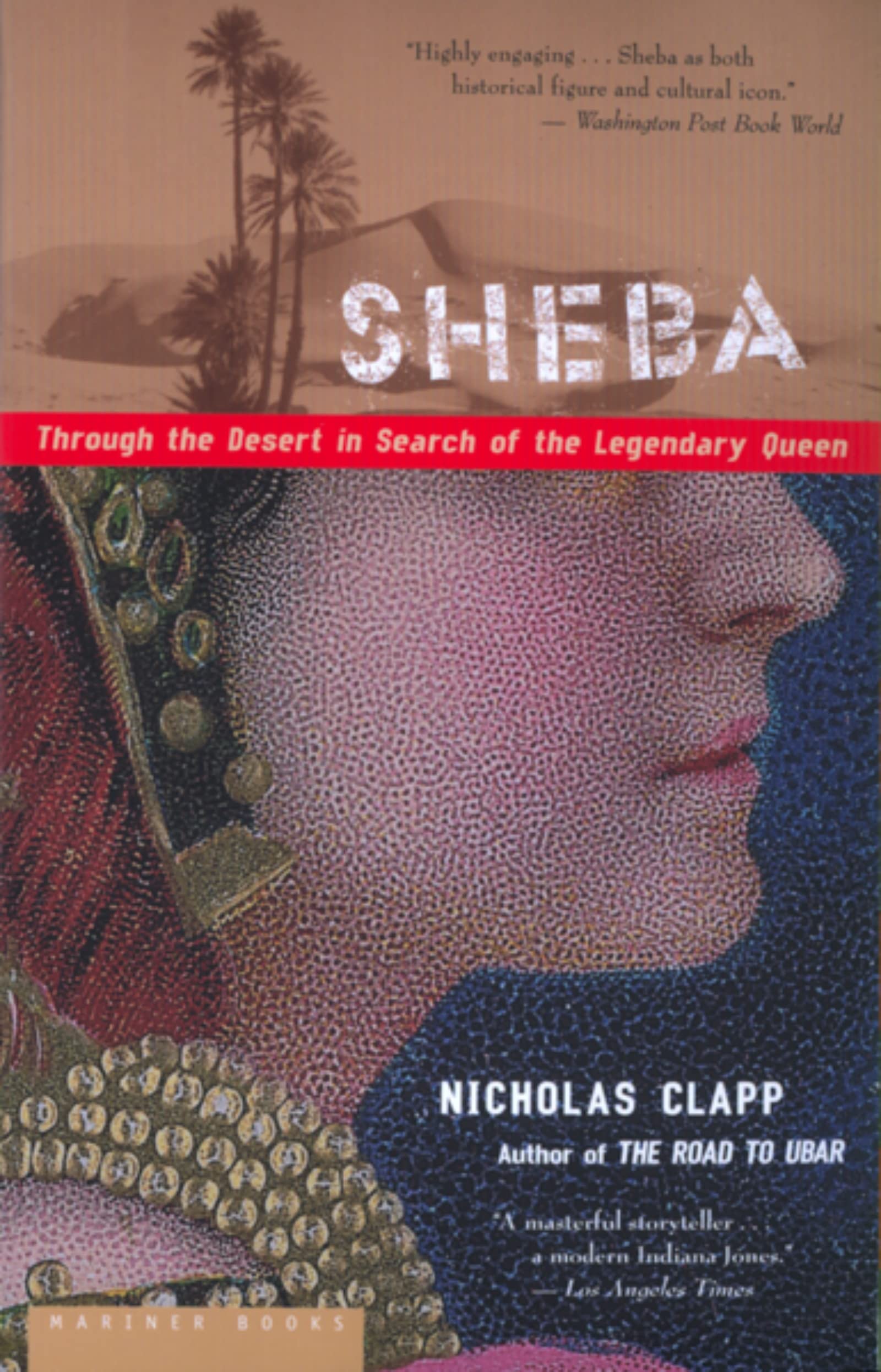



In this exhilarating archaeological adventure, Nicholas Clapp seeks the truth behind the legend of the Queen of Sheba. Ever since she swept into the court of King Solomon three thousand years ago, her story has been told and retold, often getting diluted, amended, and reworked along the way. In a quest to collect clues to the mystery of Sheba, Clapp travels to Ethiopia, Yemen, Israel, and even a village in France. Using the latest technology, including satellite images and carbon-14 dating, and some recent archaeological discoveries, he pieces together the facts behind Sheba's multifaceted myth. "makes a significant contribution to the scholarly debate about whether the queen of Sheba existed." The Los Angeles Times "charming investigative account...a combination of serious scholarly investigation, casual observation, travel account and personal diary." Publishers Weekly "Nicholas Clapp...has practically invented a new literary genre: call it 'scholarly adventure archaeology.'" Providence Journal "Armchair travelers and those interested in the Middle East and biblical history could do no better than to pick-up [Sheba]" The Oregonian "A modern odyssey filled with adventure, danger, and scientific discovery." Midwest Book Review "Written as an archaeological adventure with the lay reader in mind" Library Journal "a satisfying, highly engaging book…" The Washington Post "Clapp's self-deprecating wit, engaging manner, and enjoyment of anomaly aerate the morass of legend, myth and history…" Boston Globe Nicholas Clapp, a noted documentary filmmaker, has lectured at Brown University, the University of California at Los Angeles, California Institute of Technology, the National Georgraphic Society, and the Goddard Space Center. Clapp lives in Los Angeles, California. Sheba Through the Desert in Search of the Legendary Queen By Nicholas Clapp Mariner Books Copyright © 2002 Nicholas Clapp All right reserved. ISBN: 0618219269 Excerpt Prologue On a sleet-streaked november afternoon I ducked into the New York Public Library, collapsed my umbrella-broken-spoked on the dash from the subway-sloshed up a grand marble staircase, and turned down a dark hallway leading to the Oriental Division. ("Oriental," in the nineteenth century"s world-view, meant anything to the east of Greece, as in "We Three Kings of Orient Are . . .") In the hallway, the division"s recent titles could be accessed on two computer terminals glowing green on a table to the right. To the left, shelves of black volumes recorded older entries, typed on antique machines and even handwritten. Both sources had pages of entries beginning: "Queen of . . ." Queen of Bubbles, Queen of Frogs. Queens of Sorrows, Spies, the Swamp, Tears, Tomorrow, the Universe, Rage, and Ruin. But on this damp day, one entry shone, the one I was looking for: the Queen of Sheba. Further crosschecking would pull up hundreds of entries bearing on her life-if she did ever live-and times. I had no way of knowing it at the time, but the pursuit of the queen of Sheba would take me from Canterbury Cathedral to a Czech alchemist"s tower. I would venture to the Orient of old and to Jerusalem, the city where Sheba appeared before King Solomon, a city so at the crux of Western religion that it was long held to be the center of the world. Curiosity, that old cat-killer, would prod and beckon me on, through the cobbled streets of ancient caravansaries, through grassy green African highlands, across a stormy Strait of Tears, and into the trackless red sands of the Rub" al-Khali, the Empty Quarter of Arabia. The desert, I"ve found, is a good place for the curious, for even on a short walk you can expect the unexpected, a glimpse of something you"ve never seen before, be it an oddly striped caterpillar, a rare ghost flower or, as I once found in California"s Mojave, a barely tarnished fighter plane abandoned since World War II. This really doesn"t make sense. One imagines the surprises of the world of nature and of man to be hidden in remote alpine canyons and mist-shrouded jungles. And certainly such places have their share of the unexpected. But it"s in the desert-open, apparently lifeless, with few places to conceal anything-where secrets, perhaps the best secrets, are to be found. Or may still lie buried. On again, off again, for a decade and more, I would seek Sheba in lands (like her?) exotic, sensuous, even sinister. Would the mists of her myth dissolve, and a real queen of a real country step forth? Or, upon investigation, might she prove to be Sheba, Queen of Illusion? I had no idea. But on a winter"s day in New York, I scanned volume after worn volume and was warmed by the promise of adventure offered by Alexander Kinglake, a Victorian "traveling gent": There comes a time for not dancing quadrilles, not sitting in pews . . . and now my eyes would see the Splendor and Havoc of the East. May, 2000 Copyright © 20