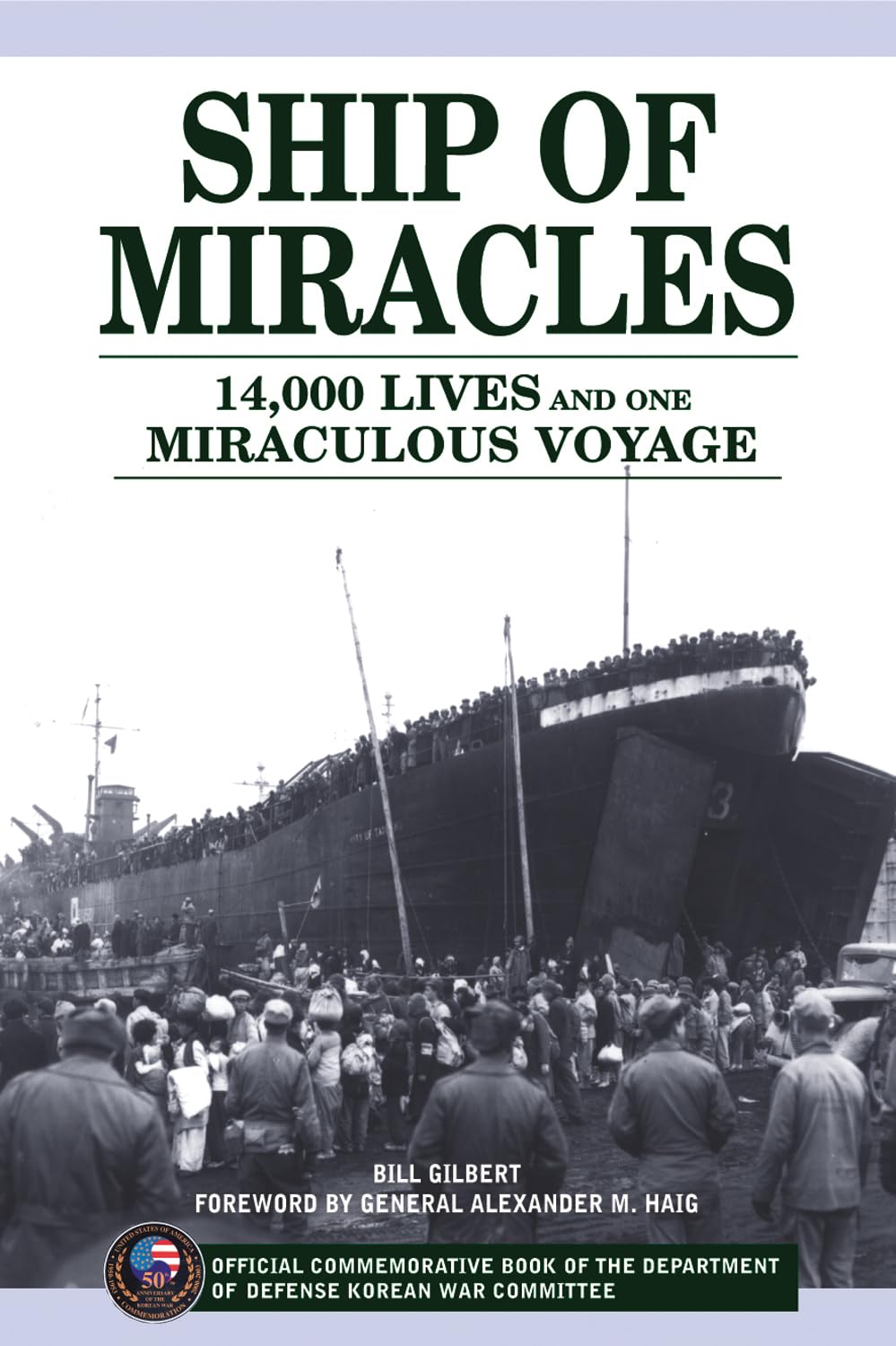



It was a miracle worthy of the season. When Captain Leonard La Rue spied from his twelve-man merchant ship, the Meredith Victory, the throng of Korean refugees on the docks of a city in flames, he didn't hesitate to do what others would consider impossible. In December of 1950, La Rue and his skeleton crew rescued fourteen thousand Korean refugees from the hands of the rapidly-approaching Chinese army in the city of Hungnam. Through the night and next day, a seemingly endless succession of refugees boarded the Meredith, their will to live and strong spirit steeling them against the bitter cold and incredibly crowded conditions. Standing shoulder to shoulder for three days the refugees and crew stoically endured as La Rue steered the ship through sea battle, a thirty-mile web of sea mines, and enemy shelling. Ship of Miracles is the incredible story of what has been called "the greatest rescue operation by a single ship in the history of mankind." Against all odds, the little merchant vessel transported its precious cargo to the island of Koje-Do on Christmas Eve completely unharmed, all fourteen thousand refugees alive and well, including an additional five new lives begun on this incredible journey. As the fiftieth anniversary of this miraculous rescue approaches, Ship of Miracles is as touching today as it was then; a tale you'll hold close to your heart, and return to time and again. While the United States Navy prepares to celebrate the fiftieth anniversary of the perilous evacuation at Hungnam and honor the Meredith Victory's miraculous feat, read this never-before-told account from the crew themselves, as they relate the incredible and unbelievable details of their three-day journey from fear to freedom. Bill Gilbert is the best-selling author of eighteen books on World War II, government, politics, and sports. A former reporter for The Washington Post , he served in the United States Air Force for four years, two and a half of which were during the Korean War. He lives with his wife, Lillian, in the Maryland suburbs of Washington, D.C. Ship of Miracles 14,000 Lives and One Miraculous Voyage By Bill Gilbert Triumph Books Copyright © 2000 Bill Gilbert All rights reserved. ISBN: 978-1-57243-366-3 Contents Foreword by Alexander M. Haig Jr., Roll Call, Acknowledgments, Map of the Korean Peninsula, Introduction: A Salute, 1. Innocent Victims and Their Terror, 2. The Way We Were, 3. The SS Meredith Victory, 4. "We Had Won the War", 5. A National Emergency in America, 6. "A Striking Sight", 7. "The Trauma of It", 8. "There Was No Room for Them", 9. Letters Home, 10. Kim Jung Hee's Fifty-Year Search, 11. Was It Worth It?, 12. "God's Own Hand", Bibliography, Photo Gallery, CHAPTER 1 Innocent Victims and Their Terror In bone-chilling temperatures and howling winds, with the imminent threat of enemy gunfire aimed at his ship from the beach and return fire from the USS Missouri, four destroyers, two heavy cruisers, and four rocket ships sailing over him back toward the shore, destiny was summoning a thirty-seven-year-old Merchant Marine captain from Philadelphia. Captain Leonard LaRue stood on the deck of his five-year-old, ten-thousand-ton freighter, the SS Meredith Victory, in the harbor at Hungnam, North Korea, 135 miles into enemy territory, in the sixth month of the Korean War, Christmastime 1950. "I trained my binoculars on the shore and saw a pitiable scene," he later wrote. "Korean refugees thronged the docks. With them was everything they could wheel, carry, or drag. Beside them, like frightened chicks, were their children." He was looking at nearly one hundred thousand terrified North Korean refugees — old men, women of every age, and children, the innocent victims of every war — who were desperately fleeing the Chinese Communists, who had threatened to behead any North Korean civilians, even though they were supposedly on the same side. The Chinese angrily charged that the civilians had been aiding the Americans and their allies. Hundreds, even thousands, of family tragedies were unfolding on those docks. Kim Jung Hee, a twenty-nine-year-old mother of three young children — two daughters and a son — carried her youngest child, Won Suk, a little girl about two years old, on her back. At the same time she clutched the hand of her son, five-year-old Doo Hyuk, with one hand and held her husband's hand with the other as he carried their oldest child, their ten-year-old daughter, Koon Ja. They lived in the North Korean city of Wonsan, sixty miles south of Hungnam. They owned a jewelry store where they sold diamonds and other gems. As the war grew worse, and with their fear of the Communist regime in the north, they made the fateful decision to leave Wonsan and escape to South Korea, where they hoped to find safety and freedom for themselves and their children. They were so desperate that they were willing to walk, even in the subzero temperatures and wi