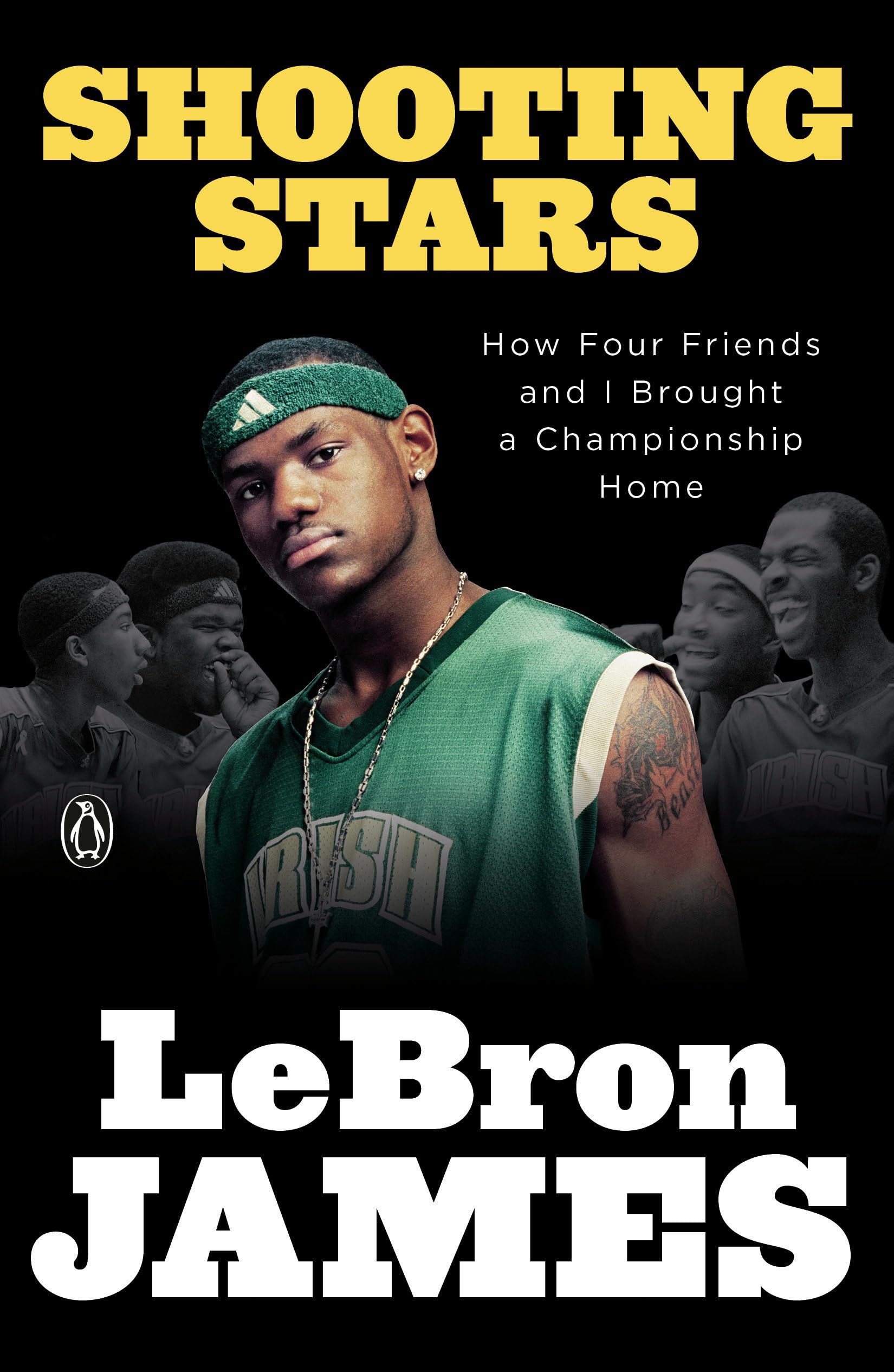



The celebrated memoir from LeBron James - a poignant, thrilling tale of the power of teamwork to transform young lives, including his own "A book that will incredibly move and inspire you.” —Jay-Z "A heartwarming story of boys who became men, teammates who became brothers, players who became champions, wonderfully told through the maturing eyes of basketball's greatest star." — John Grisham Before LeBron James was an NBA superstar, he was just a kid from Akron, Ohio, who loved to play basketball on a team called the Shooting Stars. This is the story of how this motley group of ten-year-olds grew into a team and became men together - surviving the challenges of inner city America and enduring jealousy, hostility, exploitation, and the consequences of their own overconfidence in their quest to win a national championship. Shooting Stars is a poignant, thrilling tale of the power of teamwork to transform young lives. LeBron James plays for the NBA’s Los Angeles Lakers. His superstardom is hard to overstate: at seventeen he was featured on the cover of Sports Illustrated; at nineteen he became the youngest rookie of the year in NBA history; at twenty-three he was named the third highest paid athlete in the world (including endorsements), after Tiger Woods and David Beckham. In 2006–7 he led the Cavaliers to their first NBA finals ever and finished second place in the vote for the league’s most valuable player. In 2007–8 he became the youngest player in NBA history to score 10,000 points and topped the league in scoring. He was a key member of the U.S. men’s basketball team that won a Gold Medal in the 2008 Olympics. The Cavaliers finished the 2008–9 season with the best record in the NBA. They lost the Eastern Conference finals to the Orlando Magic, in which James scored 40 or more points in three of six games. He was also named the league’s most valuable player by a landslide. He is only the third man (and the first African American man) to appear on the cover of Vogue. He has hosted Saturday Night Live, graced Oprah’s stage, and appeared on the cover of Fortune. Excerpted from Shooting Stars by LeBron James and Buzz Bissinger. Reprinted by arrangement with The Penguin Press, a member of Penguin Group (USA), Inc. Copyright (c) September 2009. Chapter 1: Mapmakers I rode my bike all over Akron when I was small, going here, going there, just trying to stay out of trouble, just trying to keep busy, just really hoping the chain wouldn’t break like it sometimes did. If you went high up on North Hill in the 1980s, you could tell that life was not like it once was: the obsolete smokestacks in the distance, the downtown that felt so tired and weary. I won’t deny it—there was something painful about all of that. It got to me, this place in northeastern Ohio that had once been so mighty (at one point it was the fastest-growing city in the country) but was mighty no more. This place that was struggling to be something again. It was still my hometown. The more I rode my bike around, and you could ride just about everywhere because it was midwestern small and compact, the more familiar I became with it. I rode along Copley Road, the main thoroughfare of West Akron, past the dark of redbrick apartment buildings with red-trimmed windows. A little bit farther up, I went past the Laundry King and Queen Beauty Supply. Riding along East Avenue, which took you from the western part of the city into the south, I went past modest two-story homes with porches and the brown concrete of the Ed Davis Community Center. I descended into the valley of South Akron along Thornton Street, past the blond brick of Roush’s Market and the Stewart & Calhoun Funeral Home. South Akron was a tough neighborhood, but still I rode, past Akron Automatic Screw Products and the aluminum siding of the Thornton Terrace apartments. Along Johnston Street I went into the east side, past simple homes of red and green and blue that looked like a rainbow. I turned south on Arlington, past the Arlington Church of God and Bethel Baptist and Allied Auto. I came to the Goodyear clock tower, towering high like the Washington Monument and the great symbol of what Akron had once been, the “Rubber Capital of the World,” producing tires by the millions until all the great factories closed. I biked up the north side into a section of the city known as the Bottom and went past the Elizabeth Park projects—my own home for a time—two-story apartment buildings in unsmiling rows, some of which had been condemned, some of which had been boarded up, some that had screen doors with the hinges torn off or the wire mesh stripped away. I headed back west and biked along Portage Path, a wealthy section of town with sprawling houses of brick and stone and shiny black shutters all perfectly aligned. I knew I would never live there unless some miracle happened, something fell from the sky, a shooting star that landed on top of me and my mom and made our lives better and carried