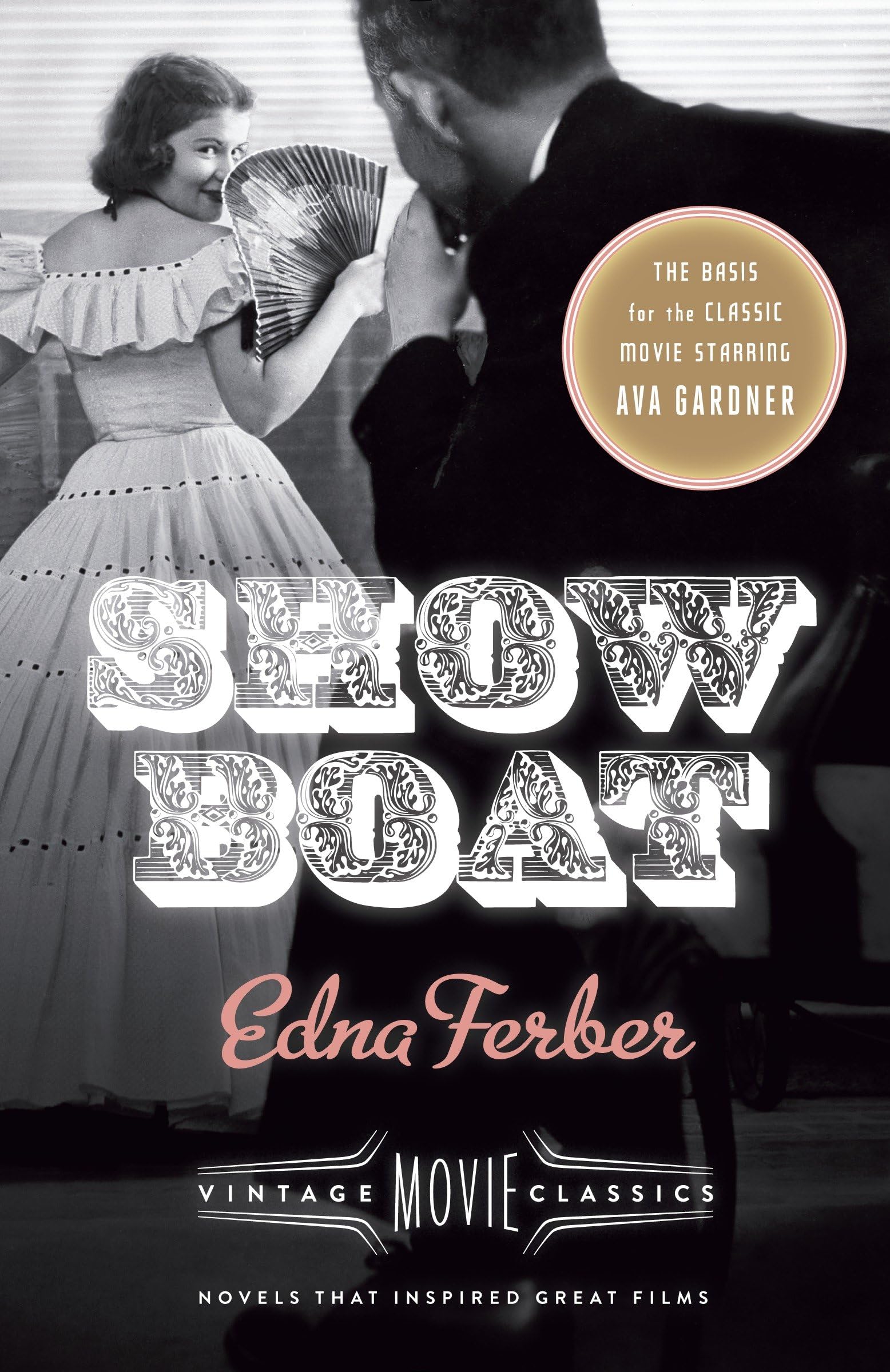



The classic tale behind MGM’s blockbuster movie directed by George Sidney, starring Ava Gardner, Howard Keel, and Kathryn Grayson. Bringing to life the adventurous world of Mississippi show boats, the grittiness of turn-of-the-century Chicago, and the majesty of 1920s Broadway, Pulitzer Prize winner Edna Ferber’s Show Boat is a classic. Magnolia Hawks spends her childhood aboard the Cotton Blossom , growing up amid simmering racial tension and struggling to survive life on the Mississippi. When she falls in love with the dashing Gaylord Ravenal and moves with him to Chicago, the joy of giving birth to their beautiful daughter, Kim, is offset by Gaylord’s gambling addiction and distrustful ways. Only when Kim sets off on her own to pursue success on the New York stage does Magnolia return to the Cotton Blossom , reflecting on her own life and all who once called the show boat their home. Originally published in 1926, adapted for the stage as a musical a year later and filmed three times over three decades, Show Boat brilliantly explores a nation going pivotal change through the lens of its popular culture. With a new foreword by Foster Hirsch. Vintage Movie Classics spotlights classic films that have stood the test of time, now rediscovered through the publication of the novels on which they were based. Praise for Edna Ferber and Show Boat “An irresistible story. . . . Gorgeously romantic. . . . Spirited, full-breasted, tireless. . . . With Show Boat Miss Ferber establishes herself . . . as one of those who are reviving first-rate story-telling.” — The New York Times “No one tells so well as Edna Ferber the story of the American people in their various backgrounds. . . . It is a gift, a lovely gift, and no one uses her talents more delightfully than Edna Ferber.” —William Allen White Edna Ferber was an American novelist, short story writer and playwright. Her bestselling novels were especially popular and included the Pulitzer Prize-winning So Big , Show Boat , Giant , and Cimarron . She died in 1968. Excerpted from the Foreword by Foster Hirsch FOREWORD As all connoisseurs of the American musical theater readily acknowledge, Florenz Ziegfeld’s 1927 production of Show Boat, with a score by Jerome Kern and book and lyrics by Oscar Hammerstein II, is America’s first serious musical play—a landmark. The show’s startling opening lines—“Niggers all work on de Mississippi, / Niggers all work while de white folks play”—issued an immediate challenge. Also revolutionary was the level of integration between music and narrative; in unprecedented ways, most of the songs and dances grew out of and complemented the action. Kern’s soaring score and Hammerstein’s big-hearted lyrics for “Ol’ Man River,” “You Are Love,” “Make Believe,” “Can’t Help Lovin’ Dat Man,” and “Bill” (original lyrics by P. G. Wodehouse and revised by Hammerstein) have ensured the work’s enduring appeal. MGM’s 1951 fi lm carried the following description: “based upon the Immortal Musical Play.” Often overlooked is that Kern and Hammerstein had adapted the 1926 bestselling novel by Edna Ferber, which provided all the characters, the settings, the plot points, and—not least—the song cues. Ferber’s description of the arrival of the show boat, for example, cries out for musical accompaniment: “As they neared the landing, the band, perched atop the , forward, alternated with the calliope. From the town, hurrying down the streets, through the woods, dotting the levee and the landing, came eager figures, black and white.” Wisely, Kern and Hammerstein seized on the scene as the inspiration for their show’s high-stepping opening numbers, “Cotton Blossom” and “Cap’n Andy’s Ballyhoo.” With its picturesque backdrop, its sweeping-across-the-generations narrative, and its richly evoked Americana, Show Boat is camera-ready, grist for the Broadway and Hollywood mills. But the novel is far more than a template for big-budget theatrical adaptations; it is a work of genuine literary craftsmanship. Ferber had a knack for selecting unusual settings steeped in American history. During a troubled out-of-town tryout for her play Minick (cowritten with George S. Kaufman), theatrical producer Winthrop Ames told Ferber about show boats; she knew at once he had given her the seed for the kind of robust saga of the American past that was already her specialty. Like a vigilant graduate student Ferber embarked on a program of intensive research, supplementing her extensive reading with firsthand experience on an actual show boat, the James Adams Floating Theatre, hosted by producer Charles Hunter and his actress wife, Beulah Adams, who was known as the “Mary Pickford of the Chesapeake.” Though Ferber had never been on the Mississippi before she wrote the novel, the river becomes her central character, a commanding, mystical presence that guides the denizens of the show boat to their awaiting destinies. In her vivid opening chapter, “the