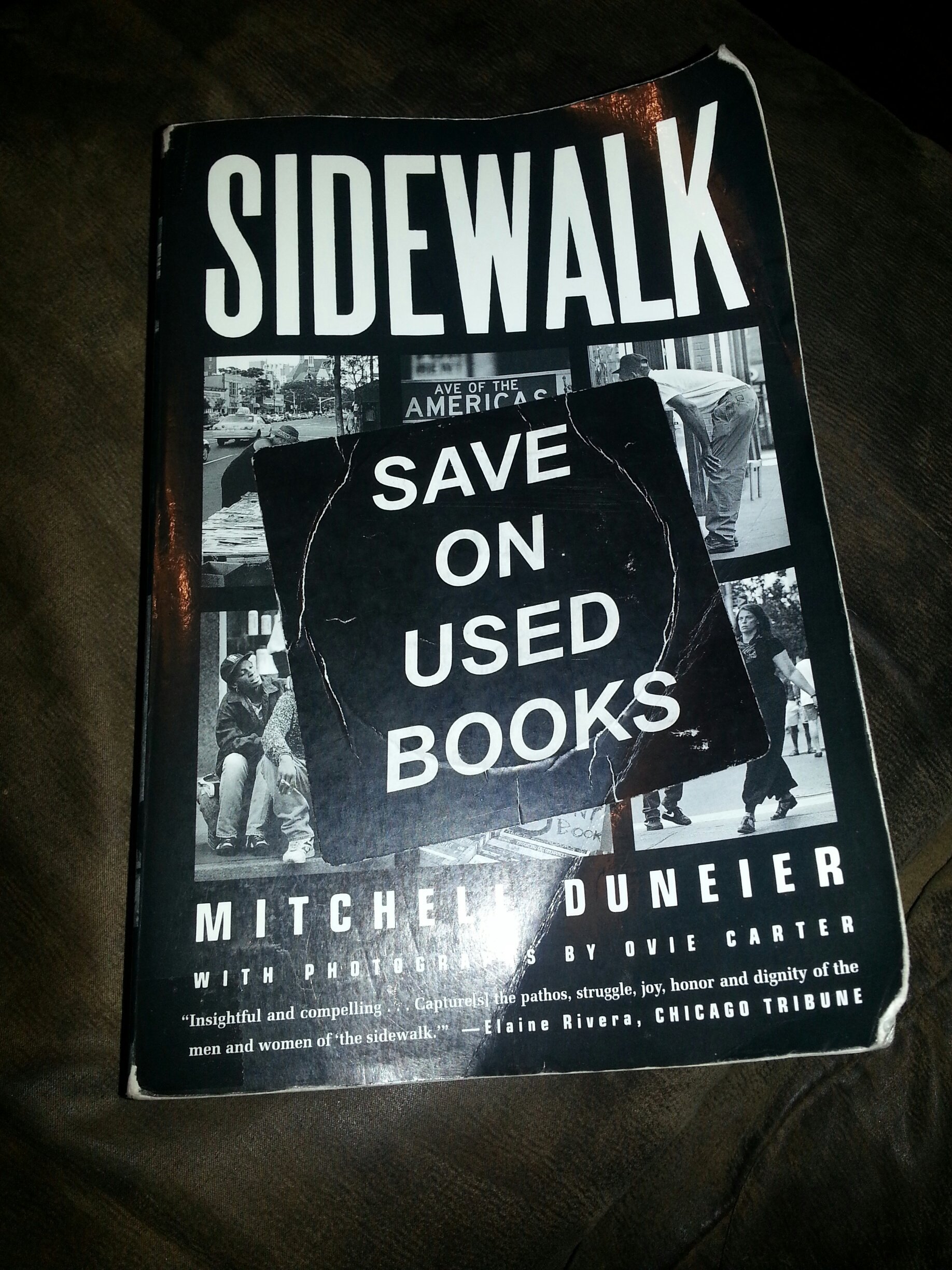



Chronicling the fortunes and misfortunes of street peddlers in New York, this unique study of modern urban street culture follows a dozen people who sell on the streets of Greenwich Village as they struggle against the city and common misconceptions in order to survive. "I've had the luxury--if you can call it the luxury," says Hakim Hasan, "of working in the formal economy, and of working at certain companies that required a certain level of training, however rudimentary, and a certain level of education." Instead, he chooses to sell books from a table on the sidewalk in New York's Greenwich Village. Soon after he met sociologist Mitchell Duneier, Hakim described himself as a "public character," and sent Duneier scurrying to reread Jane Jacobs's The Death and Life of Great American Cities to find out what he meant. That moment was one of Duneier's inspirations to spend years studying--getting to know, really--Hakim and other book and magazine vendors on his patch of Sixth Avenue. Sidewalk explains much about the street vendors: How did this become legal? Where do vendors obtain their merchandise? How do they interact with potential customers? When do they find time to go to the bathroom (and, for that matter, where do they go)? But it's ultimately about the people themselves--quoted at length from Duneier's tape-recorded interviews and photographed by Ovie Carter--as they do their best to live successfully on their own terms, with all the good and bad consequences that entail. Some of these people (almost all men) are drug addicts, yes, and some of them choose to live as "unhoused" individuals. But many of them find a strong sense of purpose and identity in their work and choose to live in ways that best facilitate that work; they are as motivated--more, perhaps--as workers holding "respectable" office jobs. Nonacademic readers may glaze over at some of Duneier's longer explanations of his methodology, and he seems occasionally overapologetic when quoting the uncensored language of his subjects, but few books succeed at plunging the reader into a community and delineating the character of its members as Sidewalk does. Behind the seeming simplicity of this book's title lies a little-known, complex subculture of urban life. Duneier (Univ. of Wisconsin/Univ. of California; Slim's Table) introduces readers to a number of people who make their home and their living on the sidewalk. He researched this population by living among, talking to, and, most of all, listening to the book and magazine vendors, pedestrians, police officers, business leaders, and politicians whose lives intersect on Sixth Avenue in Greenwich Village, New York City. Together with Carter, an award-winning photojournalist, Duneier elucidates the people and the functions of sidewalk culture, showing how, in many ways, it improves a city's quality of life. In telling the story of Sixth Avenue's "residents," the author hopes to enlighten citizenry and city leaders alike and inspire greaterrespect for this culture. A wonderful success; highly recommended for college-educated readers and larger public libraries.ADeborah Bigelow, Leonia P.L., Little Falls, NJ Copyright 1999 Reed Business Information, Inc. Sociologist Duneier (Univ. of Wisconsin, Madison; Slim's Table: Respectability and Masculinity, 1994) constructs a nuanced study of the lives of impoverished street vendors in New York's Greenwich Village. Any day along Sixth Avenue in the Village, rows of tables congest the sidewalk, piled with reading material for salefrom new books to old magazines retrieved from Dumpsters. The sellers are mostly black men; many are homeless, drug addicts, alcoholics. They often engage in ``deviant'' behavior, such as public urination and engaging unwilling passersby in conversation. Some in the neighborhood accept them as part of the scene, more view them as a threat to the quality of life of the area and a magnet for crime. As a ``participant observer'' for a number of years, Duneier has tried to understand the motivation and meaning of the actions of these street vendors. They are not an aimless gathering of down-and-outers, but a complex world of norms and self-regulation, of variegated attitudes and self-images. Most view their workeven if its only panhandling and not sellingas honorable in that they are in fact working, not stealing or robbing. Still they rankle and are often the object of police harassment and government sanctions. Why this is so involves an intricate pas de deux between the street people and residents. Because, for example, they assume with good reason they will not be allowed to use public facilities, the street people urinate in the street. Because the street people urinate in the street, local merchants assume they are not the type of people to be allowed into their establishments. And on and on. Underlying all of this, Duneier argues carefully, is the fear of black men in social spaces. His aim is to have us really begin to