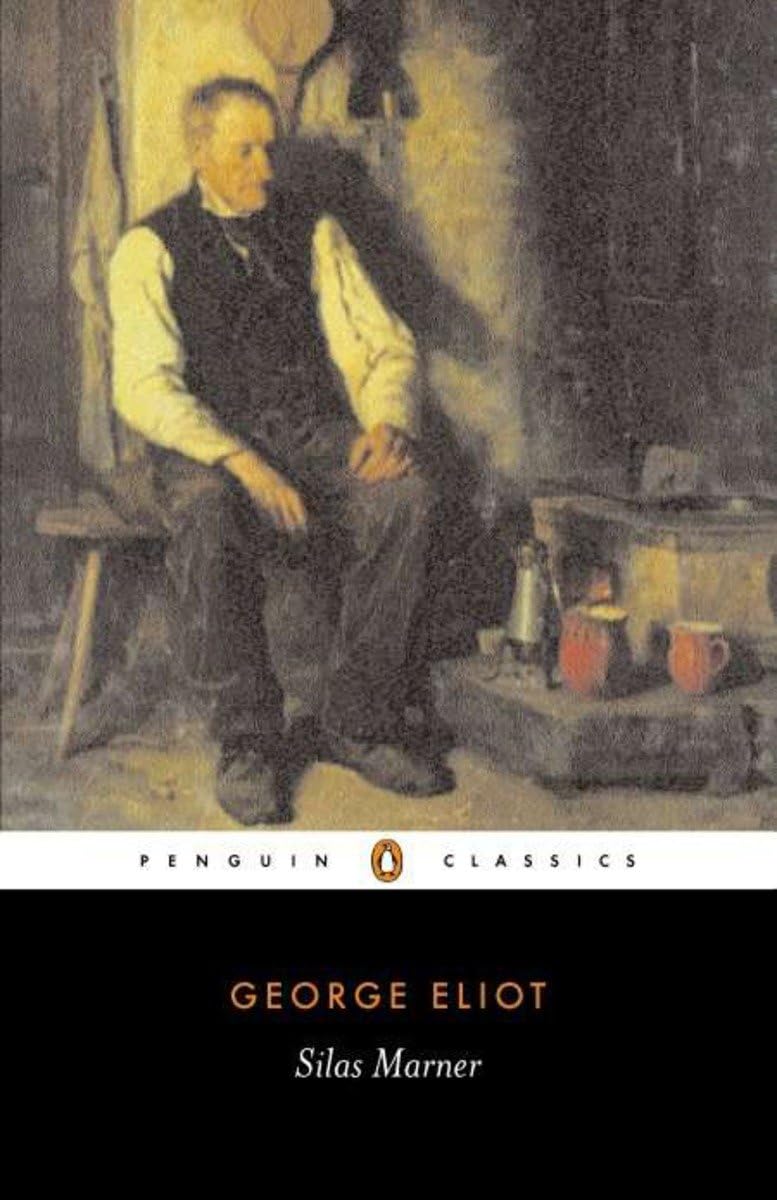



George Eliot's tale of a solitary miser gradually redeemed by the joy of fatherhood, Silas Marner is edited with an introduction and notes by David Carroll in Penguin Classics. Wrongly accused of theft and exiled from a religious community many years before, the embittered weaver Silas Marner lives alone in Raveloe, living only for work and his precious hoard of money. But when his money is stolen and an orphaned child finds her way into his house, Silas is given the chance to transform his life. His fate, and that of Eppie, the little girl he adopts, is entwined with Godfrey Cass, son of the village Squire, who, like Silas, is trapped by his past. Silas Marner, George Eliot's favourite of her novels, combines humour, rich symbolism and pointed social criticism to create an unsentimental but affectionate portrait of rural life. This text uses the Cabinet edition, revised by George Eliot in 1878. David Carroll's introduction is complemented by the original Penguin Classics edition introduction by Q.D. Leavis. Mary Ann Evans (1819-80) began her literary career as a translator, and later editor, of the Westminster Review. In 1857, she published Scenes of Clerical Life, the first of eight novels she would publish under the name of 'George Eliot', including The Mill on the Floss, Middlemarch, and Daniel Deronda. If you enjoyed Silas Marner, you might like Nathaniel Hawthorne's The Scarlet Letter, also available in Penguin Classics. 'I think Silas Marner holds a higher place than any of the author's works. It is more nearly a masterpiece; it has more of that simple, rounded, consummate aspect ... which marks a classical work' Henry James "I think Silas Marner holds a higher place than any of the author's works. It is more nearly a masterpiece; it has more of that simple, rounded, consummate aspect. . .which marks a classical work."—Henry James Mary Ann Evans (1819-80) began her literary career as a translator and later editor of the Westminster Review. In 1857, she published SCENES OF CLERICAL LIFE, the first of eight novels she would publish under the name of 'George Eliot', including THE MILL ON THE FLOSS, MIDDLEMARCH, and DANIEL DERONDA. David Carroll taught at Lancaster University. Chapter 1 In the days when the spinning-wheels hummed busily in the farm-houses—and even great ladies, clothed in silk and thread-lace, had their toy spinning-wheels of polished oak—there might be seen in districts far away among the lanes, or deep in the bosom of the hills, certain pallid undersized men, who, by the side of the brawny country-folk, looked like the remnants of a disinherited race. The shepherd’s dog barked fiercely when one of these alien-looking men appeared on the upland, dark against the early winter sunset; for what dog likes a figure bent under a heavy bag?—and these pale men rarely stirred abroad without that mysterious burden. The shepherd himself, though he had good reason to believe that the bag held nothing but flaxen thread, or else the long rolls of strong linen spun from that thread, was not quite sure that this trade of weaving, indispensable though it was, could be carried on entirely without the help of the Evil One. In that far-off time superstition clung easily round every person or thing that was at all unwonted, or even intermittent and occasional merely, like the visits of the pedlar or the knife-grinder. No one knew where wandering men had their homes or their origin; and how was a man to be explained unless you at least knew somebody who knew his father and mother? To the peasants of old times, the world outside their own direct experience was a region of vagueness and mystery: to their untravelled thought a state of wandering was a conception as dim as the winter life of the swallows that came back with the spring; and even a settler, if he came from distant parts, hardly ever ceased to be viewed with a remnant of distrust, which would have prevented any surprise if a long course of inoffensive conduct on his part had ended in the commission of a crime; especially if he had any reputation for knowledge, or showed any skill in handicraft. All cleverness, whether in the rapid use of that difficult instrument the tongue, or in some other art unfamiliar to villagers, was in itself suspicious: honest folk, born and bred in a visible manner, were mostly not overwise or clever—at least, not beyond such a matter as knowing the signs of the weather; and the process by which rapidity and dexterity of any kind were acquired was so wholly hidden, that they partook of the nature of conjuring. In this way it came to pass that those scattered linen-weavers—emigrants from the town into the country—were to the last regarded as aliens by their rustic neighbours, and usually contracted the eccentric habits which belong to a state of loneliness. In the early years of this century, such a linen-weaver, named Silas Marner, worked at his vocation in a stone cottage that stood among the nutty hedgerows near the