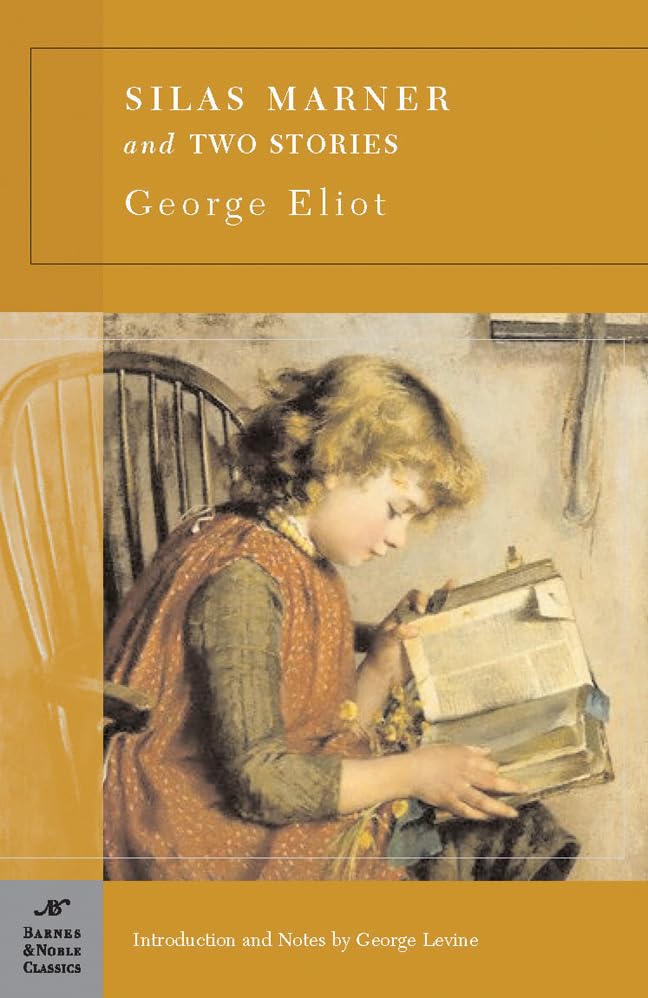



&&LDIV&&R&&LDIV&&R&&LDIV&&R&&LI&&RSilas Marner and Two Short Stories&&L/I&&R, by &&LSTRONG&&RGeorge Eliot&&L/B&&R, is part of the &&LI&&RBarnes & Noble Classics&&L/I&&R &&LI&&R &&L/I&&Rseries, which offers quality editions at affordable prices to the student and the general reader, including new scholarship, thoughtful design, and pages of carefully crafted extras. Here are some of the remarkable features of &&LI&&RBarnes & Noble Classics&&L/I&&R: &&LDIV&&R New introductions commissioned from todays top writers and scholars - Biographies of the authors - Chronologies of contemporary historical, biographical, and cultural events - Footnotes and endnotes - Selective discussions of imitations, parodies, poems, books, plays, paintings, operas, statuary, and films inspired by the work - Comments by other famous authors - Study questions to challenge the readers viewpoints and expectations - Bibliographies for further reading - Indices & Glossaries, when appropriate All editions are beautifully designed and are printed to superior specifications; some include illustrations of historical interest. &&LI&&RBarnes & Noble Classics &&L/I&&Rpulls together a constellation of influences―biographical, historical, and literary―to enrich each readers understanding of these enduring works.&&L/DIV&&R&&L/DIV&&R&&L/DIV&&R&&LDIV&&R&&LB&&R&&L/B&&R &&L/DIV&&R&&LDIV&&R&&LB&&RGeorge Eliot&&L/B&&R’s third novel, &&LI&&RSilas Marner&&L/I&&R (1861) is a powerful and moving tale about one man’s journey from exile and loneliness to the warmth and joy of the family.&&LBR&&R&&LBR&&RThe story opens as Silas Marner, falsely accused of theft, loses everything, including his faith in God. Embittered and alienated from his fellow man, he moves to the village of Raveloe, where he becomes a weaver. Taking refuge in his work, Silas slowly begins to accumulate gold―his only joy in life―until one day that too is stolen from him. Then one dark evening, a beautiful, golden-haired child, lost and seeing the light from Silas’s cottage, toddles in through his doorway. As Silas grows to love the girl as if she were his own daughter, his life changes into something precious. But his happiness is threatened when the orphan’s real father comes to claim the girl as his own, and Silas must face losing a treasure greater than all the gold in the world. &&LBR&&R&&LBR&&RThis volume also includes two shorter works by Eliot―&&LI&&RThe Lifted Veil&&L/I&&R, a dark Gothic fantasy about a morbid young clairvoyant, and &&LI&&RBrother Jacob&&L/I&&R, a deliciously satirical fable about a confectioner’s apprentice.&&L/DIV&&R&&LDIV&&R &&L/DIV&&R&&LDIV&&R&&LDIV&&R&&LB&&RGeorge Levine&&L/B&&R is Kenneth Burke Professor of English Literature at Rutgers University, and director of the University’s Center for the Critical Analysis of Contemporary Culture. He has written extensively about Victorian literature and culture, and has for a long time focused attention on Darwin and the relations between science and literature, particularly in his &&LI&&RDarwin and the Novelists&&L/I&&R. He has written and edited many books, on subjects ranging from Frankenstein to the works of Thomas Pynchon. Most recently, he has edited &&LI&&RThe Cambridge Companion to George Eliot&&L/I&&R and written a study of Victorian scientific thought and literature, &&LI&&RDying to Know&&L/I&&R.&&L/DIV&&R&&L/DIV&&R&&L/DIV&&R George Levine is Kenneth Burke Professor of English Literature at Rutgers University, and director of the Universitys Center for the Critical Analysis of Contemporary Culture. He has written extensively about Victorian literature and culture, and has for a long time focused attention on Darwin and the relations between science and literature, particularly in his Darwin and the Novelists . He has written and edited many books, on subjects ranging from Frankenstein to the works of Thomas Pynchon. Most recently, he has edited The Cambridge Companion to George Eliot and written a study of Victorian scientific thought and literature, Dying to Know . From George Levine’s Introduction to Silas Marner and Two Short Stories Of all George Eliot’s novels, Silas Marner (1861) is the shortest and perhaps the most accessible to modern readers. That is partly because it is the only one of her novels that has the atmosphere of a fable, and indeed seems to have been deliberately written as one. The very qualities of apparent simplicity, clarity, and directness that have always made it among the most popular of her novels have also made it seem as though it is not quite as serious, not quite as “real” as the other much longer and more complex works, most notably Middlemarch (1872), universally recognized as her masterpiece and arguably the greatest nineteenth-century English novel. Unusual as it seems, among Eliot’s other more imposing works, Silas Marner is not as atypical as it at first appears to be. In fact, no book of Eliot’s gives more immediate access