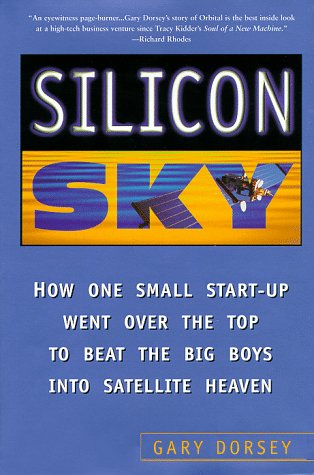
Silicon Sky: How One Small Start-Up Went Over the Top to Beat the Big Boys Into Satellite Heaven
$27.90
by Gary Dorsey



For more than a decade some of the world's most powerful defense companies have raced to launch the first constellation of low-earth orbit commercial satellites. The prize? An explosive global market for personal communications worth billions of dollars. Fresh out of Harvard Business School, twenty-something David Thompson entered the fray with an insane idea: to build his own rockets, satellites and a multi-million-dollar corporation that could go head-to-head against the big guys. His electrifying grab for the heavenshuge start-up costs, mind-blowing technical obstacles, and dark tangos with investorsis told by acclaimed writer Gary Dorsey, who was there reporting from inside. The story of their obsessive gamble in the high-stress game of space commerce is told through the lives of Thompson's managers, markets, and freshouts”a brilliant team of young engineers from the country's best universities. Like The Soul of a New Machine, Silicon Sky part of the celebrated Sloan Technology Seriesreads like fast-paced fiction, tracing the advent not just of a single company, but of a quickly emerging technological industry. Gary Dorsey's Silicon Sky tells the engrossing tale of a private company's quest to develop the world's first low-earth-orbit commercial satellite--a momentous accomplishment that paved the way for everything from reasonably priced GPS navigational receivers to pay-at-the-pump credit-card terminals at filling stations. Dorsey tackles the true story of the emerging world of "microspace" in a manner reminiscent of Tracy Kidder's pioneering The Soul of a New Machine , using an interesting combination of first-hand observations, critical analysis, and literary techniques usually found in novels. By sticking close to Orbital Sciences Corporation's extensive cast of characters working in the early design stages in 1992 through the product launch in 1995, Dorsey brings readers into the labs and boardrooms as the fledgling operation grows into a booming company that entered 1998 with $3.9 billion in orders already in its books. --Howard Rothman The small start-up of the title, now a darling of investors, is Orbital Satellite Corporation. At a time when the U.S. government's space programs had slid into a pattern of what aerospace historian Alex Roland called gargantuan missions, overwrought technology and excessive budgets, David Thompson--the driving spirit and CEO of Orbital--saw an opportunity for commercial success in space. His idea was to put up a constellation of small satellites in orbit a few hundred miles above the earth to provide such consumer services as telecommunications, position finding and vehicle navigation. The company succeeded by developing small satellites and rockets to launch them. By 1998 Orbital had become one of the 10 largest satellite-related firms in North America, with earnings estimated at $750 million. Dorsey, a journalist, spent the period from 1992 to 1995 closely observing the company's activities. His breezy account of the adventure is an entry in the Sloan Technology Series. "Gary Dorsey captures the excitement, the challenge and the heady adventure of entreprenuerial spacefaring n this eyewitness page-burner of young recruits building satellites on a shoestring to weave a communications net around the world. The best inside look at a high-tech business venture since Tracy Kidder's 'Soul of a New Machine.'" -- Richard Rhodes - "Making of theAtomic Bomb" "Gary Dorsey captures the excitement, the challenge, and the heady adventure of entreprenerial spacefaring in this eyewitness page-burner of young recruits building satellites on a shoestring to weave a communications net around the world. The best inside look at a high-tech business venture since Tracy Kidder's Soul of a New Machine ." -- Richard Rhodes, author of The Making of the Atomic Bomb This is a story about David and Goliath set in the commercial aerospace business. It's about tenacity, unrealistic goals and wild expectations. And ultimately, it's about how a small company, Orbital Sciences, overcame the odds to achieve commercial success. The book tells a fast-paced story ... reads more like a Tom Clancy novel than a business book. Dorsey's ability to tell a good story brings the cast of characters to life. Central in the story is Orbital's visionary CEO David Thompson, a wunderkind who challenged the status quo with a new way of thinking about how to commercialize space. This is an inspirational read. -- Electronic Business Magazine , March 1999 Gary Dorsey, a science writer at The Johns Hopkins University and a writer of narrative nonfiction, is the author of Congregation and The Fullness of Wings. He lives in Catonsville, Maryland, with his wife and daughter.