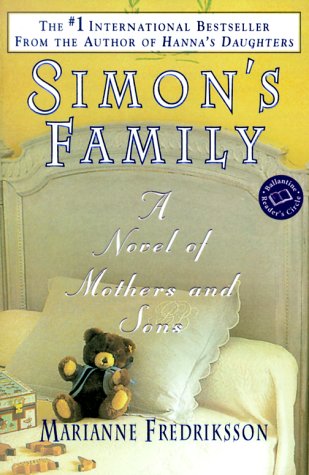



In her #1 international bestseller Hanna's Daughters, Marianne Fredriksson brilliantly evoked three generations of mothers, daughters, and the men in their lives. Now, in her haunting new novel, she traces the extraordinary relationship between a mother and son and the remarkable family they inhabit. The search for who we are and where we came from . . . the yearning for reconciliation between parent and child . . . the ever-shifting nature of what makes a family--Marianne Fredriksson weaves these elements into a powerful story of survival and transcendence, sacrifice and forgiveness, showing how even the most damaged heart can heal in the most unexpected ways. . . . "[A] QUIETLY MOVING STORY OF FAMILY, FRIENDSHIP, AND LOVE . . . In a novel rich in mystical overtones . . . Fredriksson explores relations between fantasy, myth, and reality." --Booklist "Fredriksson depicts the psychological aftermath of cruelty through the ebb and flow of interior monologues, adhering to time-honored parallels between the characters' harsh longings and the stark beauty of the remote Swedish seascape. . . . The novel contrasts the human capacity for suffering with a heartfelt optimism." --Publishers Weekly In her #1 international bestseller Hanna's Daughters, Marianne Fredriksson brilliantly evoked three generations of mothers, daughters, and the men in their lives. Now, in her haunting new novel, she traces the extraordinary relationship between a mother and son and the remarkable family they inhabit. The search for who we are and where we came from . . . the yearning for reconciliation between parent and child . . . the ever-shifting nature of what makes a family--Marianne Fredriksson weaves these elements into a powerful story of survival and transcendence, sacrifice and forgiveness, showing how even the most damaged heart can heal in the most unexpected ways. . . . "[A] QUIETLY MOVING STORY OF FAMILY, FRIENDSHIP, AND LOVE . . . In a novel rich in mystical overtones . . . Fredriksson explores relations between fantasy, myth, and reality." --Booklist "Fredriksson depicts the psychological aftermath of cruelty through the ebb and flow of interior monologues, adhering to time-honored parallels between the characters' harsh longings and the stark beauty of the remote Swedish seascape. . . . The novel contrasts the human capacity for suffering with a heartfelt optimism." --Publishers Weekly Marianne Fredriksson's novels have sold more than two million copies in her native Sweden. Hanna's Daughters was her first U.S. publication. From the Hardcover edition. "An ordinary bloody oak," the boy said to the tree. "Hardly fifteen meters high. That's nothing much to boast about. "And nor are you a hundred thousand," he said, thinking of his grandmother, now nearly ninety and nothing but an ordinary shrill old woman. Named, measured, and compared, the tree retreated from the boy. But he could still hear the singing in the great treetops, melancholy and reproachful. So he resorted to violence and crashed the stone he had kept for so long in his pocket straight into the trunk. "That'll shut you up," he said. The great tree instantly fell silent, and the boy knew something important had happened. He swallowed the lump in his throat, disowning his grief. That was the day he said farewell to his childhood. He did so at a definite moment and in a definite place; thus he would always remember it. For many years, he pondered over what he had relinquished on that day far back in his childhood. At twenty, he would have some idea, and then would spend his life trying to recapture it. But at this moment, he was on the hillside above Appelgren's garden, looking out over the sea, the fog gathering around the skerries before rolling in toward the coast. In the land of his childhood, the fog had many voices, the fog singing from Vinga to Alvsborg on a day like this. Behind him was the mountain and the meadow. At the end of the meadows, where the ground opened up, were the oak woods, the trees that had spoken to him over the years. In their shade, he had met the little man with the strange round hat. No, he thought, that wasn't true. He had always known the man, but it was in the shade of those great trees that he had actually seen him. It no longer mattered. "Just a load of shit," the boy said aloud as he crawled under the barbed wire of Appelgren's fence. He managed to avoid the old woman, Edit Appelgren, who used to tear out the couch grass in her dead-straight flower beds on early spring days like this. The foghorns had frightened her indoors. She couldn't stand fog. The boy understood that. Fog was the grief of the sea, as infinite as the sea, almost unbearable-- "Oh, shit," he said, for he knew better, and had just resolved to look on the world as other people saw it. The fog was the warmth of the Gulf Stream rising when the air grew cold. Nothing more than that. But he couldn't really deny the sorrow in the long drawn-out wai