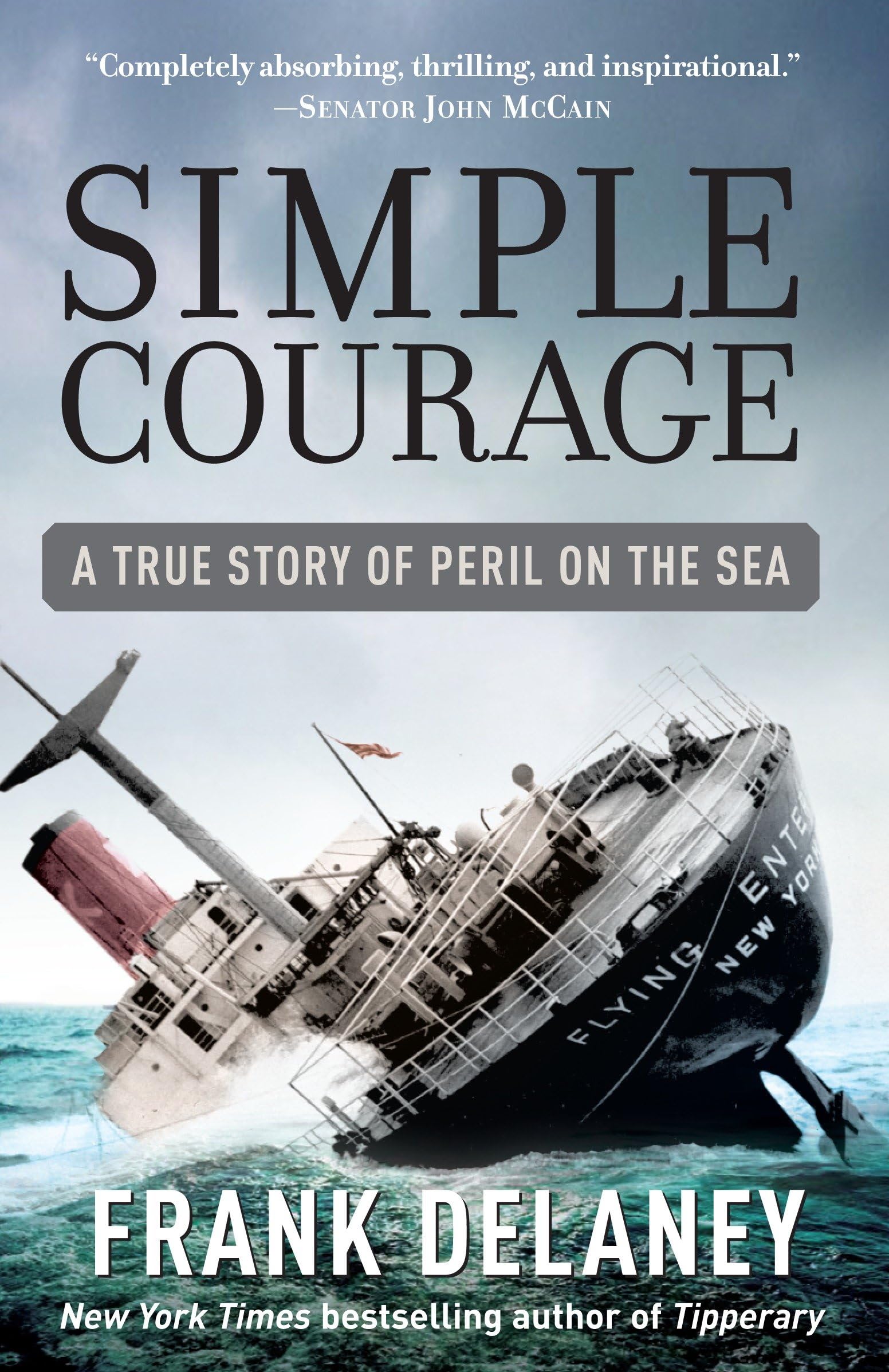



“HEAVEN HELP THE SAILOR ON A NIGHT LIKE THIS.” –old folk prayer In late December 1951, laden with passengers and nearly forty metric tons of cargo, the freighter S.S. Flying Enterprise steamed westward from Europe toward America. A few days into the voyage, she hit the eye of a ferocious storm. Force 12 winds tossed men about like playthings and turned drops of freezing Atlantic foam into icy missiles. When, in the space of twenty-eight hours, the ship was slammed by two rogue waves–solid walls of water more than sixty feet high–the impacts cracked the decks and hull almost down to the waterline, threw the vessel over on her side, and thrust all on board into terror. Flying Enterprise’s captain, Kurt Carlsen, a seaman of rare ability and valor, mustered all hands to patch the cracks and then try to right the ship. When these efforts came to naught, he helped transfer, across waves forty feet high, the passengers and the entire crew to lifeboats sent from nearby ships. Then, for reasons both professional and intensely personal, and to the amazement of the world, Carlsen defied all requests and entreaties to abandon ship. Instead, for the next two weeks, he fought to bring Flying Enterprise and her cargo to port. His heroic endeavor became the world’s biggest news. In a narrative as dramatic as the ocean’s fury, acclaimed bestselling author Frank Delaney tells, for the first time, the full story of this unmatched bravery and endurance at sea. We meet the devoted family whose well-being and safety impelled Carlsen to stay with his ship. And we read of Flying Enterprise’s buccaneering owner, the fearless and unorthodox Hans Isbrandtsen, who played a crucial role in Kurt Carlsen’s fate. Drawing on historical documents and contemporary accounts and on exclusive interviews with Carlsen’s family, Delaney opens a window into the world of the merchant marine. With deep affection–and respect–for the weather and all that goes with it, he places us in the heart of the storm, a “biblical tempest” of unimaginable power. He illuminates the bravery and ingenuity of Carlsen and the extraordinary courage that the thirty-seven-year-old captain inspired in his stalwart crew. This is a gripping, absorbing narrative that highlights one man’s outstanding fortitude and heroic sense of duty. “One of the great sea stories of the twentieth century… [a] surefire nautical crowd-pleaser.” --Booklist é (starred review) “Frank Delaney has written a completely absorbing, thrilling and inspirational account of a disaster at sea that occasioned heroism of the first order. In the hands of a gifted storyteller, the ‘simple courage’ of the ship’s captain and the young radio man who risked their lives to bring a mortally wounded ship to port reveals the essence and power of all true courage– a stubborn devotion to the things we love.” –Senator John McCain Frank Delaney is the author of the New York Times bestselling novel Ireland , as well as The Last Storyteller, The Matchmaker of Kenmare, Venetia Kelly’s Traveling Show, Tipperary, Shannon, and Simple Courage: A True Story of Peril on the Sea. A former judge for the Man Booker Prize, Delaney enjoyed a prominent career in BBC broadcasting before becoming a full-time writer. Delaney died in 2017. 1. In the national archives of the united states in washington, D.C., lies a dense report—several inches high of typed papers— on top of which rests a separate, summarizing document ten pages long. This is “the record of the Marine Board convened to investigate subject casualty, together with its Findings of Fact, Opinions and Recommendations.” Dated February 26, 1952, and signed by “P. A. Ovenden, Chief of the Merchant Vessel Inspection Division in the United States Coast Guard,” this official prose contains no hint of the magic energy that conceives a legend. Mr. Ovenden’s conclusions, sent by the Coast Guard to the chief of Merchant Marine Safety, begin by observing that a welded freighter named S.S. Flying Enterprise “departed from Hamburg, Germany for New York on 21 December 1951, loaded, among other things, with 762.6 tons of pig iron in No. 2 lower hold and 508 tons of pig iron in No. 4 hold.” Flying Enterprise, a freighter in the class known as “C1-B,” was built in the Wilmington yards at Los Angeles by the Consolidated Steel Corporation and released from the shipbuilder’s yard to the War Shipping Administration on March 18, 1944. (The man who stamped her brass registration plate made an error in the date, and his original “1943” is overstamped with “1944.”) She had the registration number 245133 and the combined signal and radio call sign KWFZ. After the war she went, in January 1946, to the U.S. Maritime Administration, where she was named Cape Kumukaki. On April 25, 1947, Cape Kumukaki became one of twelve vessels in the Isbrandtsen Line, out of New York, owned by a buccaneering Scandinavian, Hans Isbrandtsen, who, to echo the old sailing clippers, used the prefix F