Simply Rational: Decision Making in the Real World (Evolution and Cognition)
$63.32
by Gerd Gigerenzer



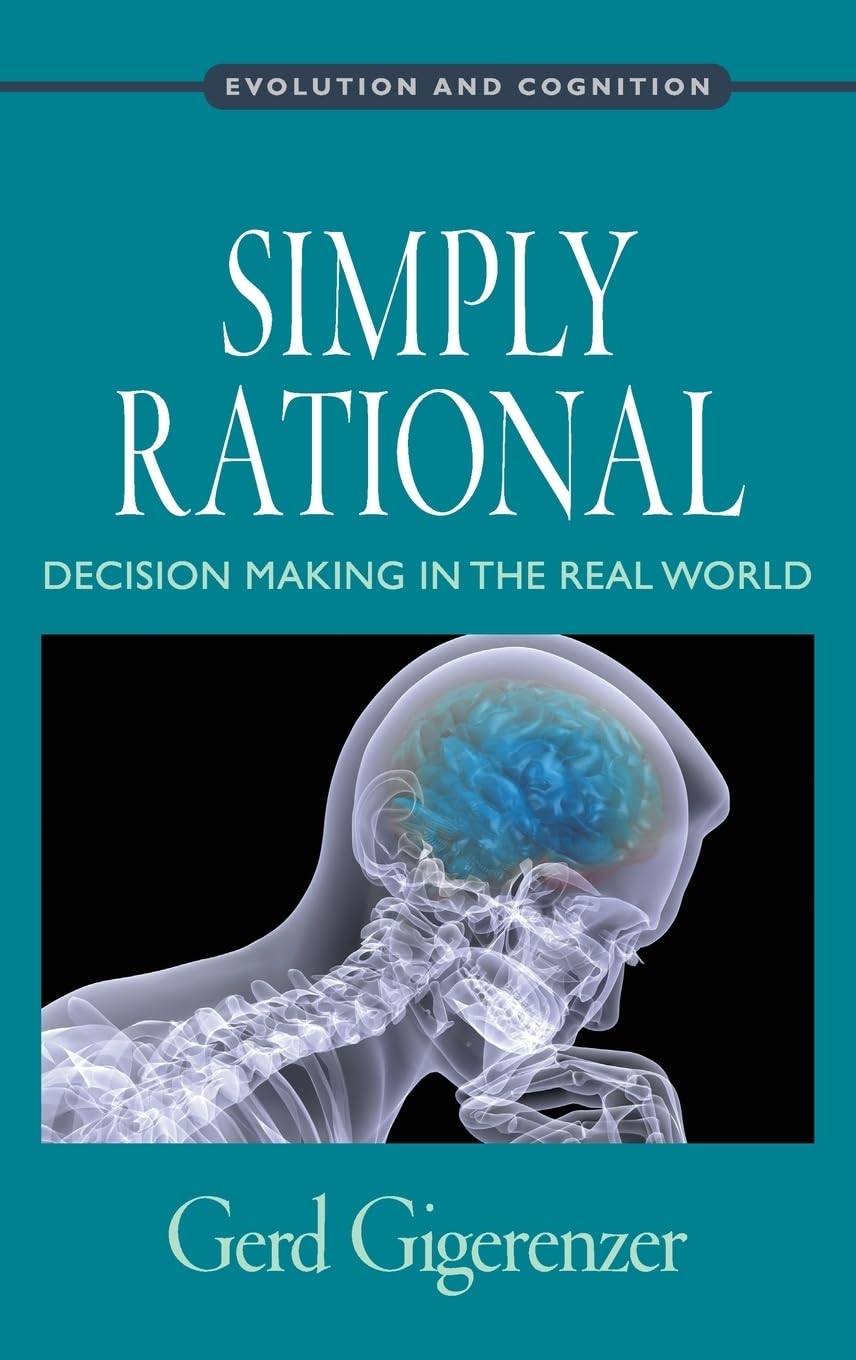
Statistical illiteracy can have an enormously negative impact on decision making. This volume of collected papers brings together applied and theoretical research on risks and decision making across the fields of medicine, psychology, and economics. Collectively, the essays demonstrate why the frame in which statistics are communicated is essential for broader understanding and sound decision making, and that understanding risks and uncertainty has wide-reaching implications for daily life. Gerd Gigerenzer provides a lucid review and catalog of concrete instances of heuristics, or rules of thumb, that people and animals rely on to make decisions under uncertainty, explaining why these are very often more rational than probability models. After a critical look at behavioral theories that do not model actual psychological processes, the book concludes with a call for a "heuristic revolution" that will enable us to understand the ecological rationality of both statistics and heuristics, and bring a dose of sanity to the study of rationality. "It was a great pleasure to read Gigerenzer's Simple Rational . There are so many insights, exciting ideas, and practical recommendations." -- Gary Klein, American Journal of Psychology "It isn't often I really enjoy a book of collected papers from a single author... However, the present volume taps into two fundamental transitions that psychology has made in the past several decades and that make this book exciting." -- PsycCRITIQUES "Gigerenzer is a master of the history of ideas in science and in psychology in particular... [He] practices what he preaches. His decades-long investment in the training of medical, judicial, and educational professionals reveals that his bottom line of concern is human freedom and well-being." --Joachim I. Krueger, American Journal of Psychology This volume of collected papers brings together applied and theoretical research on risks and decision making in the fields of medicine, psychology, and economics. Gerd Gigerenzer is Director of the Center for Adaptive Behavior and Cognition at the Max Planck Institute for Human Development, Berlin, Germany.