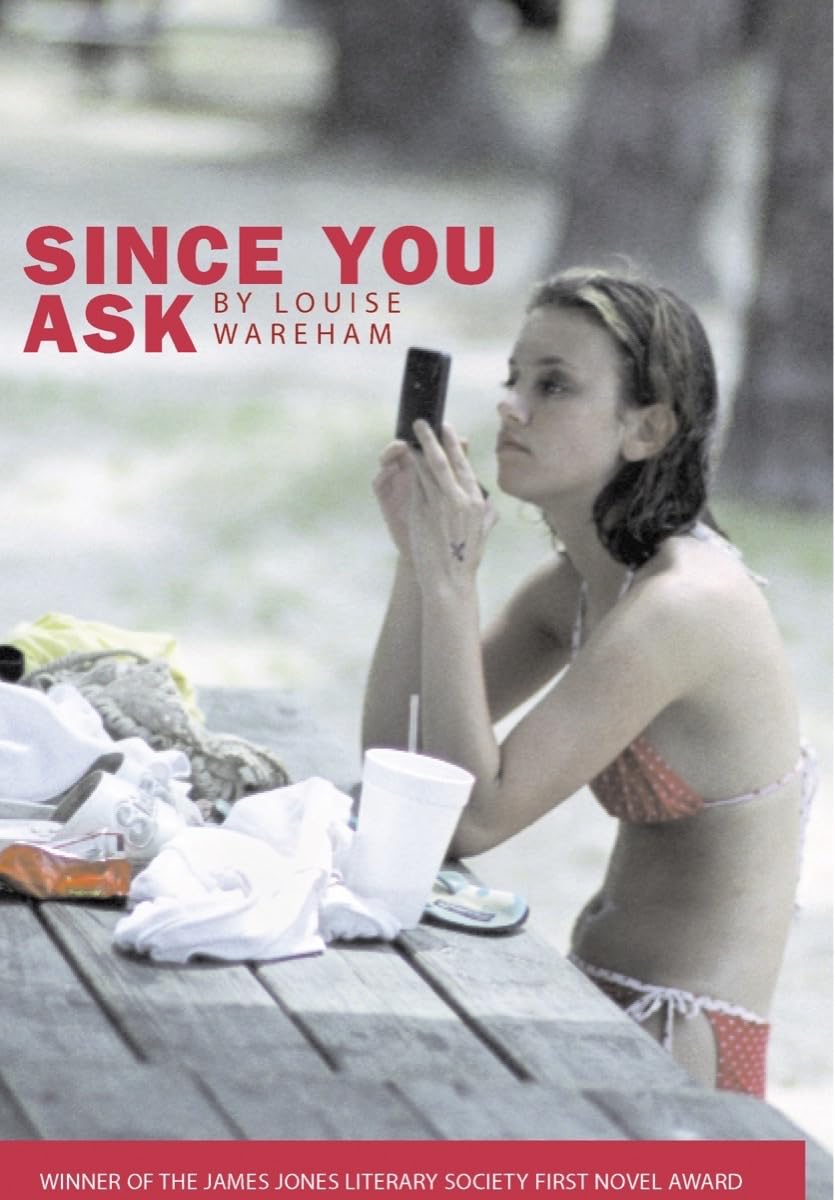



Since You Ask is about the origins of sexual compulsion, and one young woman’s attempts to be free. ―Winner of the James Jones Literary Society First Novel Award “Wareham’s simple, steady prose and aversion to glass-shattering drama elevate a potential cliche into unsettling intensity.” ―Entertainment Weekly From a Connecticut sanitarium, 24-year-old Betsy Scott tells her doctor a story about the destructive secrets in an outwardly successful family. A series of affairs take her into increasingly dark situations, from private-school Manhattan, to the outskirts of Queens, the downtown loft of a broker, the suburban house of a doctor in Scarsdale. Since You Ask is about the origins of sexual compulsion, and one young woman’s attempts to be free. Betsy Scott, a privileged private-school Manhattan teenager, is barely 16 when her reform-school boyfriend's shady boss takes an unwholesome interest in her. Surprisingly, Betsy willingly embarks on an affair with the 41-year-old. This relationship turns out to be only one of many inappropriate pairings that, along with family dysfunction and drug abuse, lead Betsy to a Connecticut mental hospital at age 24. Wareham's first novel is unsettling not only because of its subject matter but because the protagonist's simply stated but astute observations about her own compulsions force readers to rethink a lot of common assumptions about sexual behavior. Those expecting scathing indictments of what many would view as the sexual predators in Betsy's life will be sorely disappointed, as Wareham is more interested in examining what role Betsy herself plays in these situations. Although it ends on a hopeful note, this is obviously a very dark book--and potentially a controversial one--but Wareham has created a compelling character who earns her readers' attention. Beth Leistensnider Copyright © American Library Association. All rights reserved "The truly important novel, as Tolstoi so passionately averred, is the adventure of a question; and the question, most often, is unhappiness. Ranging inward to a psyche’s unsettled relation to itself, and out into the wilderness of family and love, Louise Wareham’s Since You Ask is a sustained and sustaining adventure, passionate as Tolstoi would approve. Reading this novel, I saw the substance (and substances) of unhappiness transformed into something even brighter than courage. This is a splendid debut." ― Donald Revell, author of Arcady "Louise Wareham’s keyed-down style amplifies the threat in the sexual terrain her narrator travels. She conveys the disequilibrium a young woman sustains in a run of soul-honing liaisons. ‘He saw I had been through something. And it was something that would serve him’―that the young narrator sees this and LIKES this in a man is the kind of charged and startling observation that powers this striking novel." ― Amy Hempel, author of Reasons to Live "Louise Wareham evokes the mystery of sexual compulsion with stunning honesty and quiet compassion. She captures the wry and brilliant humor of Betsy Scott, her core of tensile courage, so that we can bear to witness her life, so that we can keep our faith as she enters chaos to seek redemption. In the fragments of a fractured life, in stark and radiant images, Louise Wareham recovers miraculous beauty, a fragile stained glass vision of one woman’s whole and luminous spirit." ― Melanie Rae Thon, author of Sweet Hearts "Louise Wareham’s debut novel is a work of staggering intensity, written in a deceptively straight-forward, no-nonsense prose, which belies the vast iceberg of unexplored pain that lurks just below its surface." ― Kaylie Jones, author of Speak Now and A Soldier’s Daughter Never Cries Louise Wareham grew up in Manhattan and graduated from Columbia University. She has worked as a reporter in New York City, Oxford, Mississippi and New Zealand. Since You Ask was the winner of the James Jones Literary Society First Novel Award. Wareham lives in New York City. Last May my whole family drove out to JFK Airport to meet Raymond. He had been gone for six years, and Dad was carrying his camera as if Ray were some kind of movie star. Usually, I was nervous around Ray, but I wasn't that day. Partly because I didn't live at home anymore and partly because Ray didn't bother me anymore. 'Give your brother a kiss,' my mother said, prodding me in the back. 'Put your arm around her,' Dad said, pointing his camera at us. Then Eric stood between us and Dad took pictures of that, too. In the car, we passed rows and rows of housing projects, all square and brown and the same. I would have to kill myself if I lived in a place like that. I pointed this out, but no one said anything. Raymond lit a cigarette when he stepped out of the car. Couldn't you wait, I wanted to say. He had a few drags, then flicked it to the gutter. We went to Sardi's. It was loud and crowded, and Dad ordered wine and pasta with clams. He gave a toast to Raymond, 'our prodiga