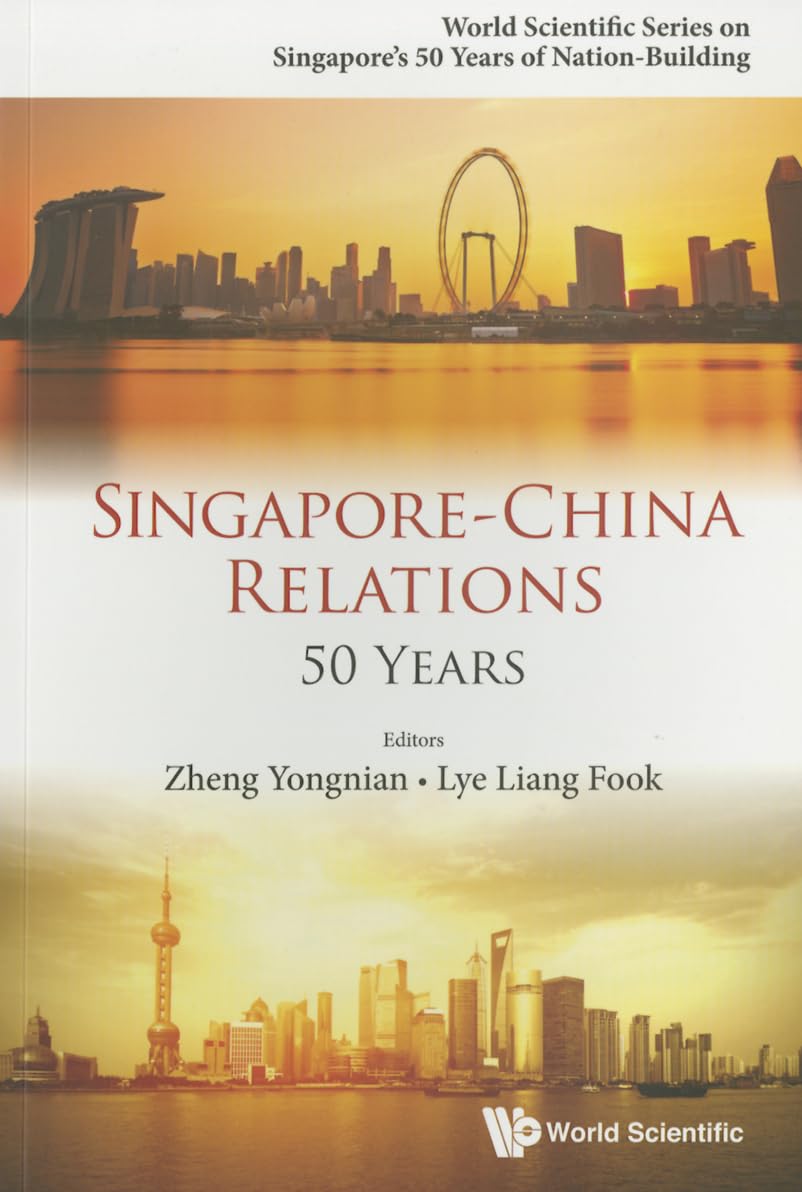
Singapore-China Relations: 50 Years (World Scientific Singapore's 50 Years of Nation-Building)
$28.00
by Liang Fook Lye



"This book highlights the distinguishing features of the Singapore-China relationship such as the strong foundation laid by the leaders of the two countries, the high-level institutional platforms that drive bilateral ties and the number of flagship projects and multi-faceted cooperation that lend substance to the relationship. It underscores Singapore's efforts to stay relevant to China's growth as well as China's inclination to work with Singapore for mutual benefit. A timely, well-written and informative publication that covers key aspects of the bilateral relationship." Wang Gungwu Chairman, East Asian Institute, Nus Chairman, Lee Kuan Yew School of Public Policy, Nus Chairman, Iseas - Yusof Ishak Institute Showcasing the substantive and multi-faceted Singapore–China relationship, this book examines the political, economic, socio-cultural, people-to-people and even military exchanges between the two countries. It also highlights flagship projects and other key private sector-led projects that have become hallmarks of bilateral cooperation. The book argues that the current level of cooperation is built on the earlier foundation laid by Lee Kuan Yew and Deng Xiaoping. In a way, the bilateral relationship is a unique one. For one, Deng Xiaoping had singled out Singapore as a model for China's reforms and China today continues to find Singapore's experience relevant. Singapore is also learning from China in the process. The two countries also have a number of bilateral institutional mechanisms that have become more important in reviewing existing cooperation and identifying new ways of working together. Rather than simply provide an overview of bilateral relations, the book highlights the unique or distinguishing features of the Singapore–China relationship. Showcasing the substantive and multi-faceted SingaporeChina relationship, this book examines the political, economic, socio-cultural, people-to-people and even military exchanges between the two countries. It also highlights flagship projects and other key private sector-led projects that have become hallmarks of bilateral cooperation. The book argues that the current level of cooperation is built on the earlier foundation laid by Lee Kuan Yew and Deng Xiaoping. In a way, the bilateral relationship is a unique one. For one, Deng Xiaoping had singled out Singapore as a model for China's reforms and China today continues to find Singapore's experience relevant. Singapore is also learning from China in the process. The two countries also have a number of bilateral institutional mechanisms that have become more important in reviewing existing cooperation and identifying new ways of working together. Rather than simply provide an overview of bilateral relations, the book highlights the unique or distinguishing features of the SingaporeChina relationship in four main areas, which are revealed in the book. Zheng Yongnian is professor and director of the East Asian Institute, National University of Singapore. He is the editor of Series on Contemporary China (World Scientific Publishing) and editor of China Policy Series (Routledge). He is also the editor of China: An International Journal and the co-editor of East Asian Policy. He has studied both China's transformation and its external relations. His papers have appeared in journals such as Comparative Political Studies, Political Science Quarterly, Third World Quarterly and China Quarterly . He is the author of numerous books, including The Chinese Communist Party as Organizational Emperor, Technological Empowerment, De Facto Federalism in China, Discovering Chinese Nationalism in China and Globalization and State Transformation in China , and coeditor of dozens of books on China's domestic development and international relations including the latest volumes China Entering the Xi Era and China and International Relations: The Chinese View and the Contribution of Wang Gungwu (2010). Besides his research work, professor Zheng has also been an academic activist. He served as a consultant to United Nations Development Programme on China's rural development and democracy. In addition, he has been a columnist for Xinbao (Hong Kong) and Zaobao (Singapore) for many years, writing numerous commentaries on China's domestic and international affairs. Prof Zheng received his BA and MA degrees from Beijing University, and his PhD at Princeton University. He was a recipient of Social Science Research Council-MacArthur Foundation Fellowship (1995–1997) and John D and Catherine T MacArthur Foundation Fellowship (2003–2004). He was professor and founding research director of the China Policy Institute, the University of Nottingham, United Kingdom (2005–2008). Lye Liang Fook is assistant director and research fellow at the East Asian Institute, National University of Singapore. His research interests cover China's central-local relations, political legitimacy, print media, China-ASEAN relations and China–S