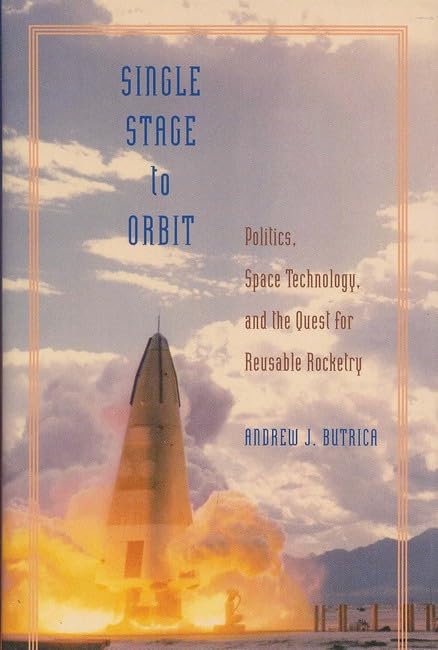
Single Stage to Orbit: Politics, Space Technology, and the Quest for Reusable Rocketry (New Series in NASA History)
$53.95
by Andrew J. Butrica



Winner of the Michael C. Robinson Prize for Historical Analysis given by the National Council on Public History While the glories and tragedies of the space shuttle make headlines and move the nation, the story of the shuttle forms an inseparabe part of a lesser-known but no less important drama―the search for a reusable single-stage-to-orbit rocket. Here an award-winning student of space science, Andrew J. Butrica, examines the long and tangled history of this ambitious concept, from it first glimmerings in the 1920s, when technicians dismissed it as unfeasible, to its highly expensive heyday in the midst of the Cold War, when conservative-backed government programs struggled to produce an operational flight vehicle. Butrica finds a blending of far-sighted engineering and heavy-handed politics. To the first and oldest idea―that of the reusable rocket-powered single-stage-to-orbit vehicle―planners who belonged to what President Eisenhower referred to as the military-industrial complex.added experimental ("X"), "aircraft-like" capabilties and, eventually, a "faster, cheaper, smaller" managerial approach. Single Stage to Orbit traces the interplay of technology, corporate interest, and politics, a combination that well served the conservative space agenda and ultimately triumphed―not in the realization of inexpensive, reliable space transport―but in a vision of space militarization and commercialization that would appear settled United States policy in the early twenty-first century. A history of one particular aspect of US space history―the attempt to develop a single-stage-to-orbit launcher . . . it is a story of muddle and waste . . . Butrica provides a competent and readable account of this debacle, which concentrates on the small research vehicle, DC-X. ―D. M. Ashford, Times Literary Supplement The 'holy grail' of the spaceship movement has been the development of a vehicle that could accomplish single stage to orbit (SSTO) flight. This study describes the evolution of this concept from the 1920s to the present, revealing a conservative space agenda that has not yet been the subject of historical analysis. As such, it makes an important contribution to space history literature. ―Roger D. Launius, The Smithsonian Institution The 'holy grail' of the spaceship movement has been the development of a vehicle that could accomplish single stage to orbit (SSTO) flight. This study describes the evolution of this concept from the 1920s to the present, revealing a conservative space agenda that has not yet been the subject of historical analysis. As such, it makes an important contribution to space history literature. -- Roger D. Launius Andrew J. Butrica, a historical consultant, is the author of, among other works, To See the Unseen: A History of Planetary Radar Astronomy , which won the 1998 Richard W. Leopold Prize awarded by the Organization of American Historians. Used Book in Good Condition