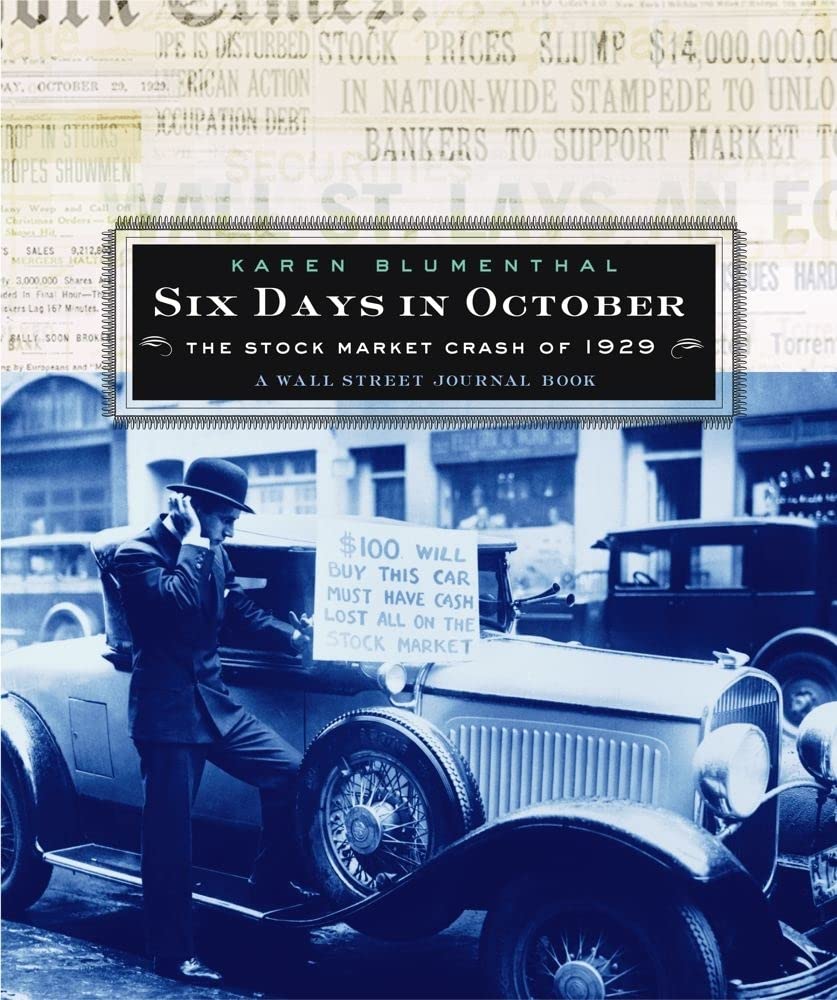
Six Days in October: The Stock Market Crash of 1929: A Wall Street Journal Book for Children
$23.73
by Karen Blumenthal



Over six terrifying, desperate days in October 1929, the fabulous fortune that Americans had built in stocks plunged with a fervor never seen before. At first, the drop seemed like a mistake, a mere glitch in the system. But as the decline gathered steam, so did the destruction. Over twenty-five billion dollars in individual wealth was lost, vanished gone. People watched their dreams fade before their very eyes. Investing in the stock market would never be the same. Here, Wall Street Journal bureau chief Karen Blumenthal chronicles the six-day period that brought the country to its knees, from fascinating tales of key stock-market players, like Michael J. Meehan, an immigrant who started his career hustling cigars outside theaters and helped convince thousands to gamble their hard-earned money as never before, to riveting accounts of the power struggles between Wall Street and Washington, to poignant stories from those who lost their savings -- and more -- to the allure of stocks and the power of greed. For young readers living in an era of stock-market fascination, this engrossing account explains stock-market fundamentals while bringing to life the darkest days of the mammoth crash of 1929. Gr. 7-12. A Wall Street Journal bureau chief, Blumenthal combines a fascinating overview of the infamous stock market crash in 1929 with a rare and useful primer of financial basics. The chapters follow the six days surrounding the crash, but Blumenthal deftly places the events in context with vivid accounts of the stock-market fever that preceded the crash, often showing the impact of abstract issues through individual stories--the losses of Groucho Marx and of General Motors' founder William Durant are particularly astonishing. Rapid, simply constructed sentences increase the drama and suspense while making difficult concepts easily understood. Throughout, fact boxes define financial vocabulary--stocks, bonds, bulls and bears, margins, the measure of a company's worth, and more--in clear language that is both compelling and instructive. Archival images--photos, cartoons, and reproduced documents--enhance the text, as do frequent excerpts from newspapers and political quotes from the era. Students using this for research may be frustrated by the source citations, which appear as an appended, generalized chapter-by-chapter listing of materials consulted rather than as specific notes that correspond to text passages. But this still offers a riveting history, along with the basic terminology needed to grasp the events and to draw parallels between the volatile, sometimes corrupt, market of 1929 and the market today. Gillian Engberg Copyright © American Library Association. All rights reserved "Fast-paced, gripping (and all too timely) . . ." Karen Blumenthal (1959–2020) was a financial journalist and editor whose career included five years with The Dallas Morning News and twenty-five with The Wall Street Journal before becoming an award-winning children’s nonfiction book writer. Three of her books were finalists for the YALSA Excellence in Nonfiction for Young Adults Award, and she was the author of Sibert Honor Book Six Days in October: The Stock Market Crash of 1929. Chapter One: October 24 Black Thursday Word spread quickly on this crisp fall morning: Stocks were in big trouble. The boys selling the morning newspapers shouted the news. Serious-voiced announcers on the radio commented on it. On the street, everyone was talking about it. Something was terribly wrong with the stock market, the greatest fountain of wealth in the history of America. In the financial district of New York City and in other offices where brokers sold stocks, people began to gather well before stock trading formally began at 10 a.m. Men and women, nervous and pale, rushed to grab seats in the special customers' rooms at brokerage houses all around Wall Street. One observer said they looked like "dying men counting their own last pulse beats." People also hurried to the corner of Broad and Wall Streets, just across the way from the New York Stock Exchange. Hundreds, then thousands, filled the streets and sidewalks. Men in overcoats and fedoras and women on break from their stenographers' jobs crowded in front of J. P. Morgan & Company, the powerful banking company at 23 Wall Street. They lined the stairs of the Subtreasury Building, right near the statue marking where George Washington was sworn in as the nation's first president. Usually, this kind of massive crowd gathered only for fires or to peer at the gore of some new crime. This day, though, there was nothing to see. Fear and excitement had brought them, the kind of intense, heart-pounding emotion felt when something really bad is happening. If stocks were dropping, plans for the future were disappearing too. For some people gathered there, every cent they owned was riding on stocks, those odd pieces of paper that represented small stakes in American companies. For