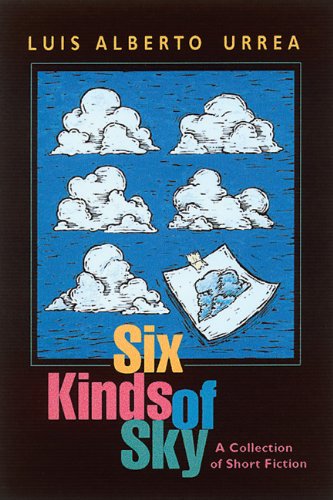



"Home isn't just a place, it is also a language." Born in Tijuana, the son of an Anglo woman and a Mexican father, Urrea says that "Home isn't just a place, it is also a language." In these six stories—each wandering beneath different kinds of sky, from the thick Mazatlan starry night to the wide open spaces of the Sioux Nation in South Dakota—Urrea maps the spiritual geography of what he calls "home." "I always thought Luis Urrea was six skies rolled into one (I mean that in a good way), and this book proves that he speaks with a multitude of passionate, powerful and hilarious voices. This book is a beautiful kind of crazy."—Sherman Alexie "With this new collection of stories, Luis Urrea makes the short list of essential American writers. His glittering landscapes, which warp and ennoble the human spirit, bring to mind the work of Salman Rushdie. I found myself going back and rereading whole passages; Urrea's got a way with words that raises the bar for the rest of us. What a marvel of a book!"—Demetria Martínez "Urrea goes in for the big picture, and there seems to be no world he cannot capture. He writes with wit and ingenuity, and the stories possess a powerful sense of acceleration. With each story I was transported to an intense and fully imagined world."—Robert Boswell Luis Urrea is a novelist, essayist and poet. His books have received The American Book Award for non-fiction, 1998, and The Western States Book Award for Poetry, 1994, and The New York Times named his non-fiction Across the Wire a Notable Book of the Year, 1993. Luis lives in Chicago. An award-winning poet, fiction writer and essayist, Urrea should be required reading for anyone living in the Southwest. -- San Diego Union Tribune, April 14, 2002 Richard Rodriguez says we are writing the stories of a mixed race, code-switching America. Urrea is writing these stories. -- Foreword Magazine, May 2002 Short, direct sentences and pitch-perfect dialogue build into original studies of passion, restlessness or mischief, one detail at a time. -- San Francisco Chronicle, April 14, 2002 I always thought Luis Urrea was six skies rolled into one (I mean that in a good way), and this book proves that he speaks with a multitude of passionate, powerful and hilarious voices. This book is a beautiful kind of crazy. Sherman Alexie With this new collection of stories, Luis Urrea makes the short list of essential American writers. His glittering landscapes, which warp and ennoble the human spirit, bring to mind the work of Salman Rushdie. I found myself going back and rereading whole passages; Urreas got a way with words that raises the bar for the rest of us. What a marvel of a book! Demetria Martínez, Mother Tongue Urrea goes in for the big picture, and there seems to be no world he cannot capture. He writes with wit and ingenuity, and the stories possess a powerful sense of acceleration. With each story I was transported to an intense and fully imagined world. Robert Boswell Luis Alberto Urrea is author of widely acclaimed novel The Hummingbird's Daughter and 2005 Pulitzer Prize finalist for nonfiction for The Devil's Highway. A member of the Latino Literature Hall of Fame, Luis was born in Tijuana, Mexico to a Mexican father and an American mother. This is his first graphic novel and Young Adult title. Six Kinds of Sky A COLLECTION OF SHORT FICTION By Luis Alberto Urrea CINCO PUNTOS PRESS Copyright © 2002 Luis Alberto Urrea. All rights reserved. ISBN: 0-938317-63-6 Chapter One MR. MENDOZA'S PAINTBRUSH WHEN I REMEMBER my village, I remember the color green. A green that is rich, perhaps too rich, and almost bubbling with humidity and the smell of mangos. I remember heat, the sweet sweat of young girls that collected on my upper lip as we kissed behind the dance stand in the town square. I remember days of nothing and rainstorms, dreaming of making love while walking around the plazuela , admiring Mr. Mendoza's portraits of the mayor and the police chief, and saying dashing things to the girls. They, of course, walked in the opposite direction, followed closely by their unsympathetic aunts, which was only decent. Looking back, I wonder if perhaps saying those dashing things was better than making love. Mr. Mendoza wielded his paintbrush there for thirty years. I can still remember the old women muttering bad things about him on their way to market. This was nothing extraordinary. The old women muttered bad things about most of us at one time or another, especially when they were on their way to market at dawn, double file, dark shawls pulled tight around their faces, to buy pots of warm milk with the cows' hairs still floating in them. Later in the day, after their cups of coffee with a bit of this hairy milk (strained through an old cloth) and many spoonfuls of sugar, only then did they begin to concede the better points of the populace. Except for Mr. Mendoza. Mr. Mendoza had taken the controversial p