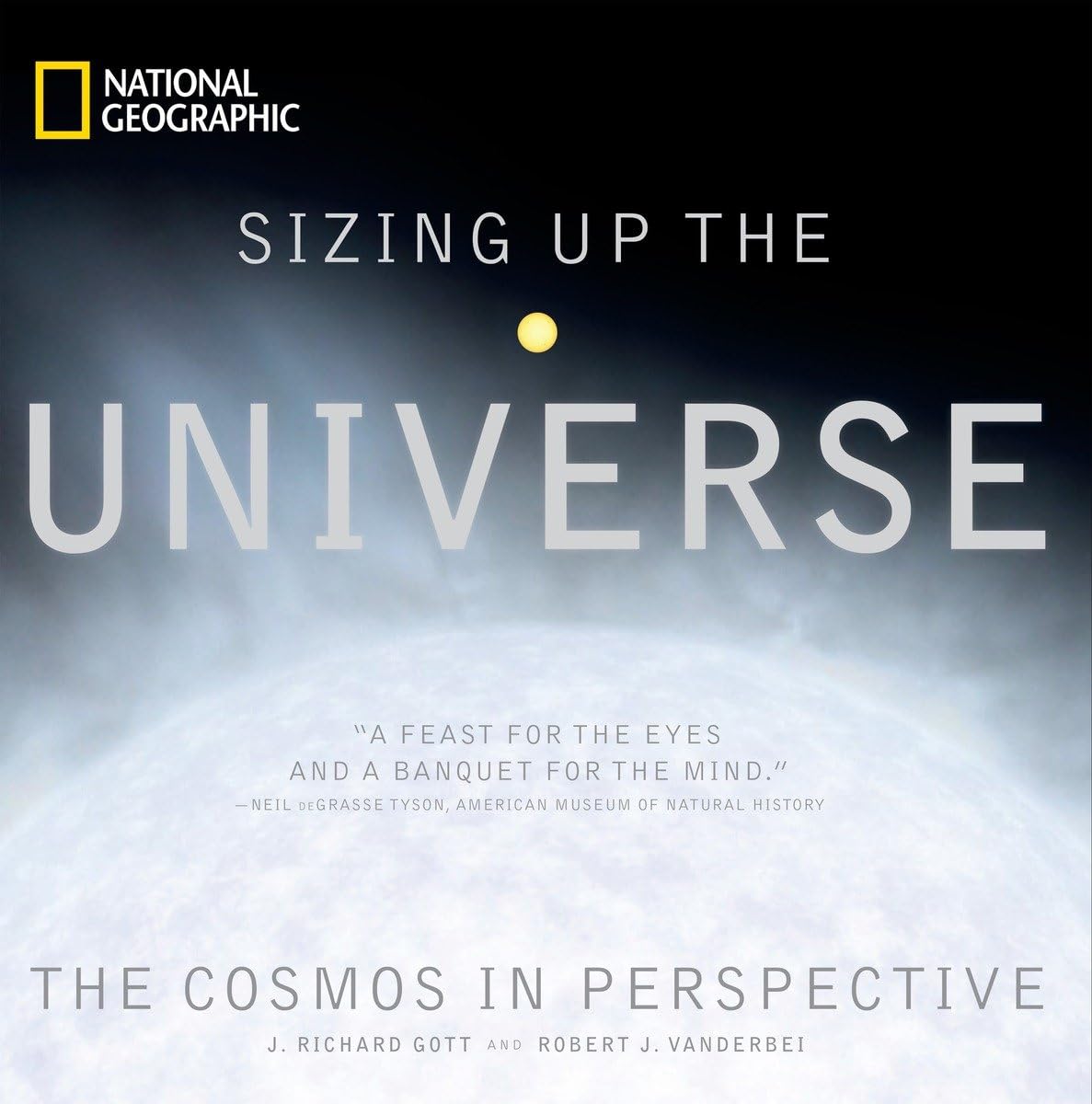



Sizing Up the Universe reveals an ingenious new way to envision the outsize proportions of space, based on the work of Princeton University professors Richard Gott and Robert Vanderbei. Using scaled maps, object comparisons, and beautiful space photographs, it demonstrates the actual size of objects in the cosmos ―from Buzz Aldrin's historic footprint to the visible universe and beyond. The authors offer visual comparisons with astonishing precision and maximum reader-friendliness, conveying clear and understandable explanations of unimaginable vastness. Plus, as an unprecedented bonus, their 1.5-million-selling Map of the Universe is published here for the first time ever in a book―presented on an oversize foldout page that maximizes its eye-popping presentation of satellites, planets, stars, and galaxies. Based on the popularity of the map and of Richard Gott's Time Travel in Einstein's Universe, and offering innovative ways to appreciate the majesty of the universe, this new title should soar. From Sizing Up the Universe Click on the images below to open larger versions. In this close-up view , the Carina Nebula features a pair of Bok globules (left and right), which are thought to be concentrations of dust condensing into yet-to-be-born stars. (NASA, ESA, p. 6-7) The Western Veil Nebula , known as the Witch’s Broom, is part of a huge supernova remnant that spans more than six moon widths (diameters) across in the night sky. (Robert J. Vanderbei, p. 8-9) The band of light known as the Milky Way is at its widest when one looks at it in the direction of the galactic center. (Jim Richardson, p. 25) The Pan-STARRS 1 telscope complex in Maui, Hawaii maps the sky. (Stephen L. Alvarez,. 44-45) With 14,000,000-power magnification provided by a hypothetical supertelescope, we would be able to see dramatic views of nearby stars as well as the footprint Buzz Aldrin left behind on the moon. (Stars: Robert J. Vanderbei, p. 43) The moon is roughly a quarter the size of Earth. When astronauts on the moon looked back at Earth, it was four times the angular diameter of the moon as seen from Earth. (NASA, p. 144) The Butterfly Nebula, a dying star shedding gas. The ring of dust at the narrow waist, thrown off by the star earlier, now forces newly ejected gas out the top and bottom, creating a nebula that is more than two lightyears in diameter. (NASA, ESA and the Hubble Heritage Team STScI/AURA, p. 187) Buzz Aldrin on the moon , photographed by Neil Armstrong. Armstrong is reflected in the visor. (NASA, p. 191) “A feast for the eyes and a banquet for the mind." Neil de Grasse Tyson, best-selling author and NovaScienceNow host “The genius of Sizing Up the Universe comes directly from the co-authors' fertile brains. ... It may strike readers, meanwhile, that the authors must have conjured up some sort of Einsteinian space warp to get so much information, in such a variety of vivid, gorgeous and conceptually brilliant forms, into a single book. You can pretty much open it to any page and have an "aha!" moment that will embed itself in your brain. And over time, without even noticing, you may even begin to grasp the true immensity of the universe." ~Michael D. Lemonick, TIME.com "It may strike readers...that the authors must have conjured up some sort of Einsteinian space warp to get so much information, in such a variety of vivid, gorgeous and conceptually brilliant forms, into a single book." --Time "You can pretty much open it to any page and have an "aha!" moment that will embed itself in your brain." -- Time "The latest attempt to put the cosmos in perspective, and it may be the most effective yet — even though it takes the retro form of a physical book...it also conveys the relative sizes and distances of cosmic objects in so many different and ingenious ways that it becomes a little dizzying — in the best possible sense." –Time "This is a wonderful book - one I had been waiting for ever since I was eight years old, and one that would make a memorable gift for imaginations young and old." – New Scientist “magnified stunning views.” – Book News “It’s impossible to fathom the scale of the universe, but Princeton professors Robert Vanderbei and J. Richard Gott sure as heck try.” – The Star Ledger (Newark) Richard Gott is Professor of Astrophysics at Princeton University. A Phi Beta Kappa, summa cum laude graduate in Physics from Harvard in 1969, he received his Ph.D. in Astrophysics from Princeton in 1973. He was a postdoctoral fellow at the California Institute of Technology and at Cambridge University in England before returning to join the Princeton faculty. He is the author of the popular book Time Travel in Einstein's Universe (Houghton Mifflin, 2001; approx. 50,000 copies in American hard cover and paperback editions sold to date, with 11 other editions around the world). Robert Vanderbei is Professor and Chair of the Department of Operatio