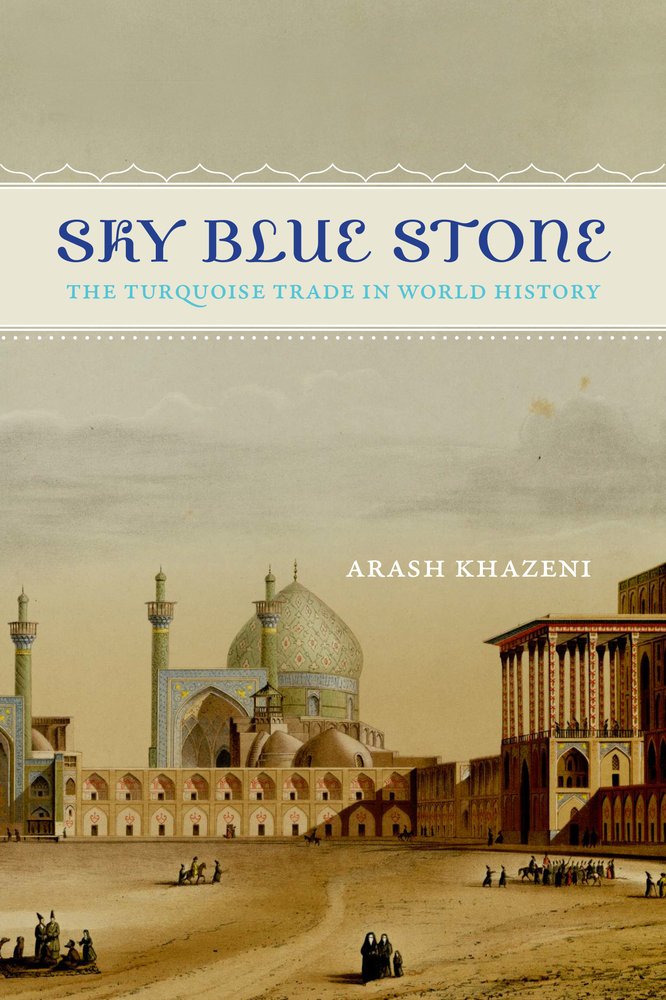
Sky Blue Stone: The Turquoise Trade in World History (California World History Library) (Volume 20)
$28.00
by Arash Khazeni



This book traces the journeys of a stone across the world. From its remote point of origin in the city of Nishapur in eastern Iran, turquoise was traded through India, Central Asia, and the Near East, becoming an object of imperial exchange between the Safavid, Mughal, and Ottoman empires. Along this trail unfolds the story of turquoise--a phosphate of aluminum and copper formed in rocks below the surface of the earth--and its discovery and export as a global commodity. In the material culture and imperial regalia of early modern Islamic tributary empires moving from the steppe to the sown, turquoise was a sacred stone and a potent symbol of power projected in vivid color displays. From the empires of Islamic Eurasia, the turquoise trade reached Europe, where the stone was collected as an exotic object from the East. The Eurasian trade lasted into the nineteenth century, when the oldest mines in Iran collapsed and lost Aztec mines in the Americas reopened, unearthing more accessible sources of the stone to rival the Persian blue. Sky Blue Stone recounts the origins, trade, and circulation of a natural object in the context of the history of Islamic Eurasia and global encounters between empire and nature. "This is a small and elegant book that modestly hides the author's extraordinary linguistic and cultural knowledge, along with his reach across disciplines such as the histories of science, medicine, and architecture. The range of archival materials consulted is staggering. Another move toward "re-Orientation," Sky Blue Stone sets a high bar for anyone attempting a global study of a rare and elusive commodity whose producers, traders, and consumers were often content to ignore the West." -- Kris Lane ― American Historical Review Published On: 2015-06-01 "The obvious and compelling strength of this book is Khazeni's ability to synthesize information from the remarkably numerous Persian language sources and later European commentaries . . . . on three major themes: the chemistry, mining, and sale of turquoise, the value and appreciation of the stone in Safavid Iran and the neighboring Ottoman and Mughal empires, and perhaps most important of all, the cultural significance of the stone and its color in Iranian culture." -- Stephen Dale ― International Journal of Middle Eastern Studies Published On: 2016-01-14 "An important aspect of the author's approach is that it exposes a previously underutilized body of writing as its main source base: javahirnama . . . . Khazeni argues provocatively that these texts operated as natural histories in their own right, exerting significant influence over environmental, scientific, cultural, and political economic knowledge in the Persian-reading world, as well as prefiguring Western environmental and mineralogical thinking. This is the most captivating dimension of the monograph and one that should incite much future study for those looking to reorient and globalize our understanding of the history of the natural world . . . . It will be welcome reading for anyone looking to complicate their understanding of the early modern world of trade, Islamic World history, environmental history, the meanings of blue, and ornamentalism." -- Danielle Kinsey ― Cultural and Social History Published On: 2016-04-12 "This is a small and elegant book that modestly hides the author's extraordinary linguistic and cultural knowledge, along with his reach across disciplines such as the histories of science, medicine, and architecture. The range of archival materials consulted is staggering. Another move toward "re-Orientation," Sky Blue Stone sets a high bar for anyone attempting a global study of a rare and elusive commodity whose producers, traders, and consumers were often content to ignore the West." -- Kris Lane ― American Historical Review Published On: 2015-06-01 "The obvious and compelling strength of this book is Khazeni's ability to synthesize information from the remarkably numerous Persian language sources and later European commentaries . . . . on three major themes: the chemistry, mining, and sale of turquoise, the value and appreciation of the stone in Safavid Iran and the neighboring Ottoman and Mughal empires, and perhaps most important of all, the cultural significance of the stone and its color in Iranian culture." -- Stephen Dale ― International Journal of Middle Eastern Studies Published On: 2016-01-14 "An important aspect of the author's approach is that it exposes a previously underutilized body of writing as its main source base: javahirnama . . . . Khazeni argues provocatively that these texts operated as natural histories in their own right, exerting significant influence over environmental, scientific, cultural, and political economic knowledge in the Persian-reading world, as well as prefiguring Western environmental and mineralogical thinking. This is the most captivating dimension of the monograph and one that should incite much future