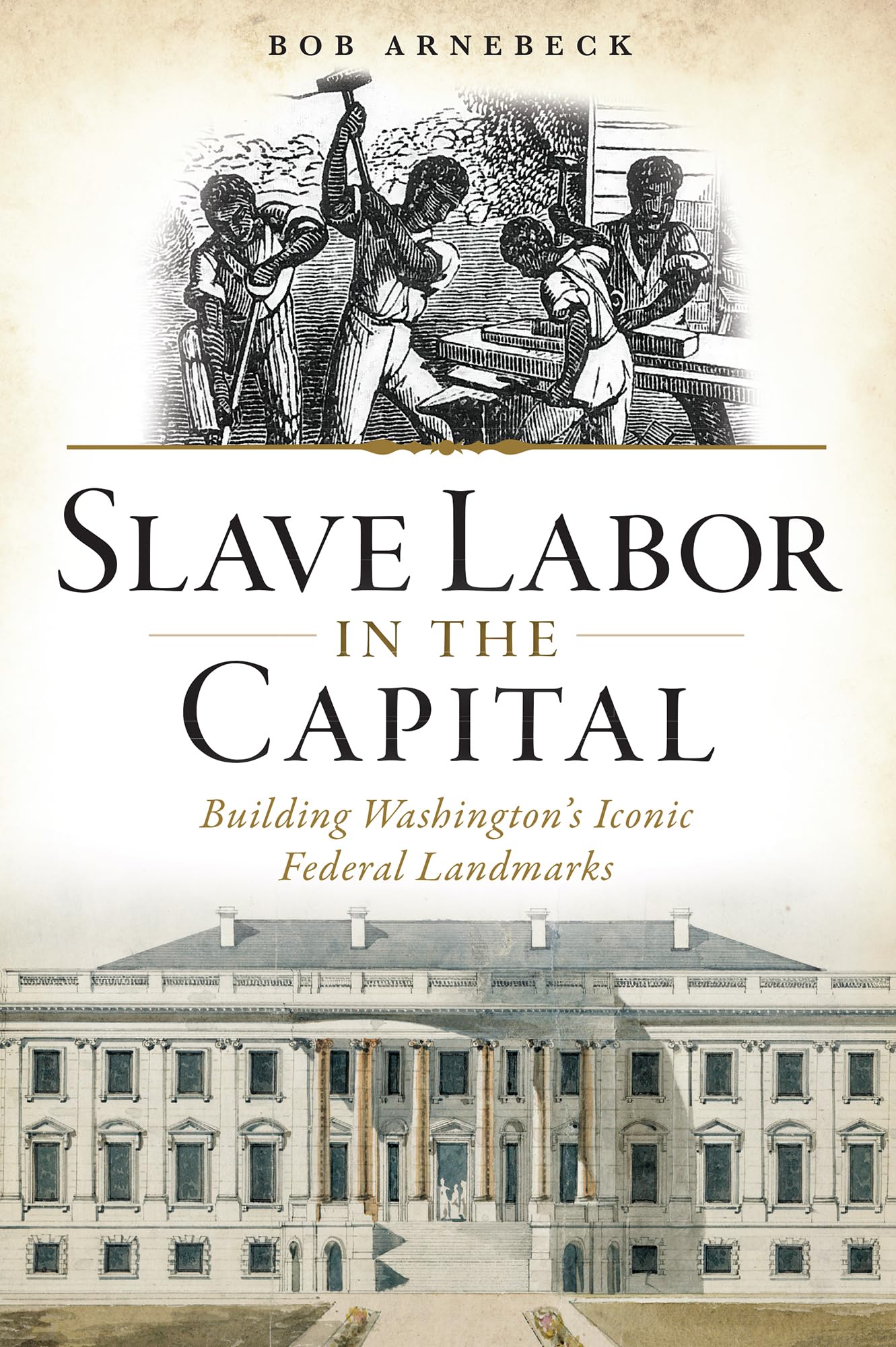
Slave Labor in the Capital: Building Washington's Iconic Federal Landmarks
$21.99
by Bob Arnebeck



In 1791, President George Washington appointed a commission to build the future capital of the nation. The commission found paying masters of faraway Maryland plantations sixty dollars a year for their slaves made it easier to keep wages low for free workers who flocked to the city. In 1798, half of the two hundred workers building the two most iconic Washington landmarks, the Capitol and the White House, were slaves. They moved stones for Scottish masons and sawed lumber for Irish carpenters. They cut trees and baked bricks. These unschooled young black men left no memoirs. Based on his research in the commissioners' records, author Bob Arnebeck describes their world of dawn to dusk work, salt pork and corn bread, white scorn and a kind nurse and the moments when everything depended on their skills. Bob Arnebeck was born in Washington in 1947 and graduated Beloit College in 1969. In 1987 he was a commentator on NPR's Morning Edition. He wrote Proust's Last Beer: A History of Curious Demises (Penguin Books, 1981) and Through a Fiery Trail: Building Washington 1790, 1800 (Madison Books, 1991). In 1994 he moved to Wellesley Island in the St. Lawrence River. Slave Labor in the Capital Building Washington's Iconic Federal Landmarks By Bob Arnebeck The History Press Copyright © 2014 Bob Arnebeck All rights reserved. ISBN: 978-1-62619-721-3 Contents Acknowledgements, Introduction, 1. Far from Home, 2. Chocolate Butter for Breakfast, 3. Axe Men, 4. Quarries, 5. Hauling, 6. Stonecutters and Masons, 7. Sawyers and Carpenters, 8. Bricks, 9. Living Conditions, 10. 1800, Lists of Masters, Their Slaves and Free Workers, Sources, About the Author, CHAPTER 1 Far from Home No one ever described the arrival of any of the slaves hired to build the Capitol and White House. Getting slaves to those work sites would hardly seem to be an issue. In 1790, there were more slaves in Prince George's County, Maryland, than whites: 11,176 to 10,004. That was the county from which the city of Washington was extracted in 1800 when the federal government officially made it the national capital. It is often assumed that all the slaves needed, never more than 100 in the peak years of slave hire, lived nearby. Indeed, around 400 slaves lived a few miles from the site of the Capitol. Over 600 lived in Georgetown, not far from the site of the White House. But to accurately imagine the arrival of the slaves contracted to work in the city for a year, we have to picture the first preparations for the move taking place on a wharf in the Patuxent River just below a plantation called Resurrection Manor. The master there, Edmund Plowden, could not simply give passes to the eight slaves he hired out — Gerard, Tony, Jack, Moses, Lin, Arnold and two slaves named Jim — and expect them to walk. St. Mary's County, Maryland, is not within walking distance of Washington. Plowden could have sent his slaves by wagon, but given the nautical bent of Marylanders who lived on the creeks and rivers convenient to Chesapeake Bay, he more likely sent them on a sloop with two sails. Remember, no one ever described this, and if we are left to imagine it, we might as well make the sloop's voyage a memorable one and imagine that it picked up every hired slave along the way as it sailed southeast toward the bay, rounded Point Lookout and hoped for a south wind to push it up the Potomac River. Its next stop might be St. Mary's City on the other side of the peninsula that forms St. Mary's County. We are not sure if E.J. Millard lived there, but he was a lawyer and county official, and that city is still the county seat. So welcome his slaves Tom and Joe aboard. St. Mary's City is ninety nautical miles from the city of Washington, but our imaginary sloop had to deviate from a true route. The innumerable bays along the river had eased access to tobacco plantations for the past 150 years, and that's where slaves who could be spared for work in the city lived. The Wicomico River forms the border between St. Mary's and Charles Counties, and the sloop had to put in there to pick up Bennett Barber's four slaves. A Luke Barber and Ann Barber also hired out slaves to the city. Then our sloop might have to wait for the Reintzell slaves to come down Chaptico Creek — Valentine Reintzell's Mike and George, as well as his brother Anthony's slaves Dick, Jacob, Will, Amos and Charles. The sloop's major port of call was Port Tobacco in Charles County, about forty-two nautical miles from the city of Washington. There we picked up Tom, Jack and Dick, who were hired out by Miss Anne Digges. The five daughters of the late Robert Brent of Charles County — Mary, Elinor, Teresa, Elizabeth and Jane — each hired out a slave or two to work at the Capitol: David, Charles, Silvester, Gabe, Henry and Nace. Assuming they didn't inherit large farms too, here was a way to profit off their inheritance rather than selling their slaves. Then there were Joseph Queen